Campaign Fragmentation in B2B Marketing: Costs, Causes & Solutions

Your demand generation team executed 47 campaigns last quarter: LinkedIn ABM, email nurtures, retargeting ads, webinars, content syndication. Attribution dashboards show activity. Engagement scores look healthy. Yet pipeline velocity has slowed, cost per opportunity jumped 23%, and your VP of Sales still questions marketing's ROI. The culprit? B2B campaign fragmentation; the silent efficiency killer hiding in plain sight across your go-to-market motion.
And the issue is not one of putting enough effort into your campaigns. It’s entropy.
Most business-to-business go-to-market functions struggle with fragmented campaigns: multiple campaigns being run simultaneously and optimized according to their individual success criteria without synergy between them.
As per research from B2B Institute, brand recall falls by 67% if the message varies between touchpoints. In addition, more than 81% of B2B advertisements lack sufficient engagement or recall. The figures are grim: almost $25 billion spent on annual U.S. B2B marketing campaigns doesn’t have any bearing on pipelines.
This is not about cutting corners but rather recognizing why fragmented marketing efforts produce friction instead of momentum, and why fragmentation inevitably dismantles the memories needed to guide enterprise customers through their purchasing process.
What B2B Campaign Fragmentation Actually Looks Like
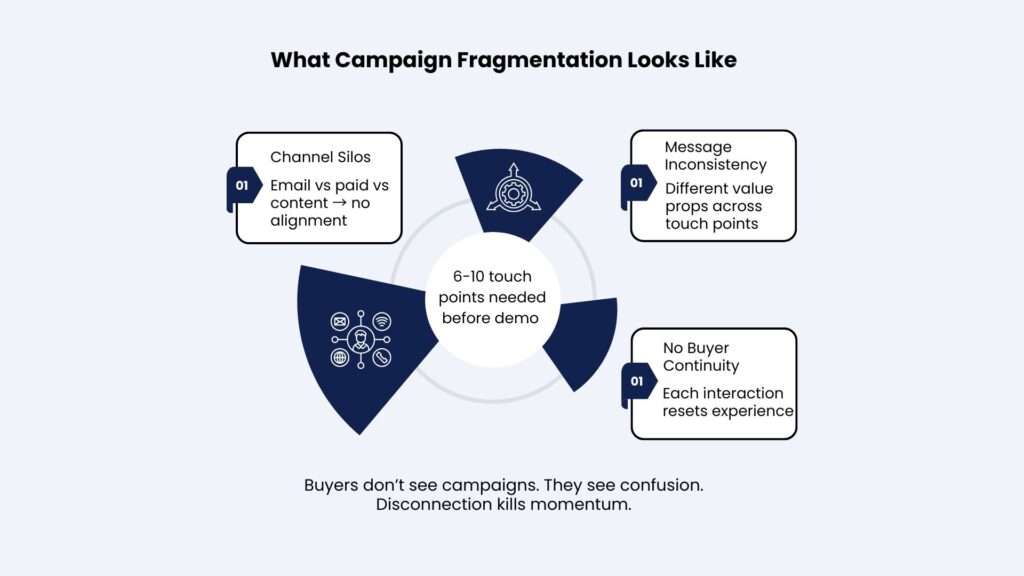
Campaign fragmentation manifests as structural disconnection between marketing initiatives that should reinforce each other but don't. Understanding B2B campaign fragmentation starts with recognizing these three structural patterns:
Channel silos operating as independent programs
Your email team promotes an ROI calculator. Simultaneously, paid social pushes a comparison guide. LinkedIn ads highlight customer stories. Content marketing launches a podcast series. Each has distinct creative, separate calls to action, and unrelated value propositions. A prospect encountering all four touchpoints within two weeks experiences four different companies, not one coherent brand.
Message incoherence across buyer touchpoints
A SaaS company targeting CFOs ran this actual sequence: Week 1 email emphasized "reducing software spend by 40%." Week 2 LinkedIn ad positioned "accelerating digital transformation." Week 3 retargeting focused on "improving team collaboration." The prospect needed to solve budget constraints. The only message that mattered was buried among competing narratives that diluted recall and weakened purchase intent.
Zero continuity in buyer experience
Gartner research indicates B2B buyers engage with 6 to 10 content pieces before requesting a demo. Yet most demand programs treat each touchpoint as an isolated conversion event. When a prospect downloads your ebook on Tuesday, then sees your webinar ad on Thursday, there's no acknowledgment of the relationship history. Every new campaign launch presses the reset button.
The buyer doesn't experience progression. They experience repetition without reinforcement.
Why Smart B2B Teams Still Fragment Marketing Campaigns
B2B campaign fragmentation persists not despite organizational sophistication, but often because of it. Three structural forces drive the pattern:
Team structure optimizes for channel execution, not buyer coherence
Most marketing organizations assign ownership by channel: email team, paid media team, content team, events team. Each optimizes for channel-specific KPIs. Email teams chase open rates. LinkedIn teams pursue engagement. Paid teams optimize clicks. Performance reviews reward channel excellence. Budget allocation follows channel performance. Nobody owns the question: "What cumulative narrative is this buyer experiencing across our entire presence?"
Tool-driven execution replaces strategy-driven design
Marketing technology aims to create efficiency but ends up creating silos. Organizations invest in best-of-breed tools: Marketo for email marketing, 6sense for intent, Outreach for sequence, Demandbase for ABM. These platforms are built in a way that they encourage campaigns to be created in their own environment, and each is optimized according to its own key performance indicators without connecting with the others.
Short-term KPI pressure kills long-term coherence
When quarterly MQL targets loom, launching five new campaigns feels more defensible than pausing to architect how existing campaigns should interconnect. Velocity metrics reward launches. Attribution models credit last touch. Budget justification requires demonstrating new initiatives. The incentive structure punishes the very integration that would improve outcomes.
A RevOps director at a Series C cybersecurity company put it bluntly: "We knew our campaigns weren't building on each other. But our board wanted to see lead volume growth month over month. Consolidation looked like reduction. So we kept layering."
The Hidden Cost of Fragmented B2B Marketing Campaigns
B2B campaign fragmentation creates four categories of pipeline damage that traditional marketing analytics routinely miss:
Message dilution destroys positioning clarity
When buyers encounter inconsistent value propositions across touchpoints, their mental model of your solution becomes fuzzy. Research from the Ehrenberg-Bass Institute shows that unclear category association increases consideration set size and extends sales cycles by an average of 34%. You're not building distinctive memory structures. You're training prospects to forget you.
You can read more about this, here.
Cumulative impact collapses to linear touches
Effective demand generation works through reinforcement. Each touchpoint should strengthen recall of previous ones, building associative memory that lowers friction at purchase time. Fragmented campaigns can't reinforce what they don't acknowledge. SiriusDecisions research found that coherent multi-touch campaigns generate 2.8x higher conversion rates than disconnected parallel campaigns with identical reach.
Audience reset penalties accumulate invisibly
Every time you launch a new campaign with new creative and new messaging to the same ICP, you're asking prospects to start their learning process over. They must decode new positioning, evaluate new claims, build new mental shortcuts. This cognitive cost increases with each reset. After the fifth disconnected message, buyers begin active avoidance.
Brand memory decays faster than it builds
B2B Institute research found that inconsistent messaging increases memory decay rates by 40 to 60%. A prospect who saw your message 30 days ago in a fragmented campaign environment has the same recall as someone who saw it 60 to 90 days ago in a cohesive campaign environment. You're fighting uphill against your own previous work.
The Compound Campaign Model: Solving B2B Campaign Fragmentation
The antidote to B2B campaign fragmentation isn't running fewer campaigns, it's building campaign cohesion. Leading demand teams are rebuilding around a compound campaign model that treats every touchpoint as a chapter in a continuous story, not an isolated event.
Unified narrative across channels
Instead of channel-specific campaigns, architect a single thematic narrative that unfolds across touchpoints. A financial software company moving upmarket built their Q3 demand program around one idea: "CFO teams waste 40% of capacity on manual close processes." Email, content, paid media, sales outreach, and events all laddered to that single premise. Approached from different angles, with different proof points, but always reinforcing the same core insight.
Results: 61% increase in pipeline generated despite 15% reduction in total campaign count. The insight wasn't more touches. It was coherent accumulation of the same essential truth.
Sequential touchpoint design
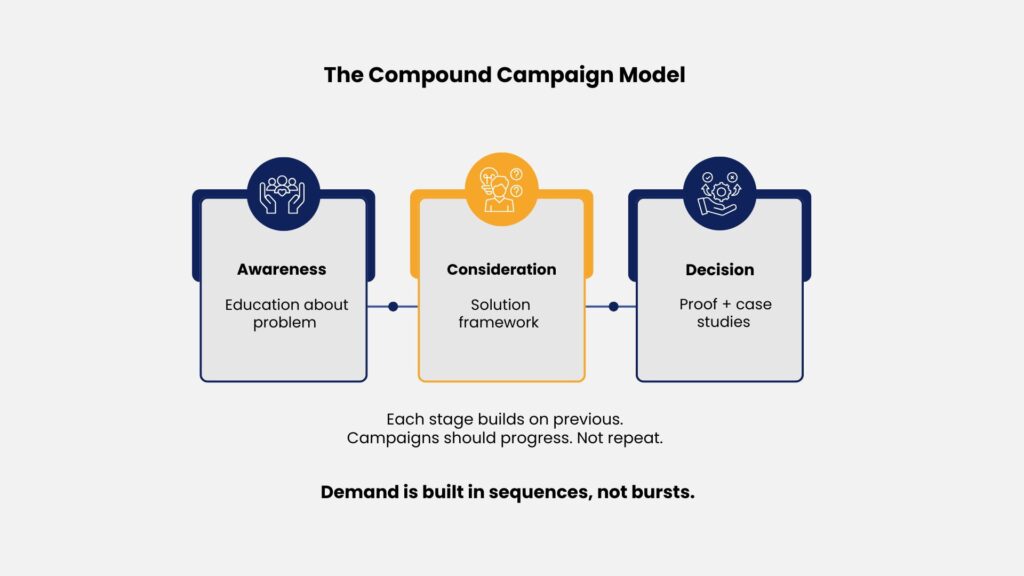
Effective demand programs design touch sequences with intentional progression. Awareness touches establish category problem. Consideration touches demonstrate differentiated approach. Decision touches provide proof and reduce risk. Each stage acknowledges and builds on previous stages.
A Series B infrastructure company redesigned their product launch campaign to function as a three-act sequence rather than simultaneous multi-channel blasts.
- Act 1 (weeks 1-2): problem education across content and social.
- Act 2 (weeks 3-5): solution framework introduction via email and webinars.
- Act 3 (weeks 6-8): proof delivery through case studies and demo invitations.
Conversion to opportunity increased 89% compared to their previous launch approach. Same channels, same budget, different architecture.
Reinforcement over repetition
Fragmented campaigns repeat messages. Compound campaigns reinforce them. Repetition shows the same ad seven times. Reinforcement shows the same core idea through seven different lenses. Each adding context, each deepening understanding, each building on what came before.
How to Fix Campaign Fragmentation: Operationalizing Cohesion
Moving from fragmented to compound campaigns requires three structural changes:
Cross-channel planning frameworks
Replace channel-based campaign briefs with narrative-based campaign architecture. Before any execution, answer: What is the single mental shift we need to create? What sequence of exposures best creates that shift? How does each channel contribute one part of a larger argument?
Leading teams use campaign narrative maps: visual documents showing how each touchpoint connects to others, what role it plays in the buyer's progression, and how it reinforces previous touchpoints.
Centralized messaging framework
Create a nested framework for your messaging, including a primary story (the non-negotiable truth), secondary stories (the proof mechanisms), and variable execution in each channel. Each piece of communication, be it email, ad copy, content, or sales, must be built using this same framework. Adjusting language and format to match the channel but not breaking the framework.
Shared KPIs beyond MQLs
Channel-level metrics must complement cohesion-based metrics rather than substitute them. These include messaging recall consistency, messaging story completion rate, and overall engagement value. Innovative demand marketing organizations measure the cross-campaign lift of prospects who have been exposed to connected campaigns versus prospects who have seen an equal number of unconnected campaigns. The preliminary results indicate that there are lifts of 2x to 4x when a cohesion strategy is executed successfully.
From Fragmented Campaigns to Unified B2B Strategy
The future of B2B demand generation lies with the teams which grasp one simple but paradoxical reality: visibility without coherence equals disruption.
Where B2B customers are exposed to more than 5,000 marketing messages each month, attention isn't the hardest thing to earn. Recall is. There are no such things as underexposure problems when it comes to reaching B2B buyers. What there are, instead, are disconnects between campaigns – disconnects which make them fight for real estate in prospective minds.
In response to a triggering event (such as budget availability or executive change or a competitive threat), no business decision maker will methodically analyze available alternatives. They will short-list from their memories of what they remember best. These memories aren't necessarily those which have been repeated most frequently.
It takes a paradigm shift: from launch campaigns to story networks, from channel optimization to alignment of buyer journeys, from tracking activities to tracking memories.
Your marketing campaigns aren’t just supposed to reach prospective customers; they need to impart an indisputable lesson to prospects, multiple times over, in increasing measure. That’s because, in the B2B world, where buying cycles extend into months, fragmentation is not only ineffective – it is lethal.