B2B Organizational Influence Mapping: Identifying Who Really Drives Buying Decisions

Organizational influence mapping reveals why B2B deals stall: Your SDR spent three months targeting the VP of Marketing. The demo was strong. Budget was confirmed. Then the deal went silent. Weeks later, you find out a mid-level IT architect raised security concerns that killed it. Your team never knew this person existed.
This is not a sales failure. It is a targeting failure.
B2B buying committees now average 13 stakeholders. Formal job titles rarely reflect real influence. The people who actually drive decisions often operate from unexpected roles, wielding informal power that standard targeting completely misses.
Why Job Titles Mislead B2B Buying Committee Targeting
Conventional B2B marketing is based on a pretty straightforward formula: locate the decision-maker by title, create a persona, launch the campaign. Marketing automation ads target Chief Marketing Officers, infrastructure is offered to Chief Technology Officers, and financial software marketing is sent to Chief Financial Officers. This strategy is expected to work, but it is losing its effectiveness very quickly.
A CTO might hold signature authority on a technology purchase, yet defer entirely to a senior engineer's technical assessment. A CMO might approve marketing tool budgets while acting on the marketing operations manager's recommendation alone. The person with the title often approves decisions that were already shaped by people your targeting never identified.
Gartner research shows buyers spend only 17% of their total purchase journey meeting with vendors. The rest happens internally. Before you engage with your sales team, 41% of B2B buyers have already chosen their preferred vendor based on conversations with individuals that your title-based targeting does not capture for your business development efforts.
Many of the players who influence purchasing decisions do not hold traditional, title-based positions. A junior analyst, for example, who built the existing reporting dashboard could be incredibly influential when evaluating different analytics platforms because of their first-hand experience. An operations coordinator, who may use your software on a daily basis, could potentially carry more weight than the director who approves budgets but has no experience with the tools. Many of these individuals do not hold impressive titles, however, they are helping shape your customers' purchasing decisions every day.
The Influence Network Inside Every Organization: Why B2B Organizational Influence Mapping Matters
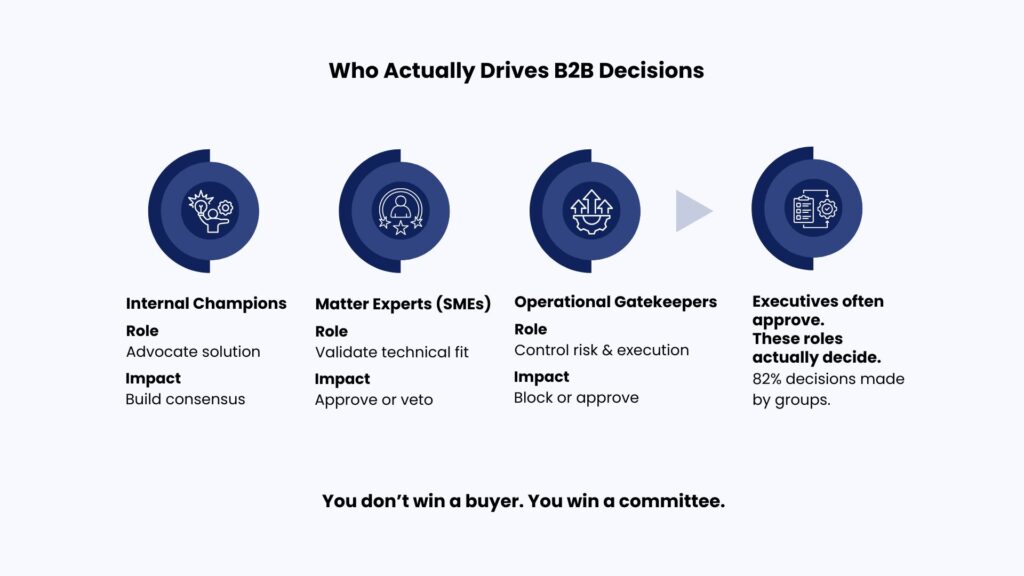
Organizations do not make decisions through neat hierarchies. They make them through influence networks where expertise, relationships, and credibility create authority independent of formal titles.
Internal Champions: Key Influencers in Buying Committees
Advocates inside an organization who endorse your solution before it reaches their awareness are your internal champions. Typically, these individuals are mid-level practitioners or contributors who have personally experienced the pain associated with a problem and have discovered your solution through their own research. These individuals create coalitions to support your solution, help to overcome objections to the implementation of your solution and support the advancement of initiatives.
When a committee of buyers has reached a consensus regarding which solution to purchase, they are 2.5 times more likely to classify their final decision as quality. Internal champions help facilitate this process of building consensus among all committee members, one person at a time.
Subject-Matter Experts: Hidden Stakeholders with Veto Power
Subject-matter experts (SMEs) hold effective veto power through specialized knowledge. Security architects evaluate vulnerability assessments. Data engineers assess integration capabilities. Compliance specialists review regulatory alignment. A CMO might not understand API architecture, but when the integration engineer says a platform will not work, the CMO believes it.
SMEs rarely attend executive meetings. They are invisible in CRM systems. They shape technical decisions that formal authority simply ratifies.
Operational Gatekeepers: Influencers Who Block or Approve Deals
Operational gatekeepers control access, information flow, and implementation feasibility. Procurement enforces compliance requirements. IT determines integration complexity. Finance validates ROI models. These stakeholders rarely initiate purchases. They block them.
Research shows 86% of purchases stall because of internal disagreements. Many of those stalls happen when gatekeepers surface concerns that went unaddressed during the sales process. Legal finds contract clauses they cannot approve. Operations reveals implementation requirements that were never scoped. Security demands documentation that does not exist.
Where Traditional B2B Targeting Breaks Down (And Why Influence Mapping Works)
Most B2B marketing strategies rely on static persona models built around job titles and seniority. These models assume decision-making follows predictable patterns. Real organizations do not work that way.
Influence is contextual. The person who drives CRM decisions differs from the one influencing marketing automation choices. Infrastructure purchases elevate IT voices. Customer-facing tools empower revenue leaders. Compliance-heavy solutions give legal teams outsized authority. Static personas cannot capture this fluidity.
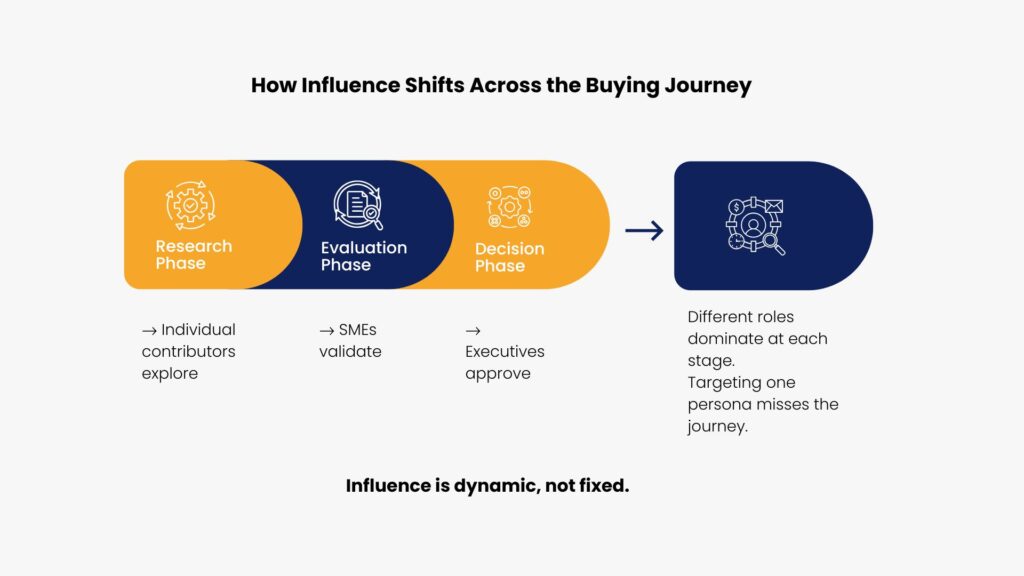
Influence also shifts throughout the buying journey. Early research phases involve individual contributors exploring solutions independently. Mid-stage evaluations bring in SMEs for validation. Final approvals require executive buy-in. Targeting the same title at every stage means reaching the wrong person at the wrong time.
Incomplete stakeholder analysis makes this worse. For mid-sized firms, an average of seven people are involved in buying decisions. For enterprise deals, committees stretch to 15. Many of those people never attend sales meetings or appear in CRM records. They influence through internal conversations your team never observes.
How to Map Organizational Influence in Target Accounts
Identifying influence networks requires systematic effort. Organizational influence mapping starts with the right questions during discovery.
Ask who your buyer consults when evaluating tools like yours, who needs to validate technical requirements, who will raise concerns if they do not address them early, and who successfully championed the last similar purchase. These questions surface stakeholders who will never appear in a title-based target list.
Track engagement signals. Watch who downloads your technical content, asks detailed questions in webinars, or gets referenced in prospect conversations. When a buyer says, "I will need to run this by Sarah" or "John would have concerns about this," those names indicate influencers worth engaging immediately.
Analyze communication patterns. Who gets copied on critical emails? Whose opinions get cited in internal discussions? These patterns reveal informal power structures that org charts do not show.
Observe collaboration structures. Formal reporting structures often mask operational reality. Cross‑functional initiatives create parallel paths of influence outside the organizational chart.
Understanding who coordinates across departments often reveals where real decision weight sits.
Marketing Strategies That Reach Every Buying Committee Member
B2B Organizational influence mapping allows you to tailor your marketing to the distinct role each stakeholder plays.
How to Arm Internal Champions in Target Organizations
Internal advocates need content they can share, not content that sells to them. Give them ROI calculators they can customize for their organization, comparison matrices that address common objections, and one‑pagers and decks they can easily share internally.
The simpler you make it for a champion to advocate for you, the stronger your message travels.
What Subject-Matter Experts Need to Influence Decisions
Subject-matter experts do not need marketing content. They need proof assets. Sandboxes. Detailed integration maps. Security documentation. API references. These materials answer technical questions without requiring a sales conversation. When an engineer gets what they need to validate your solution independently, they stop being a blocker and start becoming an advocate.
How to De-Risk Buying Decisions for Operational Gatekeepers
Gatekeepers are persuaded by proof, not passion. Case studies showing reliable implementation timelines. Compliance documentation that addresses procurement requirements. Total cost of ownership models that finance teams trust. Engage them early. Do not wait until they raise concerns that stall a deal that you nearly closed.
To explore in depth, read here.
ProspectVine's Approach to Organizational Influence Mapping
At Prospectvine, we believe the best GTM strategies are built on empathy for the entire buying committee. Every stakeholder has a different threshold for trust, and a different reason to say yes or no.
Our approach to organizational influence mapping centers on identifying Narrative Anchors: the specific messages that resonate with technical influencers, operational gatekeepers, and executive champions alike. We do not help clients target a title. We help them influence a network.
By building earned continuity across every touchpoint, we ensure that internal conversations in Slack channels, project meetings, and boardroom discussions work in your favor. You do not win a client. You win a committee.
The Competitive Shift: Why B2B Influence Mapping Is Now Essential
82% of B2B buying decisions are now made by groups rather than individuals. Those groups include champions, SMEs, and gatekeepers whose influence far exceeds their titles.
When your competitor's champion is advocating internally while you are still trying to book a meeting with an executive, the deal is already shifting; when SMEs have validated the competing solution while you are targeting titles, influence has moved; and when gatekeepers have approved someone else's implementation plan while you are still learning those gatekeepers exist, the committee has formed without you.
B2B organizational influence mapping isn't optional in modern B2B sales, it's competitive survival. Formal job titles will never reveal real influence. The question is not whether influence mapping is worth the investment. The question is whether you can afford to keep targeting titles while competitors target the people who actually drive decisions.