Your B2B content distribution strategy determines whether your content generates leads or gets lost in the noise. Your most definitive resources have already been published. The research was original, actionable insights included in it and excellent design has made sure your material is of high quality. You have, however, published this same content for over three months now and have received little or no downloads to date. This is a classic example of a content visibility issue often faced by many older B2B companies.
For instance, your content team created a complete industry overview report in roughly three weeks. You published the same report to your blog, sent only one post about it out through LinkedIn and waited for leads to flow in from there. After one week how many views, downloads, and/or qualified conversations do you believe you had produced from this content?
If you guessed 47 views, 2 downloads, zero qualified conversations you are exactly right. Your content doesn’t seem to be the problem, but rather the issue is the way you chose to distribute it.
According to research, 97% of B2B marketers now use content marketing to market their business. This means that all of these companies are producing blogs, video, webinars, and thought leadership. As a result of how much other similar marketing material your target audience will come across, you will have trouble getting your prospect to see your marketing materials.
The B2B Content Visibility Problem: Why Distribution Matters
B2B marketing teams have never produced more content. Every day, organizations publish blog articles, whitepapers, webinars, case studies, reports, and LinkedIn posts. Content calendars are full. Editorial pipelines are structured.
Yet despite this volume and effort, a significant portion of B2B content fails to generate meaningful impact. Not because the content lacks quality. Because the content is never seen by the right audience.
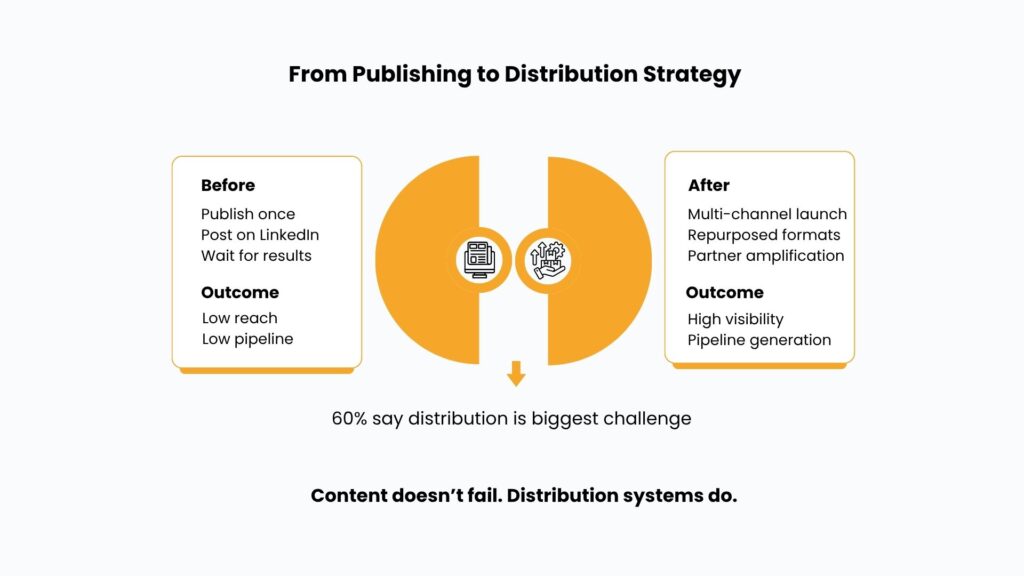
Research conducted by Content Marketing Institute established that almost 60% of B2B marketers state that content distribution as opposed to content creation represents their greatest challenge.
According to a 2025 survey by CMI, while 97% of B2B marketers say they have a content strategy, only 32% have been able to achieve success using that strategy. The difference between having content available and generating results is not due to the quality of your content, but rather whether your target audience will even encounter your content.
B2B buyers typically research 2 to 7 websites before making a purchase, and they often consume 3 to 7 pieces of content before they speak with a sales rep. If your content distribution strategy does not position your content within these key decision-making moments, your competitors will occupy the space in your customers’ minds.
Although companies spend heavily on creating valuable content, they have not invested enough in the systems needed for efficiently distributing that content. Ultimately, how the content creators write the content does not determine a successful piece of content, but instead the manner in which they distribute it does.
What B2B Content Distribution Strategy Actually Means
Many people mistake distribution strategies for posting content to social media and other channels; however, they can better define content distribution as an organized method of making sure that content reaches the intended audience at the right time and through appropriate means.
A systematic approach to placing content in the places where your target customers are engaging will result in them seeing it in credible and appropriate formats for them.
An effective B2B content distribution strategy answers three critical questions: Where do your buyers spend time? What format do they prefer? Which channels influence their decisions?
B2B Distribution Channels: Where Your Buyers Actually Engage
In B2B markets it is common for buyers to have a number of different channels through which they engage with suppliers which tend to cause fragmentation of buyers’ attention. The reasons for this include that decision makers are using many different environments to search for information, therefore, looking to socialize (networking) – such as LinkedIn, industry newsletters, blogs, community and forum, webinars and virtual events and through peer-to-peer conversation.
Detailed data available for 2025 shows consistent patterns. In the case of B2B marketers, social media accounts for the highest percentage of content distribution effectiveness (90% of B2B marketers indicated this) will followed by blogs (79%), email newsletters (73%) and email campaign (66%). Within the social channels category, LinkedIn is reported to offer the most value (84%) of all B2B marketers surveyed.
To create a successful distribution strategy, it is important that marketers encode the content for the channels that buyers use instead of relying on only one channel for all their content activities.
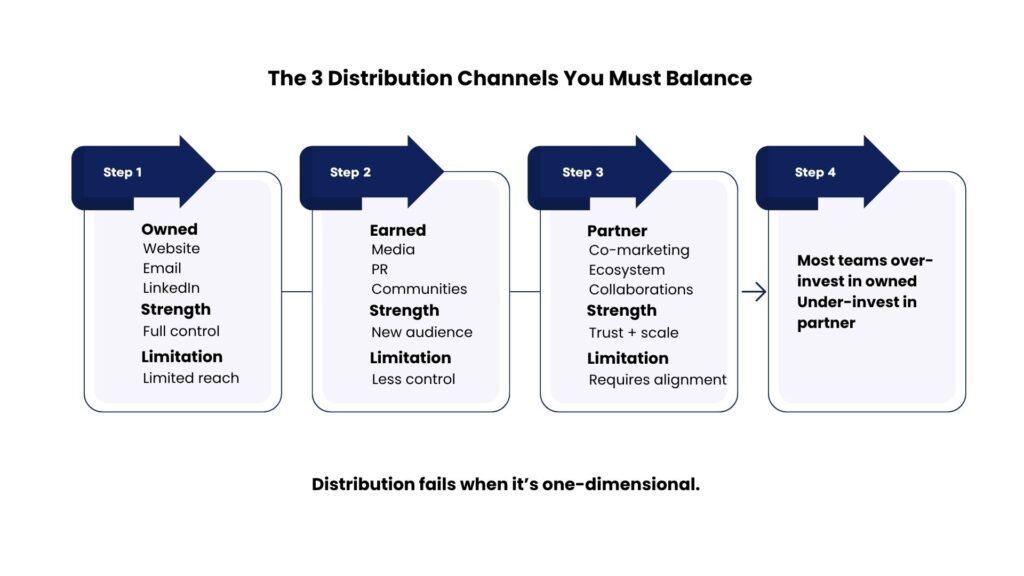
Types of B2B Distribution Channels
Distribution gets broadly categorized into three channels.
Owned distribution: A company’s own sites or means through which they promote their brand (examples: website/blog/email/newsletter/social media).
Earned distribution: A company’s products receive exposure through Third Party Sources (examples: News Articles/Media Notices/Word Of Mouth Marketing).
Partner distribution: Partnerships with other groups, businesses, and ecosystem partners extend your reach.
Successful B2B marketing strategies must use all three marketing types in balance: built audiences, earned audience distributions (to reach new audiences), and audience channels (providing credibility through association). Learn more about Omnichannel Distribution here.
Why B2B Content Distribution Fails (And How to Fix It)
While the importance of distribution is widely understood, execution remains a major challenge for most organizations.
Over-Reliance on Single Channels
Many companies publish content, post once on LinkedIn, and consider distribution complete. When that channel underperforms due to algorithm changes or audience fatigue, the content fails entirely.
Organizations building strategies around one platform face catastrophic vulnerability when effectiveness declines. Single-channel strategies miss buyers who don’t use that channel or who require multiple touchpoints before engaging.
Publishing Without Amplification
The “if you build it, they will come” fallacy assumes great content will naturally attract attention. In a saturated market, this is rarely true. Content must be pushed into visibility, not left to be discovered.
Organizations treat distribution as a checkbox: “We published the report and shared it on LinkedIn.” This passive approach works for brands with massive existing audiences. Everyone else needs systematic amplification.
Lack of Partnerships and Community Leverage
The most efficient distribution often happens through partners and communities, industry groups, professional associations, complementary vendors. Companies operating in isolation miss these channels entirely.
Research shows 78% of B2B marketers now allocate budget to experiential marketing. However, less than 30% rate their efforts as established or advanced.
How to Build a B2B Content Distribution Engine That Works
Building a sustainable B2B content distribution strategy requires intentional design, not sporadic effort.
Multi-Channel Distribution Framework for B2B Marketers
You should map the channels your target customers use to reach them (such as specific LinkedIn groups, industry specific publications, niche newsletters, community forums and trade shows). For each piece of content you produce, identify three to five channels that will resonate with your target audience.
You should create a specific standard operating procedure for activating multiple channels at the same time automatically. When you publish a significant asset, the distribution sequence will automatically activate on multiple channels (owned, earned and partner) for a lengthy period of time after the initial publication date.
Post the asset on your site, announce on LinkedIn, email subscribers, and submit to relevant aggregators.
During the first week of continuing to share the relevant content to your social media platforms, there are many options to consider. Create social posts with key points and share links with customers. Pitch guest articles to partners to build networks and distribute content.
Repurposing Content for Multi-Channel B2B Distribution
Different channels favor different formats. A single research paper can be repurposed for either a series of blogs, webinar or PowerPoint presentation; infographic; LinkedIn Carousel; podcast episode; and speaker presentation, etc.
A 20-page report can yield: a 2-minute video, 10 social graphics, a webinar, 5 blog posts, and one infographic.
Video is now a part of 84 % of B2B marketers’ marketing strategy. Video formats generate results tied with case studies at 53% for producing the best B2B outcomes. Repurposing extends reach without recreating effort.
B2B Distribution via Industry Communities and Events
Highly engaged audiences form communities like Slack groups and forums. Marketers gain credibility by adding value, not just promoting content.
B2B content being distributed via either an in-person or virtual event receives a reported effectiveness rating of 56%. Event participation, speaking opportunities, sponsored sessions, places your content directly in front of qualified audiences.
Organizations like ProspectVine demonstrate this approach through multi-channel engines focused on repurposed, community-amplified content. As one perspective noted, effective campaigns blend data intelligence, AI-powered targeting, and storytelling across multiple channels to make a brand memorable before sales ever calls.
Measuring B2B Content Distribution Effectiveness
Distribution strategy requires its own metrics, distinct from content quality metrics.
Audience Reach Quality
Not all reach is equal. Measure not only views, but whether the reached audience matches your ideal customer profile. High reach among irrelevant audiences is wasted effort.
50,000 views mean very little if they’re not from the right people. Even 500 views from your ideal customers can deliver far more value.
Engagement Depth
Are readers consuming the content? Time on page, scroll depth, and completion rates indicate whether distribution channels are delivering genuinely interested audiences.
Page scroll depth, video completion rates, and content download conversions indicate genuine interest versus passive exposure.
Inbound Opportunities Generated
The purpose of distribution is to produce action. Measure and quantify inbound inquiries, demo requests, and sales discussions by their respective distribution channels.
Businesses are using content to generate business results (qualified conversations, sales meeting, develop pipeline, revenue). Great distribution strategies will yield measurable growth of inbound inquiries from target accounts.
Why B2B Content Distribution Deserves Equal Investment
Without visibility, great content will not provide any value to the creator. The most significant factor influencing marketing return on investment (ROI) in the current saturated environment is how effectively companies distribute their content.
Successful companies treat distribution like creation: map channels, build partnerships, measure success, and improve continuously.
A winning B2B content distribution strategy shifts your thinking from ‘create and hope’ to ‘distribute with purpose. You should create great content that can generate leads for you, and your prospects are looking for you; however, they won’t do that by chance.