
Your performance dashboard looks great. Your clicks have increased, you're generating leads, and campaigns are on track to meet quarterly targets. However, the pipeline still feels a bit weak. The opportunities you anticipated to close are now slipping away.
This is the central paradox of a short-sighted B2B marketing strategy. What's missing is a long-term B2B marketing strategy built on strategic patience, one that recognizes that 92% of B2B buyers purchase from vendors already on their radar long before the formal evaluation ever begins.
Unfortunately, current marketing dashboards mainly reward short-term work thereby creating a huge gap between what is measured and what actually drives sustainable growth.
In B2B markets, where the buying cycle lasts for several months and the decision involves multiple stakeholders, marketers create real value through activities that take time to show results and rarely succeed in the same quarter in which they implement them.
Why Short-Term Pressure Undermines Your B2B Marketing Strategy
Without a long-term B2B marketing strategy, teams are left chasing activity over outcomes.
Nowadays marketing runs on dashboards culture. Campaign platforms show results in real time. Analytics tools immediately track click-through rates, conversions, and leads counts. Weekly reporting cycles assess marketing success just a few days after launch. These instruments have changed marketing measurement totally. They have also led to a side effect: short-term metrics pretty much control marketing strategy nowadays.
Marketing heads get questions very often, such as: How many leads did the campaign generate this week? What pipeline did the webinar create immediately? How quickly can we convert campaign traffic into opportunities?
Though these questions are quite legitimate, they reveal a very serious structural demand: a craving for tangible short-term results. This pressure severely disrupts the priorities of marketers for B2B companies working in intricate markets.
Marketers judge marketing operations that aim at gradual and successful influence by the same yardstick as they judge the performance of a campaign in one click or one day. Long-term strategic development is cut off prematurely.
The study of B2B marketing effectiveness shows that campaign metrics have almost totally replaced other marketing evaluation criteria. Furthermore, senior management expects marketing to immediately contribute to the sales pipeline, even though the average buying cycle is as long as 10.1 months.
The result is a marketing system looking efficient on dashboards but struggling to generate durable pipeline growth.
Long B2B Buying Cycles Demand a Long-Term Marketing Strategy
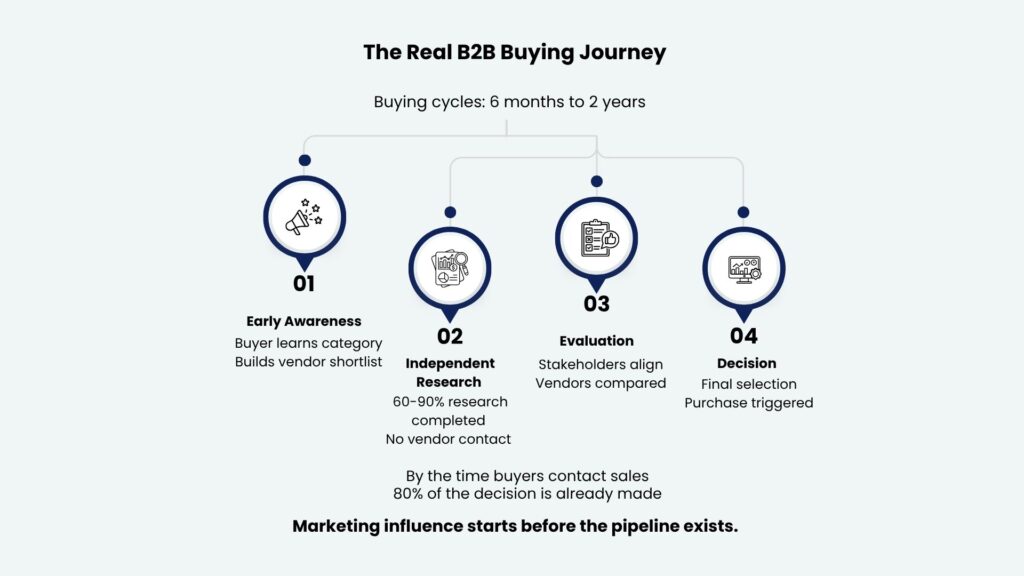
Unlike consumer purchases, B2B buying decisions rarely happen quickly. Enterprise software, technology infrastructure, and strategic services often involve complex evaluation processes.
A Gartner study reveals that a "standard" B2B buying committee consists of 6-10 people who each have different priorities and risk factors. Forrester's research shows that big-ticket purchases can take anywhere from half a year to two years to go from initial awareness to the final decision on the vendor. Longer durations of purchase decisions change the dynamics of marketing influence.
Marketing's most important role occurs early in the buying journey, long before buyers enter formal evaluation cycles.
More critically, the visible sales cycle represents only late-stage execution of decisions largely made earlier. Detailed studies of buyers reveal that prospects do 60% to 90% of their product research themselves before reaching out to vendors. In fact, when a prospect finally fills out a "Contact Sales" form, they have typically completed 80% of their buying process.
In most cases, the first-stage marketing efforts consist of informing the market about new challenges, defining categories, establishing credibility by regular messaging, and assisting buyers in grasping new ways of providing solutions. Usually, by the time a buyer consults a vendor for the first time, they have already decided most of their requirements.
Early influence matters more than late persuasion.
Organizations absent from awareness during research phases rarely recover regardless of late-stage sales excellence. Marketing systems optimized exclusively for short-term lead generation struggle to capture this long-term influence.
The Hidden Risks of Ignoring Long-Term B2B Marketing
When organizations focus too heavily on short-term metrics, several strategic risks emerge.
Constant Tactical Switching
Short-term focus erodes any long-term B2B marketing strategy by pushing teams toward tactical switching. Suppose a campaign does not bring good leads immediately; the team will immediately changing the format, channel, or message. Experimenting is great, but a constant change stops campaigns from gaining progress. People get to know the brand and understand the product gradually. If the tactics are changed very often, the process of learning will be started over and interrupted. Such never-ending experimentation is the reason why the tactics never reach the level of yielding returns. It is the SEO that needs six to twelve months before significant organic traffic is delivered. By content marketing, the authority is being built through continuously publishing the proof of one's knowledge over time.
Abandoning Campaigns Before They Mature
It takes time for many good advertising actions to work and give you new customers. Those programs where you want to be an expert, advertising your product category, and content creation are examples of things that take time - sometimes quarters of a year. If the top management decides to check the results only after a few weeks, these programs will seem to them as a waste of money. So, they will stop campaigns before time, and this way, they will miss the chance to enjoy the growth of the audience that is getting more and more familiar with them.
Study of LinkedIn's B2B Institute proves that if you show your brand regularly, it will have a great impact on revenue results in the long run, even if the way of getting new customers in the short-term seems not so good. Marketing automation systems, account intelligence systems, and content strategies all follow the pattern of J-curve where during the early period, the results are near zero while the systems are getting stronger.
Weakening Brand Equity
Short-term optimization even promotes marketing messages that stress prompt conversion rather than long-term credibility. As a result, campaigns tend to revolve mainly around promotional offers, urgent calls to action, and quite forceful lead capture tactics. Although these methods result in short-term responses, they usually don't help nurture brand trust or establish authority in the category. Brand equity builds up through a steady stream of signals that enhance positioning, value propositions, and category expertise over time.
How to Build a Long-Term B2B Marketing Strategy That Scales
A sustainable long-term B2B marketing strategy balances immediate results with investments that compound over time.
Balancing Brand Building and Lead Generation
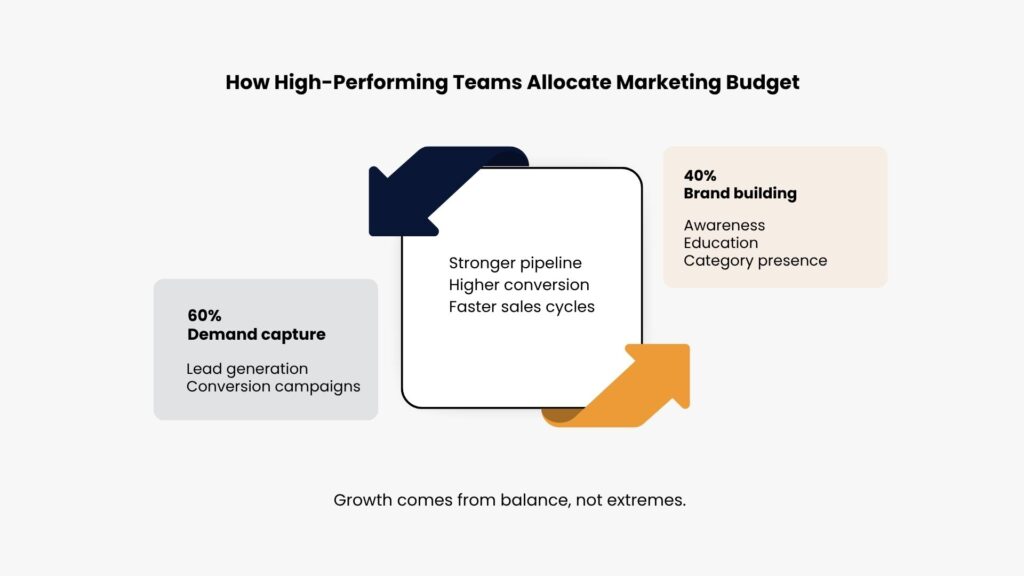
The most sophisticated marketing organizations operate with a portfolio approach. The company allocates a portion of the budget to direct response campaigns designed to generate leads and influence the near-term pipeline. Another portion is allocated to brand building, sustained category presence, audience education, thought leadership.
Research on integrated marketing approaches reveals organizations achieving superior performance typically allocate 40% to 60% of marketing resources toward brand building with returns measured over quarters and years. The remaining 40% to 60% focuses on demand capture with returns measured over weeks and months.
Prospectvine demonstrates this balance through approaches prioritizing relevance over reach and sustained narrative continuity. Rather than chasing maximum coverage through scattered tactics, they build deep category presence through consistent value delivery.
Sustained Category Presence
Buyers cannot choose a brand they do not remember. Sustained presence across the channels where buyers spend time ensures that when they enter a buying cycle, they consider your brand.
This presence is not measured by click-through rates but by the gradual accumulation of familiarity. The implementation requires discipline resisting quarterly temptation to abandon channels showing slow immediate traction.
Continuous Audience Education
B2B buyers are becoming more self-directed in their approach. They do their own research, interact with content in a way they like, and postpone sales talks until the very end. Educational content that informs rather than sells is a perennial way to earn buyers' trust in their self-directed phase. Studies determining content effectiveness find that buyers have more faith in a brand that educates them with useful information. 77% of leading B2B marketers believe that quality content is the most important factor for success.
Measuring the Impact of Your Long-Term B2B Marketing Strategy
Shifting to a long-term perspective requires new metrics tracking progress short-term dashboards miss.
Pipeline Quality Trends
Instead of counting leads, evaluate the quality of pipeline over time. Are deals sourced from educated, brand-aware prospects progressing faster? Do they tend to be larger in size? Are they more likely to close? Improving pipeline quality is a lagging indicator of effective long-term marketing.
Brand Familiarity Metrics
Monitor the ease with which your brand gets recalled when the consumers are making purchasing decisions. One of the ways to measure this is via surveys, secondly the volume of branded search over time and lastly the portion of pipeline coming from non-branded channels.
Sales Cycle Improvements
Continuous brand building leads to the most valuable result of having shorter sales cycles. If the buyers are already acquainted with your brand, they will need less explanation and will take a shorter time to come to a decision.
The Discipline of Patience
Strategic patience is the foundation of every effective long-term B2B marketing strategy; not a luxury, but a structural requirement. It is not the same as simply waiting without doing anything. Rather, it refers to the focused and methodical dedication of one's resources towards things that keep growing in value over time, i.e. the awareness and trust the brand creates among its target audience as well as the brand's constant visibility in the market segment. You cannot find such things on any quarterly report; however, these are the very factors that enable the attainment of the set quarterly goals if they are in place.
The organizations winning in B2B are not those optimizing every dollar for immediate return. Those maintain presence through cycles, educate audiences before they are ready to buy, and build familiarity long before the RFP is issued.
As one approach frames it, the goal is to be "an engine of demand, not leads," to build a presence making your brand memorable before sales ever calls. This is the work of strategic patience.