Sales marketing alignment breaks down the moment buyers move from marketing content to sales conversations. Once a buyer reads your whitepaper, the main positioning becomes clear. It focuses on business transformation, long-term outcomes, and category leadership. But two weeks later, when that buyer talks to a salesperson, features, pricing, and timelines bury the original message and the strategic framing just disappears.
This sales marketing alignment gap creates conflicting stories from teams within the same organization.
According to Gartner research, 67% of B2B buyers say they do not want to do business with vendors that provide them with inconsistent messages throughout their buyer journey. Additionally, only 8% of companies report that sales and marketing narratives are fully aligned. All this fragments the buyer experience and erodes trust. As a result, prospects take longer to decide, and your win rates drop.
Sales Marketing Alignment Breakdown: What It Looks Like
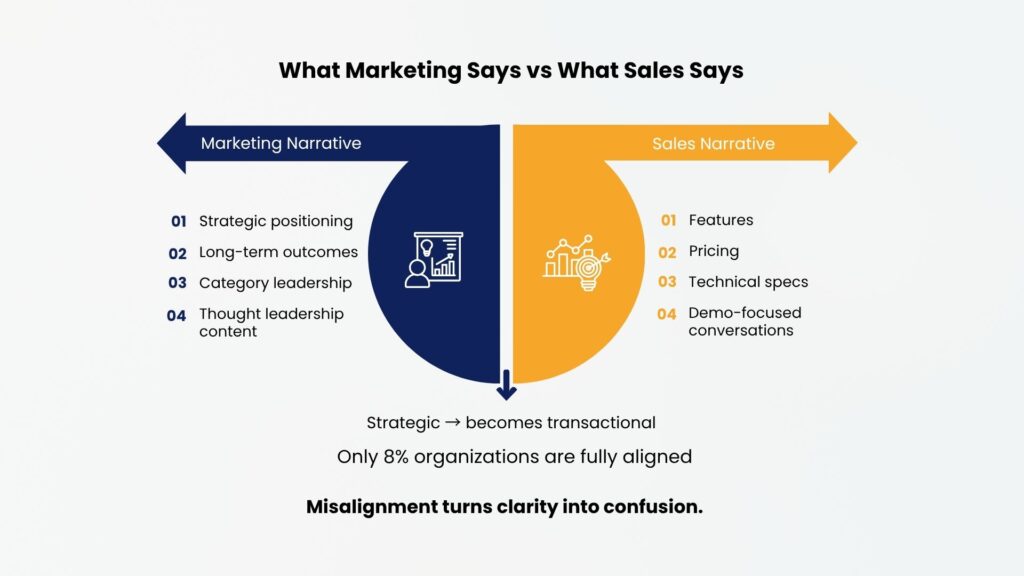
Marketing creates messages that convey transformation, strategic value, and business results. The website, content, and campaigns have been designed to appeal to the C-Suite. They should be able to draw the attention of executives and also indicate an organization’s leadership by category.
Sales only enters the game once the quota is established and there are buyer questions that must be answered by the customer. Reps will generally answer buyer questions by providing technical specifications, functionality, and price. As a result, they have now converted the originally strategic conversation into a transactional conversation, leaving buyers in a state of confusion.
The disconnect between marketing and sales extends across channels. Marketing emails are typically thought leadership-based, while the sales email requests, “Can we meet?” without any value proposition to support that request. Marketing webinars typically provide an overview of industry developments, but the sales demo shows specific aspects of the product without linking them to the buyer’s business objectives.
In a buying committee of 13 stakeholders, this is a serious problem. Executives hear the strategic narrative. Implementers hear the tactical pitch. The committee cannot align internally with what they are purchasing or why it matters.
Why Sales Marketing Alignment Fails: The Root Causes
Narrative conflict is not the result of incompetence. It is a structural byproduct of how most B2B organizations are built.
Competing Performance Incentives
Marketing gets measured on lead volume, brand engagement, and pipeline contribution. These metrics reward broad, differentiated messaging. Closed deals and quota achievement are two factors that affect sales compensation. These metrics tend to reward things that close deals quickly, often leading to the simplification of strategic positioning through tactical feature comparisons that buyers can easily comprehend right away. This incentive structure undermines sales marketing alignment at its foundation.
When a rep feels quota pressure and the buyer asks for specific questions, the easiest course of action is to provide a direct tactical response. Over time, sales builds its own narrative optimized for closing, not positioning. Miscommunication drives 64% of conflicts between marketing and sales, and incentive divergence is often the root cause.
Teams Operating in Isolation
Research shows 53% of organizations experience handoff misalignment between marketing and sales. Marketing develops campaigns in isolation. Sales learns about messaging changes from prospect interactions rather than internal communication. Neither team understands the other’s daily realities.
Marketing knows the strategic narrative but not the objections reps face daily. Sales knows what resonates in live conversations but never feeds that intelligence back into messaging. Two separate understandings of buyer needs develop in parallel.
Messaging That Gets Updated but Never Adopted
Marketing updates show how it positions itself according to data from market research and competitive analysis; however, as sales focuses on meeting quota, sales continue to use the prior quarter’s pitch, which was successful. Research shows that the sales teams will not use up to 60% of marketing-created content without sales.
The website and sales deck do not communicate the same message. Purchasers view both.
The Business Cost of Poor Sales Marketing Alignment
Narrative conflict creates external confusion and issues for buyers, and often their responses are not positive.
When buyers are faced with two different stories, they often don’t know exactly what your company can actually accomplish. Your internal champion, the individual fighting for your solution within the buying organization loses credibility if they cannot consistently articulate what you offer. The two stories don’t match; one was told to them by marketing, and the other by sales. Thus, they are uncertain as to which story to share with their CFO.
Inconsistency in your messaging creates feelings of uncertainty in buyers. When buyers observe inconsistency in what your marketing team says versus what your sales team says, they question how the implementation team and support team will work together after they sign the contract. Studies reveal that buyers perceive the quality of a deal to be 2.5 times higher when their internal groups are clearly aligned than when the groups are not aligned. Narrative conflict makes it difficult for buyers to develop consensus within themselves about your offering.
The result of narrative conflict is the creation of longer sales cycles and buyers want to receive more demos, more proof points and more reference checks in order to reconcile the two different stories they have heard. Studies show that when two or more organizations are unaligned, the average sales cycle is 25% longer than organizations with aligned teams. Longer cycles provide greater opportunities for competition to interfere with your efforts to close a deal.
How to Build One Unified Narrative
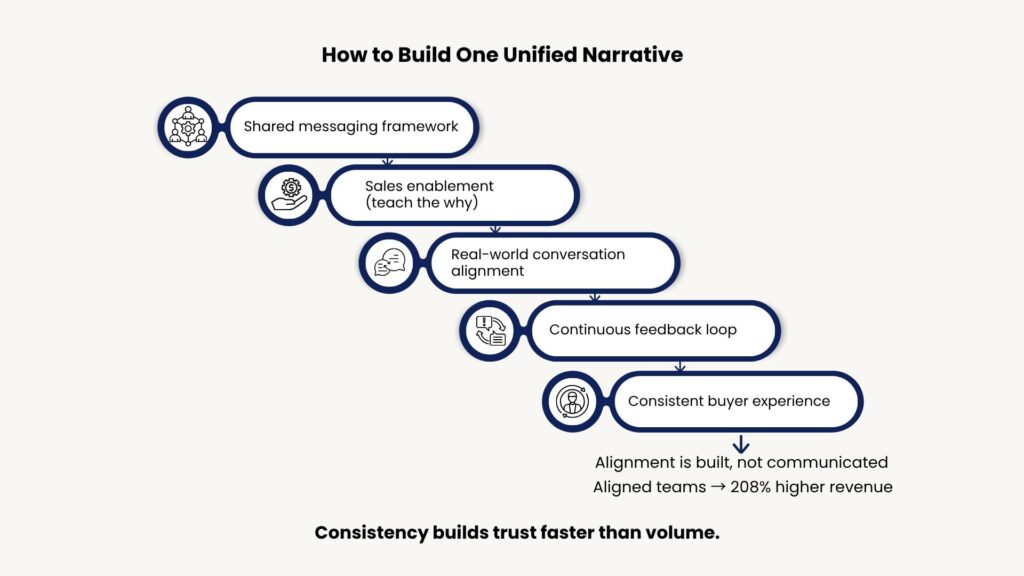
Alignment requires structural change, not communication memos.
A Shared Messaging Framework Both Teams Build Together
This shared framework is the cornerstone of sustainable sales marketing alignment. This gives employees insight into what the core problem statement is, what the value proposition is, and how to communicate key attributes/preferences effectively through supporting proof points.
Ultimately, both marketing and sales need to involve themselves in creating this document/guide; marketing draws on its experience with developing positioning and works with at least some degree of depth in completing market research, whereas sales provide first-hand knowledge (from real-life conversations) about which messages successfully drive revenue versus those that do not.
When both teams build the framework together, both teams own it. Companies with aligned messaging report 36% higher engagement with marketing content and significantly better sales adoption of marketing materials.
Sales Enablement That Teaches the Why
Enablement is more than just a new deck or an updated PDF folder. You must provide sales with an understanding of why strategic positioning is important, how to translate that into real-life conversations, and how to relate the product’s capabilities to the business outcomes that you will achieve at every stage of the sales process.
An effective enablement process includes trainers conducting role play exercises for common objections, sharing examples of successful strategic conversations (recorded), and providing clear guidance on when to take a visionary approach versus when to take a tactical approach. The objective is that the sales team internalize these concepts rather than just map/ memorize them.
Continuous Feedback Loops
Achieving alignment requires an ongoing effort and a continuous feedback loop between both groups. The sales team should have a mechanism to communicate to the marketing team which elements of the messaging resonate with buyers and which meet with skepticism. It is then the responsibility of marketing to use that data for real time optimization of the position and messaging, rather than waiting until quarterly updates.
High-performing organizations leverage weekly sales/marketing sync meetings, reporting dashboards that detail performance of their messaging, and monthly reviews for both won and lost sales to achieve this ongoing alignment with both teams. Research indicates that 73% of organizations report greater alignment through the use of joint performance dashboards.
ProspectVine’s Take
At ProspectVine, we see narrative conflict as the primary cause of what we call the GTM Confidence Gap. Customers delay purchase decisions, typically not due to lack of product features but rather from feeling unconfident making a decision.
We address sales marketing alignment by creating continuous narratives across all buyer touchpoints. Instead of chasing a perfect team structure, we align teams around what buyers actually hear throughout their journey.
When you respect buyers’ time by sharing consistent, evidence-based messages at every touchpoint, leads convert faster; boosting revenue instead of creating decision drag that slows deals and shrinks your customer base over time.
What Alignment Actually Delivers
The business case for sales marketing alignment is measurable.
Buyers who encounter a consistent story across all touchpoints develop clear understanding of your value proposition. They move through evaluation without additional validation cycles. Research confirms aligned organizations achieve 208% higher marketing-generated revenue by ensuring consistent messaging from first touch through close.
Narrative consistency gives you an edge in competitive deals. When marketing, sales, and customer success all share the same value message, buyers see you as one confident, cohesive team.
Aligned organizations achieve an average sales win rate that is 38% greater than non-aligned organizations and are 58% more likely to reach their revenue goals. Consequently, sales will spend less time resolving confusion caused by misaligned messaging and more time moving deals forward.
One Company, One Story
To begin with, review your last ten closed-won and closed-lost sales. Determine if the buyers experienced consistent marketing messaging through each of their interactions with your company. Evaluate whether your sales calls reinforced the marketing positioning and if there was any disconnect between them. List the anomalies found and what kind of confusion they caused the buyer.
Both marketing and sales teams put in a lot of effort towards success. If the marketing and sales teams have disparate narratives, the buyer will be aware of it before you are. In B2B, where trust drives buying decisions, a broken story hurts your edge. Today’s top companies align marketing and sales as one revenue team, telling a single, clear story at every step of the buyer’s journey.