Ecosystem marketing strategy is transforming how B2B companies win deals. Your team wins a large sale. When you look back at this event it’s clear to see that the buyer made this decision as part of a larger overall group of people who helped guide this buyer to this agreement. The decision maker had a vendor relationship with your customer relationship management (CRM) partner, and as such, they referred you to this client. In addition, your analytics software vendor stood behind the quality of your software’s ability to integrate properly with their products; and, finally, the consulting company that helped the buyer implement their digital transformation had architected you into their solution blueprints. The combined influence of three different companies in the ecosystem; therefore, impacted this sale more than your direct relationship with the buyer.
Research conducted by Forrester and KPMG in 2025 found that 75% of business leaders today view partnerships within the ecosystem as a primary driver of growth for their business; revenue generated from partnerships has increased to between 26% and 28% of total B2B revenues in 2025 as compared with 18% to 20% in 2024; and last, the majority of buyers do not purchase standalone solutions but instead seek to develop integrated environments comprised of complementary solutions, expecting them to flawlessly work together from day one. The companies who are winning in this new marketplace are those who can establish themselves as the most embedded within the ecosystems where their customers choose to do business, creating a high level of trust with their customers.
Why Buyers Demand Ecosystem Marketing Solutions
The average mid-market company uses over 100 SaaS applications. Buyers evaluating any new vendor now ask whether the solution fits their existing technology stack before asking about features. Integration projects consume 30 to 40% of implementation budgets while delivering roughly 10% of business value. Buyers have learned this through experience and now seek vendors who have pre-solved integration with the tools they depend on.
Research shows buying committees in 2025 average 13 members and include stakeholders specifically evaluating ecosystem fit. IT teams assess technology compatibility. Operations teams evaluate process integration. Data teams examine information flow across vendor boundaries. 76% of business leaders see ecosystems as the primary disruptor of today’s business models. Vendors competing as isolated point solutions face systematic disadvantage before a single sales conversation begins.
Three Forms of Ecosystem Marketing
Technology Integrations
The foundation is technical interoperability. Building native integrations with platforms your buyers already use transforms you from a vendor they must evaluate to a component of a system they already trust. A listing in a partner’s marketplace is a marketing asset as much as an engineering output. For account intelligence and B2B data platforms, this integration proves especially valuable: intent signal monitoring flows into demand generation workflows, contact enrichment updates populate across the technology stack, and isolated capabilities become comprehensive go-to-market systems.
Co-Marketing Partnerships
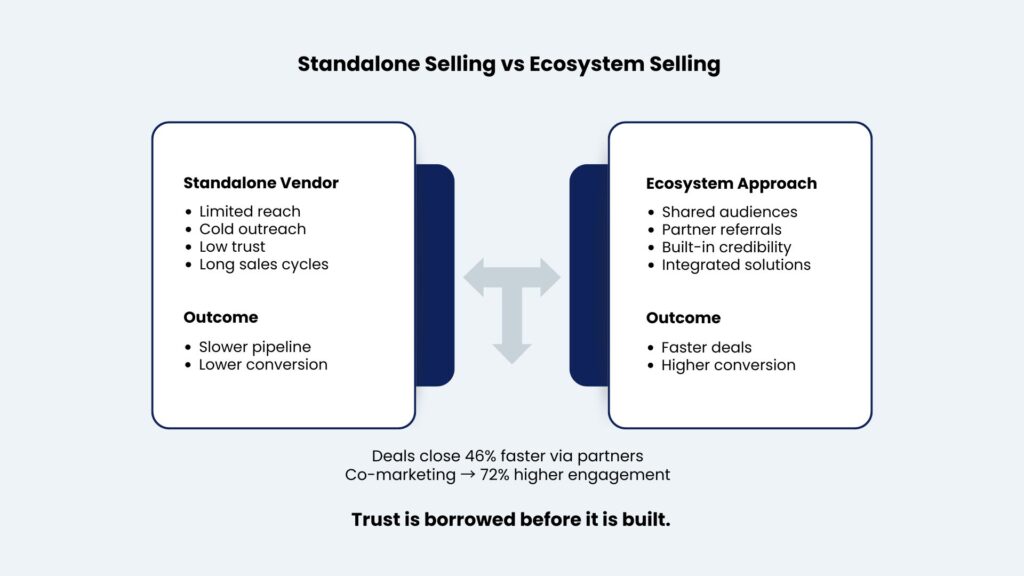
Campaigns that are co-branded produce a 53% higher attendance rate than solo campaigns, and account-based advertising combined with partners leads to a 72% increase in customer engagement. The improvement in performance is due to two factors: partner audiences help you reach new segments that you cannot access on your own, and the mutual endorsement provides a level of credibility that vendor claims alone cannot match.
At ProspectVine Marketing co-marketing is based on the idea of Narrative Continuity: developing a joint narrative in which the strengths of each partner highlight the value of the other. Joint webinars, co-authoring research, and collaborative solution frameworks are not only giving real value to buyers but also showing the ecosystem cohesion that individual vendors are unable to demonstrate. A recommendation from a trusted partner not only reaches the buyers but does so in a context of trust that no outbound campaign can achieve.
Solution Bundles
Buyers overwhelmingly prefer bundled solutions for complex initiatives. Digital transformation, revenue operations optimization, and customer experience modernization all require capabilities spanning multiple vendor categories. Ecosystem bundles reduce evaluation burden, accelerate purchase decisions, and improve implementation success rates. A three-way MarTech bundle in one documented case produced 3x ACV and 55% faster sales cycles compared to individual vendor pitches. When buyers purchase a bundle, replacing individual components creates friction across their entire stack. This stickiness is competitive advantage that standalone product quality cannot produce.
How Trust Flows Through Partner Ecosystems
Partner-sourced deals close 46% faster than cold outreach, according to Crossbeam research. Trust has already been established before your sales team enters the conversation. When a buyer trusts one vendor in an ecosystem, that trust extends to its partners. 94% of B2B marketers agree trust is key to success, and buyers trust ecosystem recommendations far more than vendor claims.
This trust operates through three channels. Implementation partners recommend specific technology combinations based on real deployment experience. Consulting firms architect transformation roadmaps featuring preferred vendor ecosystems. Technology partners suggest complementary solutions during expansion discussions. Each channel amplifies your market access independent of your direct sales investment. Vendors outside these conversations face uphill battles even with superior standalone capabilities.
Designing Your Ecosystem Marketing Strategy
Identifying the Right Ecosystem Partners
Strategic partners are essentially those who have the same ideal customer profile as you but offer a solution to a different aspect of the same big problem. ProspectVine Marketing refers to these as natural neighbors: businesses whose products or services are typically utilized directly before or after yours in the customer journey.
Assess potential partners according to four aspects: the degree of overlap in customer segments, compatibility of technologies, the extent to which brand values and market approach are aligned, and future roadmap direction. The aim is true complementarity rather than just an opportunity for co-branding.
Building a Joint Value Proposition
A partnership without a clear joint value proposition is a press release. Work with partners to articulate specific outcomes the combined solution achieves that individual solutions cannot. Rather than generic messaging about integration capability, specify the workflow improvements, risk reduction, and implementation acceleration buyers gain.
ProspectVine Marketing leads with economic benefit, not technical compatibility. Co-branded ROI calculators, stack assessment tools, and joint case studies bring this specificity to life and give buyers something concrete to act on.
Co-Created Thought Leadership
Co-author research on industry trends. Host joint roundtables bringing together leaders from both companies and shared prospects. Build shared toolkits buyers use in their own planning. This continuous audience education positions the partnership as a collective guide rather than a sales effort. Buyers recognize the distinction and respond to it.
ProspectVine Marketing calls this Earned Continuity: visibility and trust built through consistent value delivery over time, not through aggressive outreach.
The Long-Term Advantage of Ecosystem Marketing
The true power of ecosystem marketing strategy lies in:
Expanded reach: Through partners, you get access to the market segments that usually require one to invest the time of several years to be able to build independently. For example, a single B2B SaaS ecosystem consisted of seven partners and produced $12 million in pipeline with a 38%-win rate lift. If you had gone head-to-head in direct competition for the same accounts, it would have cost a lot more and the conversion rates would have been lower.
Shared credibility: When your partners who are already well-known and established in the market, recommend your organization to others, then a part of their credibility gets transferred over to your evaluation. This is especially a great help for vendors who are new or those who are expanding into adjacent segments. Instead of trying to get trust from scratch, being part of an ecosystem through partner association gives you an immediate credibility base.
Stronger competitive positioning: Ecosystem participation creates switching costs that standalone product quality cannot generate. Buyers invested in ecosystem configurations face substantial friction replacing individual vendors. Early ecosystem participants establish integration depth and partner relationships that later entrants struggle to replicate. A global technology company that made ecosystem marketing strategy, the core of its GTM strategy, sustained a 28% CAGR over four years against an industry average of 12%.
Where to Start Your Ecosystem Marketing Strategy
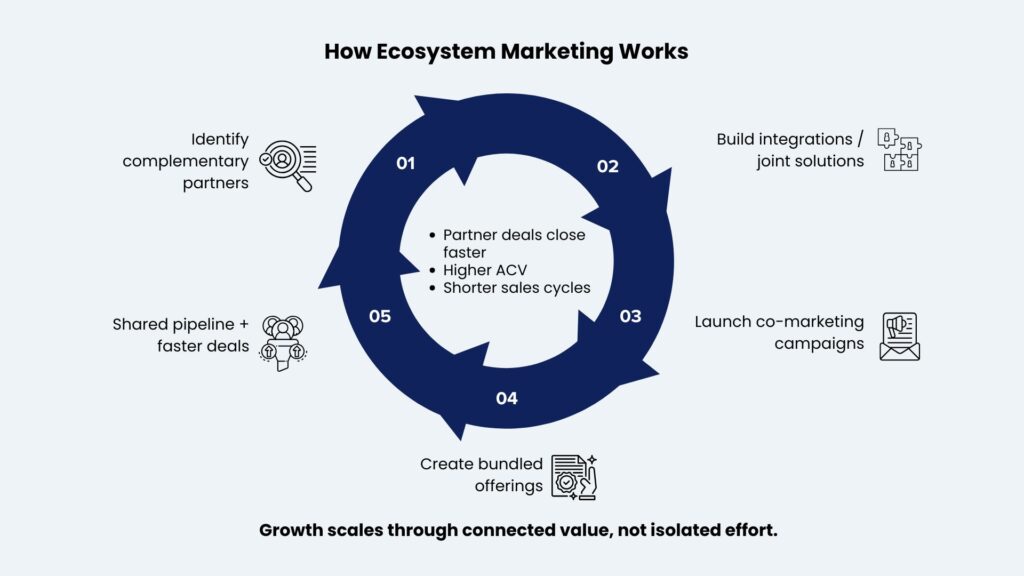
Map out your ecosystem first. Find 20 to 30 companies that could be potential partners with you because their customers are likely to be your ideal customers. Then, look at each company in terms of complementarity, reach, and strategic alignment. Decide on the top five and plan three mutually beneficial actions with each: a co-marketing campaign, a technology integration, and a combined offering.
Track the performance of the ecosystem by specific indicators: the amount of partner-derived pipeline, the impact of co-marketing campaigns, the degree of integration usage by shared customers, and the percentage of opportunities with partner attribution. These figures will tell you where your ecosystem investments have been profitable and where to focus your efforts on future partnership developments.
The question is not whether to invest in an ecosystem marketing strategy. The question is whether your organization will lead ecosystem formation or react to ecosystems your competitors build. The companies that shape their ecosystems now determine who gets evaluated and selected in every buying cycle that follows.