
Your Series A felt inevitable. Outbound campaigns generated meetings. Paid channels produced leads. Content created awareness. But you grew your team, increased your budget three times, and opened up new channels. Six months in, pipeline growth is stagnant; not from lack of effort, but from weak demand infrastructure scaling.
As reported by Pipeline360, just 12% of marketers find themselves “exceptional” at what they do, while more than half acknowledge that their progress toward pipeline objectives is “limited.” It’s not because of a lack of ambition. It’s because their systems weren’t built for scale.
Companies that crack this code come to realize one harsh reality: Growth doesn’t depend on effort. It depends on system strength.
What Demand Infrastructure Scaling Actually Means
The demand infrastructure is the operating system for revenue.
It's not the toolkit. The Demand Infrastructure is the architecture that determines how demand is generated, captured, analyzed, and monetized.
Organizations typically work in silos. They have technology, but not infrastructure. They have activity, but not architecture.
There are four parts to scalable Demand Infrastructure:
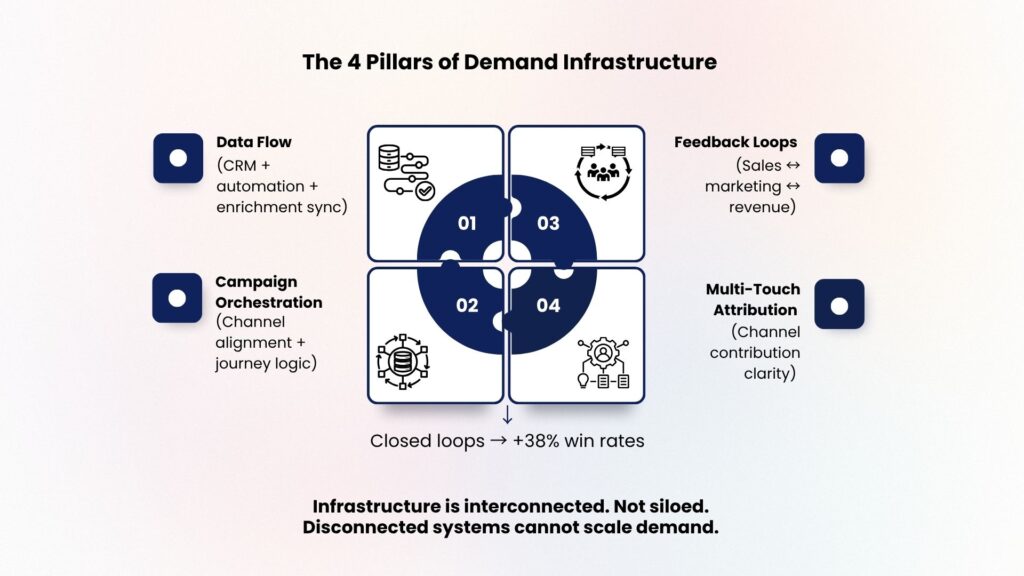
Data Flow
Information must be easily transferred between systems: CRM, marketing automation, data warehouse, enrichment engines. If a lead downloads content, then your nurture campaign changes. If they register for a webinar, the SDR gets enriched intent signals prior to outreach. As reported by the 2025 State of B2B Pipeline Growth Report, 56% of marketers in the UK and Europe characterize their stack as either "limited" or "disorganized." In the absence of smooth data flow, everything done downstream is based on fragmented ground.
Campaign Orchestration
Channel-based multi-channel execution isn't about segmentation. It's about orchestration. Gartner research indicates that B2B purchasers reach 83% of their purchase decision without contacting any salespeople. Campaign Orchestration makes sure that your demand generation campaigns match the reality of purchasing. An engagement with bottom-of-the-funnel content results in different activities than an engagement with awareness-level content.
Feedback Loops
Marketing creates leads. Sales gives the feedback needed for qualification. The revenue numbers tell us what marketing campaigns lead to closing. When marketing and sales systems are fragmented, all that information gets stuck in departmental silos. Campaigns get adjusted based on sales feedback, budgets are reallocated according to revenue, and loss analysis guides messaging. Forrester claims companies that have closed loops enjoy 36% better customer retention and 38% better win rates.
Multi-Touch Attribution
Knowing the effect channels, campaigns, and touches have on generating revenue is crucial. Multi-touch attribution tells you how it was done: what awareness content sparked an interest, what consideration assets created urgency, and what decision enablement got it done. The high performers are five times more likely to claim proficiency in data use than the low performers. Without multi-touch attribution, budget allocation is based on politics, not data.
You can learn more about multi-touch attribution, here.
The difference between campaigns and infrastructure is the difference between plateaus and scale.
Warning Signs Your Demand Infrastructure Can't Scale
Here are the warning signs of an infrastructure problem:
Pipeline volatility despite constant activity
You generate a constant outflow of prospects. Campaigns launch on schedule, and content marketing is active. Yet your pipeline remains volatile from one quarter to the next. This is the hallmark of teams attempting growth without demand infrastructure scaling. Systemized growth accumulates.
Performance inconsistencies of campaigns
Content syndication generates 200 qualified leads in Q1 but only 47 in Q2 while using the exact same strategy. One campaign works exceptionally well, and the next one underdelivers even with identical inputs. This is not variance; this is a lack of systematic execution, data, and feedback loops.
Dependence on manual execution
SDRs spend 60% of their time conducting research due to the lack of enrichment data feeds. Marketing Operations team builds attribution reports from scratch every month due to the silo effect of disparate systems. People adjust for this lack of system by conducting manual clean-ups and optimizing targeting and campaigns manually.
No growth patterns are formed
Where there is no repeatable process, there is no growth pattern. Growth becomes a function of specific campaigns, channels, and wins rather than predictable process output.
Why Traditional GTM Scaling Fails Without Infrastructure
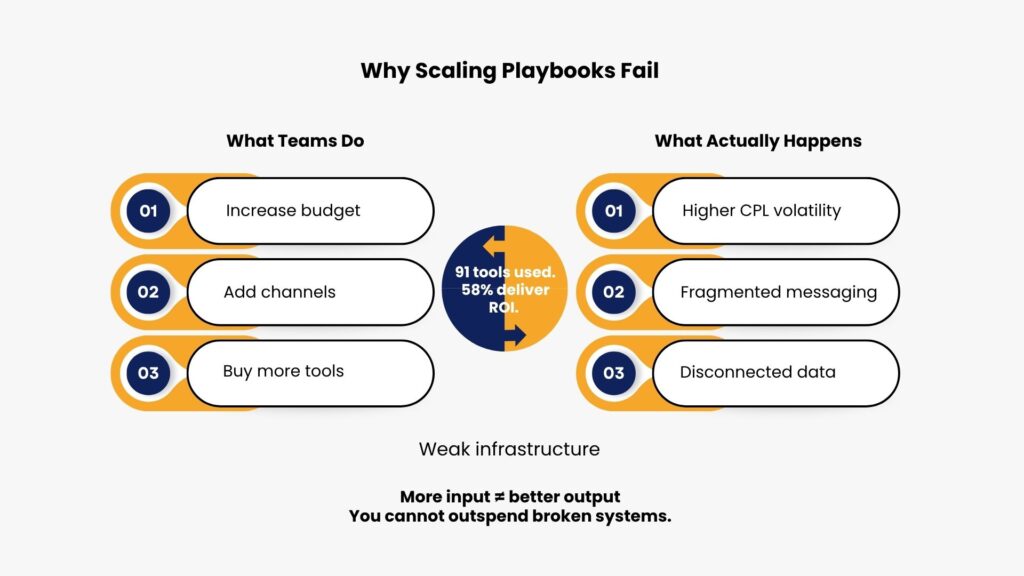
When you hit a plateau, the reflex is always to throw more at the problem; more budget, more channels or more technology but this is no longer effective. Demand infrastructure scaling requires a fundamentally different approach than simply adding resources.
Increased budget doesn’t mean better results
A B2B technology provider increased their paid media budget expecting corresponding increases in pipeline. Instead, their cost per lead decreased by 15% while sales-qualified lead conversions dropped 31%. What happened? All the additional volume made them unable to handle leads manually. They had high-intent buyers who took three days for an SDR to contact, making them cold. Lack of infrastructure to optimize additional spending means your additional budget goes into channels that are already saturated.
Increasing channels doesn’t increase reach
Demand Gen Report says 67% of B2B buyers feel inconsistencies in message and communication decrease chances of purchase. Additional channels just add to the integration challenges. Because there’s no orchestration, a potential customer will get three separate communications on three separate channels without them knowing of each other.
Adding more tools doesn’t equate to improved coordination
On average, businesses utilize 91 different martech tools but only 58 percent of them meet their ROI objectives. Adding more tools means adding another layer of complexity, fragmentation, and inefficiency. The intention platform understands who is searching. The CRM understands who is in the sales funnel. And the advertising platform understands who interacts with content. However, this fragmented data never comes together to create a complete picture for generating demand intelligently.
Scaling methodologies have always been about working on symptoms, rather than addressing the problem itself.
Building Infrastructure for Demand Generation at Scale
Demand infrastructure scaling requires systems designed for growth from day one. There are three design principles that set apart scalable systems from non-scalable systems.
Modular Campaign Architecture
Rather than building campaigns as monolithic units, architect campaigns as modular units: messaging modules, audience modules, channel modules. If the message fails to deliver results, you change the message, not the campaign. If the channel oversaturates, you reallocate budget, not change strategy. This campaign architecture allows for easy testing without affecting the underlying system itself.
Unified Data Layer
Siloed data is the bane of scalability. A unified data layer collects, cleanses, and resolves identity for all sources. It delivers a true record of the account, contact, and interaction. Modern revenue velocity relies on systems identifying marketable prospects, tracking trigger events, and delivering intelligence directly to the execution phase. Without this foundation, each downstream step must operate with incomplete information.
Closed-loop feedback as operational tempo
Weekly: MQL-to-SQL analysis by source. Monthly: velocity analysis by campaign touchpoint. Quarterly: contribution analysis and budget rebalancing. Tempo is key as well as metrics. Feedback loops do not function without systemization, only ad-hoc experimentation.
Orchestration above execution
Execution is tactics. Orchestration is strategy. Orchestration layers create alignment between channels, teams, and timelines. They make sure your email, paid, social, and direct channels all move in the same direction, not against each other. “Generic GTM is dead,” explained one revenue leader. “Micro-segmented, automated signal-driven engagement is the future.”
Implementation can be modest at first. A single SaaS organization started with just three systems integrated: its intent tool, its marketing automation software, and its CRM platform. In turn, they could automatically prioritize high-intent accounts for SDRs, along with enriched insights about each opportunity. The outcome? SQL conversion increased by 43%, without adjusting staff or spend. Just infrastructure optimization.
ROI of Scalable Demand Infrastructure
Organizations with robust demand infrastructure gain compounded rewards.
Infrastructure makes pipeline creation predictable and stable rather than volatile. When an organization captures leading metrics, it predicts confidently based on what it knows rather than on wishful thinking.
Stability in CAC results from infrastructure and optimization. The lack of it causes CAC spikes and instability due to failed campaigns and scrambling to fix them. By implementing infrastructure that captures knowledge and leverages it consistently, organizations see reduced volatility and improved CAC performance.
Faster cycles mean faster learning. Want to test something new? Just plug it into your infrastructure and measure its effects quickly. Rapid learning is critical for success.
The findings in the Pipeline360 study showed that high performers tend to excel much more in all areas measured by the study – data usage, lead nurturing, content quality, and sales-marketing alignment. These are no coincidences; they are results of solid infrastructure building efforts.
Growth Is a Function of System Strength
Plateauing is not the failure of aspiration. It is a failure of design.
The difference between the organizations that succeed and the ones that plateau lies in their awareness that effort compounds linearly but infrastructure compounds exponentially. They have systems ready even before they require them. They design for scalability and not for heroism. Demand infrastructure becomes a strategic tool rather than an operational expense.
The real challenge is not whether you work hard with your team. Rather, it’s whether you have the systems that allow such effort to compound.
The key difference in today's B2B marketplaces isn't visibility, it's demand infrastructure scaling that creates sustainable pipeline. It is systemization that creates the pipeline, and winning is about sustaining demand, not creating it.