Geographic market expansion presents a critical challenge for B2B companies: what works in your home region often fails in new markets. A successful geographic market expansion strategy requires more than translating content, it demands deep localization of messaging, channels, and buyer engagement approaches.
When companies venture into new regions, they quickly discover that engagement and conversions drop because cultural practices, consumer behavior, and regulatory environments differ fundamentally. A message that works in one region may not make sense in other regions. This is a failure in communications, not the fit of products in the markets.
Failure does not mean that there is no need for the product in the market. It means that the message is not right for the culture of the region.
Hidden Variables in Geographic Market Expansion
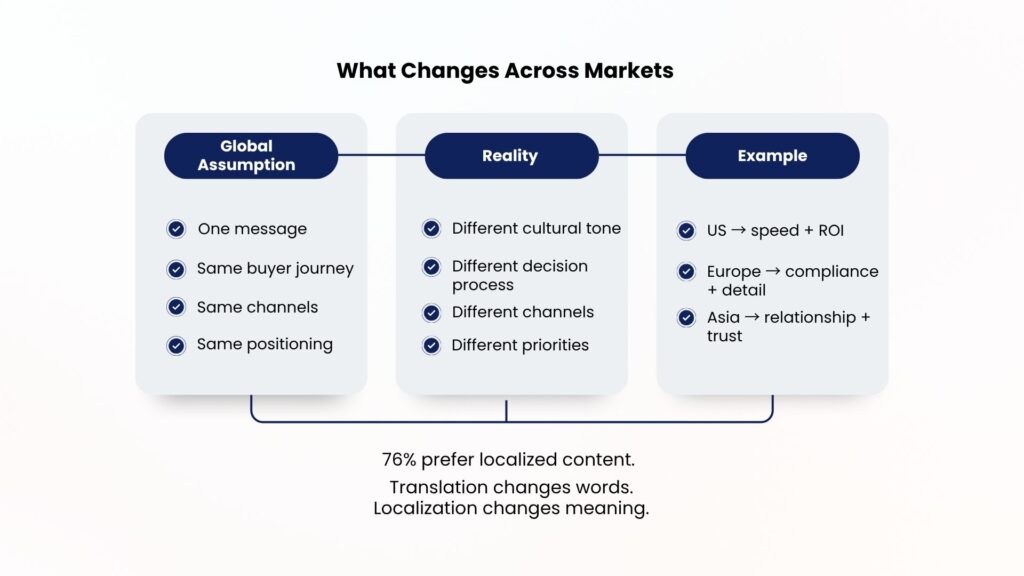
Understanding these variables is foundational to any geographic market expansion strategy. The factor of geographic expansion creates variables that change how buyers evaluate, assess, and buy solutions. Words have cultural connotations. A more subtle message can better replace an assertive one that works in the United States in some European and Asian regions. The product that is seen as innovation in Silicon Valley should now be viewed differently as efficiency in a traditional market environment.
The expectations of buyers depend on local business culture. In some regions, buyers would require more information upfront, the process of decision-making is based on approval at different stages, and relationships are built for a longer period of time. On the contrary, in other places, speed and concise messaging are key.
Regulatory climates differ widely. Privacy regulation, for example, plays an important role in shaping data gathering and market communication efforts. What may be common practice in one market may be considered outright illegal in others.
Market development is not universal. While one market segment is thoroughly educated on a particular issue, another one may require education and training. The length of the sales cycle will differ according to each region’s needs.
Why Localization Is Strategic, Not Tactical
Many people confuse localization with translation. This misconception is costly for businesses around the world. Translation means translating words. Localization involves adapting strategy.
CSA research based on data from 8,709 consumers from 29 countries has shown that 76% would prefer products containing information in their language even if they had to pay more than products that did not contain any information in their language. But 69% would still prefer popular brands despite the fact that they have no information in their language.
Bad localization might have bad consequences. BMW launched advertising in the UAE, where some fans of the football team showed inattention during the performance of the national anthem of the country, which sparked fierce protest. Also, when HSBC Bank’s slogan “Assume Nothing” was translated as “Do Nothing” in several languages, they spent $10 million rebranding.
In case of business-to-business organizations, complicated purchasing processes involving many stakeholders require local adaptation. If you explain a particular product’s return on investment to American finance directors in a certain way, then you should present it to German finance directors differently.
Building a Regional Market Expansion Framework
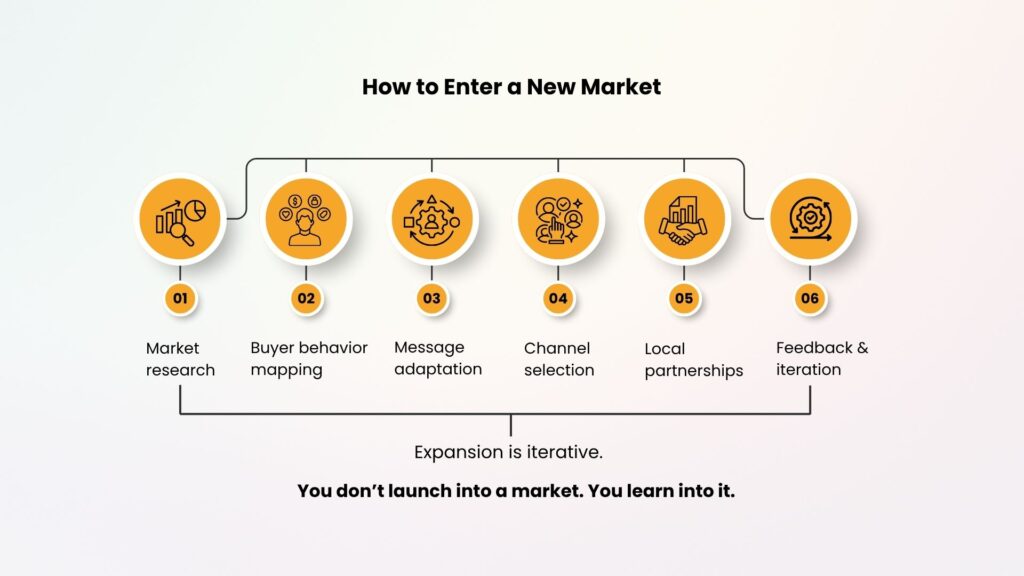
Successful geographic market expansion strategy structured adaptation across multiple dimensions. This is not a one-time project. It is a continuous process of learning and refinement.
Adapt Messaging to Regional Market Priorities
The message should take into consideration the issues that affect the region. Make the value proposition resonate with the local pains; cite cases within the region, and match your tone to the culture of the people there. If you sell intelligence solutions, in one part of the world, you could talk about efficiency, but in the other, about compliance. You need to transcreate the message in order to preserve the style, intent, and tone of the message.
Map Region-Specific Distribution Channels
Channels which might be dominant in one region will only be effective to a small extent in other regions. LinkedIn is the most used channel when it comes to B2B leads in the western world, but WeChat is the channel which dominates conversations between businesses in China. E-mails are the main mode of communication between business-to-business entities in the North American region, while WhatsApp helps businesses build connections in Latin America.
Build Local Partnerships for Market Entry
Partnerships help in creating credibility in several markets. Resellers, implementation partners, and technology partners offer credible ways for reaching buyers. Building relationships with these partners is much easier than creating awareness from scratch.
Geographic Expansion Traps That Drain Resources
Even experienced companies make predictable errors when expanding geographically. Understanding these traps helps you avoid them.
Translation vs. Localization in Market Expansion
This is one of the most popular yet risky approaches. Many companies invest in translations but do not change their strategy for the better. For instance, when Nintendo released Pokemon Sun and Moon using a unified Chinese strategy to address the markets of China, Hong Kong, and Taiwan in order to save money, the result was an adverse response from fans in Hong Kong.
Understanding Regional Buyer Behavior Patterns
Regional buyer journeys are not uniform. Timelines for decision-making differ. The level of stakeholder participation varies. Processes for evaluation differ. There are regions where the focus is on internal buy-in, while others emphasize executive buy-in. A fast-paced approach that thrives in New York would be considered unprofessional in Tokyo and Frankfurt.
Balancing Centralization and Regional Autonomy
Marketing operations tend to be centralized in order to keep things consistent. Though this allows for the branding process to remain consistent across markets, it does make the process less flexible for regional teams to respond to changes within a particular region, since the head office needs to authorize any change.
Designing a Scalable Geographic Expansion Framework
To operate effectively in several markets, corporations require a system that facilitates both consistency and flexibility. It does not entail forsaking global consistency, but rather finding a balance between the two.
Define the Core vs. the Edge
Some things need to be uniform all around the globe for the same reason, which includes brand identity, overall value proposition, positioning strategy, and brand visual guidelines. After ensuring that, regional differences can be integrated into the campaign by adding layers. The layering will cover region-specific communications, region-specific content creation, and region-specific distribution strategies. The best possible approach can be having a global body that provides strategies, while the regions implement the strategy on a local level.
Build Modular Content Systems
Generate libraries of content modules that regional teams can customize, instead of trying to force a misfitting global library onto a regional campaign. Translation through AI and post-editing speeds up the process while enhancing quality. Marketing automation tools today are capable of supporting multiple languages, regional variations in content, and localized customer journeys.
Establish Feedback Loops and Invest in Regional Teams
Develop a process through which regional marketing teams can feed back lessons learned to central marketing. What’s working? What’s surprising? Collect data on key performance indicators in each region, but keep the measurements standardized. The most effective adaptation is done by people who actually live in the region, understand its culture, and speak its language. Building a local marketing team is essential.
From Demand Generation to Regional Market Relevance
A well-executed geographic market expansion strategy changes the dynamics of demand generation. There is the need for organizations to change from having one message all through the globe to having messages that take into consideration regional contexts. Organizations should move away from generalizing their buyer personas. It means that there should be ongoing efforts of learning and insight-gathering in each specific market segment. These factors lead to a sustainable competitive advantage in the business environment.
Regional Mastery, Global Scale
When applying to new locations, there is a combination of the potential prospects and obstacles faced by the marketer. Marketing initiatives that succeed in some locations may fail in other locations without making changes to the marketing strategies to fit the new location’s target audience and others.
Localization is not simply taking the translated content and placing it in another language; the localization process requires an understanding of how the target customers perceive, evaluate and behave within their particular market. Localizing the marketing strategy based on findings from regional market research, adapting the message to match the requirements of the local market and establishing good relationships with the target audiences will be easier for companies if they conduct regional market research, adapt their message to the regional market and localize their entire marketing strategy. In other words, to establish a successful company, you will often need to balance providing a common message and the local requirements of methods for delivering that message.
Companies that have a global approach but execute their business based on a regional basis use localization as part of their competitive advantage, they conduct regional market research and grant their regional teams total autonomy to implement their marketing strategy, and they approach their next expansion with the mentality that they are going to learn from every time they enter a new market.
The most common way for B2B companies to grow is through entering new markets, however, this is not typically the primary source of growth for all B2B companies.