Most B2B marketing operates on campaign timelines- three months of activity, weekly dashboard reviews, immediate pipeline expectations. But B2B brand memory building operates on entirely different timelines, influencing buying decisions years before formal evaluation begins.
A buyer encounters your brand at a conference. Eighteen months later, they download a white paper. They see your LinkedIn content periodically but never respond to outreach. Then, two years after that first touchpoint, they initiate contact. Within weeks, they become a customer.
This pattern appears more often than most attribution models reveal. A Forrester research involving over 3,500 B2B buyers shows that 92% ultimately choose a vendor they had in mind before they began formal research. Of those creating shortlists, 78% select products they had heard of previously, rising to 86% for enterprise buyers.
The implication is clear: decisions worth hundreds of thousands or millions of dollars are shaped by memories formed long before budget meetings convene. Yet 76% of marketers measure performance within 90-day windows while actual buying cycles average 12.3 months. This temporal mismatch destroys value at scale.
What matters over the long term is not the organization with the best campaign. Rather, it is the company that creates robust memory structures through presence, signifiers, and narratives to influence customer decisions years before evaluation has begun.
The Extended Memory Timeline in B2B Buying
The Two-Phase Buying Journey
The B2B buying journey unfolds in two distinct phases. Research shows that 70% of the journey occurs in a Selection Phase where buying groups form, gather information, and build consensus shortlists without ever speaking to sellers. By the time your sales team receives an inbound lead, the real decision has often already been made in the buyer’s mind.
Regional Timelines and the 95-5 Rule
The timeline varies by region. APAC buyers take an average of 13.2 months in their buying journey. North America averages 11.2 months. EMEA buyers move slightly faster. But these figures only measure the formal evaluation period. The actual memory formation that enables brand recall happens far earlier.
Think about the 95-5 principle that was popularized by the Ehrenberg-Bass Institute and the LinkedIn B2B Institute. Only 5 percent of your customers are looking for an immediate solution at any point in time. Ninety-five percent of them are out-of-market buyers who are not even interested in the products and services you offer. They will be ready in months and years to come.
Building Brand Memory and Mental Availability
The goal is to ensure that when the 95% eventually shift into the 5%, your brand is the first one they remember. This requires building mental availability over time through repeated exposure across the channels buyers actually use.
Previous experience with a vendor proves critical, helping brands get chosen even as buyers move jobs. This portability of brand memory across organizational boundaries makes long-term brand building even more valuable in B2B contexts where decision-makers change roles frequently.
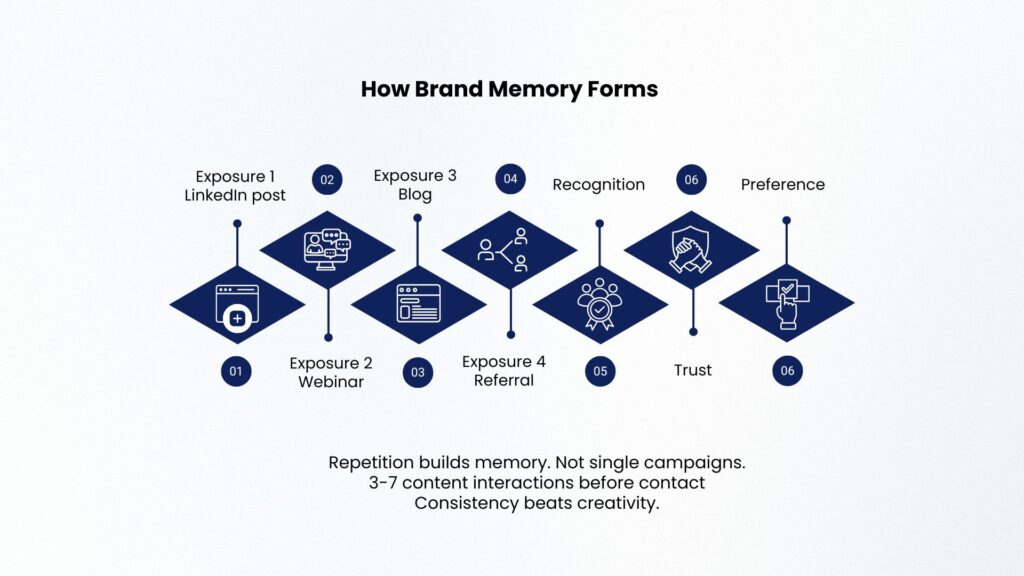
How B2B Brand Memory Forms and Persists
Memory Encoding in B2B: Repetition Over Drama
B2B brand memory building doesn’t happen through single dramatic exposures. It forms through a neurological process called encoding, where the brain converts experiences into retrievable memories through pattern recognition and repetition.
Every contact builds memory. From a LinkedIn post, to being mentioned on a webinar, to reading a blog post, to a sales call, to a referral from a colleague. In isolation, each is not particularly noteworthy. Together, they build recognition. Studies prove that repeated exposure builds preference and trust, even without realizing it. On average, B2B buyers will consume 3-7 pieces of content before contacting a salesperson, with 11% viewing more than seven pieces.
Why Consistency Matters More Than Creativity
This science proves the reason why consistency is more important than creativity. With each encounter between a consumer and the brand through its consistent look, consistent message, and positioning, we reinforce connections in our brains. Effective B2B brand memory building relies on this cumulative reinforcement rather than one-time creative impact. Research has shown that the frequency with which marketing communications mention a brand positively correlates to the effectiveness of the campaign. The more people mention a brand, the more the audience remembers it.
Brand identity is especially crucial in this case. Unique visual elements such as color, shapes, icons, pattern, and phrases help buyers recognize the brand before the brain even analyzes the information. All of these elements create what scientists call ‘fluency’, the ability for the brain to quickly recognize a brand when the purchasing context arises.
The Trap of Marketer Boredom
But distinctive assets only work when deployed with ruthless consistency. This is where most B2B brands fail. In pursuit of freshness or market feedback, they abandon distinctive elements before those elements achieve sufficient market penetration. The critical insight: repetition is the mechanism brands rely on, and marketers get bored long before the market has even seen the content.
Why Short-Term Campaigns Fail to Build Brand Memory
The Timescale Mismatch Between Campaigns and Memory
The quarterly planning cycle governing most B2B marketing operates on a fundamentally different timescale than memory formation. Campaigns last for 60 or 90 days, get evaluated, new creative is introduced, and the process starts again. However, your best customer never even knew that your advertisement was out there because after seeing it twice without acting, they now see something completely unrelated to what they have just seen.
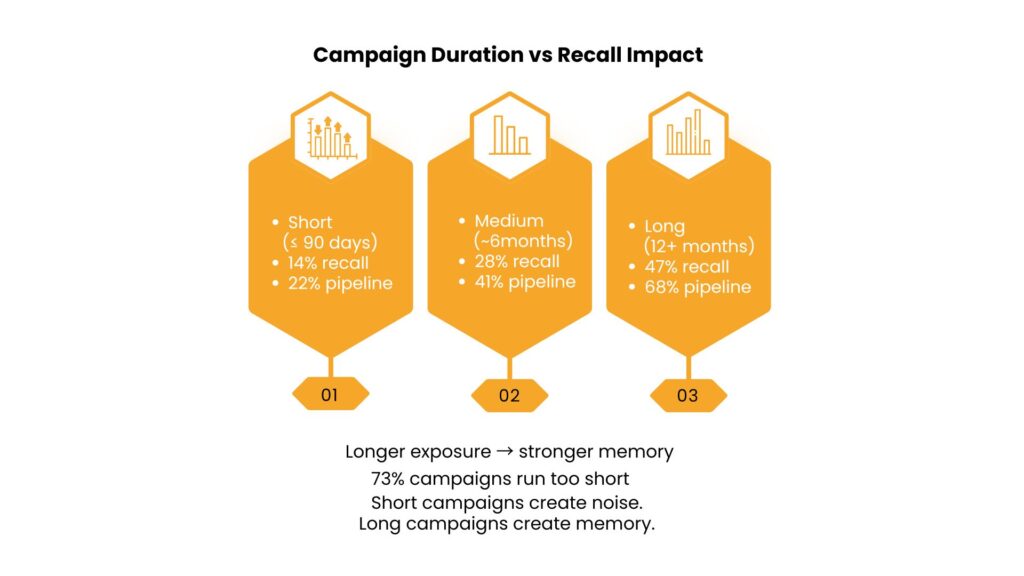
Brand memory requires repetition over time. A campaign running three months and then disappearing may generate immediate response, but it does not build durable recall. Data shows that 73% of campaigns run less than six months, missing the recall window entirely. When campaigns end, the fragile neural pathways begin to fade.
The Cumulative Cost of Inconsistent Messaging
Inconsistent messaging creates even deeper problems. When every campaign introduces new messaging, new visuals, and new positioning, the brain must start over each time. Each exposure becomes isolated rather than cumulative. Memory generation requires continuity that short-term campaigns cannot provide.
The math is revealing. Short campaigns under 90 days show 14% recall rates and 22% pipeline contribution. Medium campaigns at six months achieve 28% recall and 41% pipeline contribution. Long campaigns exceeding 12 months reach 47% recall and 68% pipeline contribution. This requires consistent messaging across sales and marketing to reinforce memory structures rather than fragment them.
Rising Customer Acquisition Costs and the Performance Marketing Trap
The economic impact appears in customer acquisition costs. A buyer who has seen your brand consistently over time converts more efficiently, with improved click-through rates from recognition and better conversion because landing pages do not need to explain the category. Performance marketing ends up compensating for the absence of brand memory, making every click and every lead progressively more expensive.
The fundamental problem: short-term campaigns optimize for immediate response while brand memory optimizes for long-term recall. When your next campaign uses entirely different messaging and creative, it actively works against the memory structures the previous campaign started forming.
Designing B2B Marketing for Long-Term Memory Building
Core Narrative Themes for Memory Building
Building marketing that creates durable brand memory requires rethinking standard B2B practices. It begins with developing consistent narrative themes that persist across quarters and years, not campaigns.
Theme identification. The themes that need to be identified here include what problem does the business solve, what unique insight it brings to the table, and how it stands out among competitors in the market. The best brand stories in the B2B market tend to be very straightforward: clearly stating the industry the business is part of the problem they solve, and the reason for their uniqueness.
In the case of a company specializing in data intelligence, themes could revolve around seeing the unseen signals, being able to make proactive decisions, and cutting down uncertainty within their go-to-market strategy.
Recognizable Cues and Steady Channel Presence
Brand signals recognizable enough to allow for instant identification play the role of visual and linguistic shortcuts. It means avoiding the temptation of reinventing your logo, palette, slogan, or overall appearance merely because the internal team has become bored of it. According to Nielsen studies, brand consistency can lead to an income boost of up to 23%.
The channel approach should emphasize persistent exposure rather than optimizing performance. Instead of investing money into channels that provide instant results, successful memory-building techniques focus on constant exposure in channels used by prospective buyers who are not currently in the market.
It doesn’t mean being constantly bombarding people with intense content. It means staying persistent and consistent. Regular content creation, constant social media engagement, periodic industry engagement, and persistent education.
The Dual-System Approach to Brand Memory
Organizations that have built their marketing operations around demand generation metrics and short-term ROI often find this shift uncomfortable. It requires maintaining spending on activities that will not show immediate pipeline impact, trusting that memory formation is occurring even when attribution systems cannot measure it.
The best practitioners solve this by creating dual systems: performance marketing that captures existing demand from buyers already in-market, and brand marketing that builds memory with the 95% of prospects who will eventually buy but are not ready today. Both are necessary. The mistake is optimizing the entire system for the 5% at the expense of the 95%.
Measuring B2B Brand Memory Building Success
Why Traditional Metrics Fall Short
Traditional marketing metrics were not designed to capture brand memory. MQLs, pipeline contribution, and campaign ROI all measure immediate response, not the gradual accumulation of memory that determines future buyer behavior.
Proxy Indicators and Alternative Measurement Approaches
More sophisticated approaches track proxy indicators. Recognition in sales calls provides qualitative evidence. When sales development representatives connect with prospects who already know the brand, that signals successful memory building. When buyers say “We have been seeing your content for a while,” it reflects accumulated memory.
Traffic from direct visitors is an additional indicator. The rise in direct traffic can mean that customers know the brand’s name well enough to look up the website independently without using search or advertisements. The moment a potential customer enters the website’s URL by himself into his browser is an indication of good brand recall.
Brand recall surveys, while labor-intensive, provide the most direct measurement. Periodic surveys allow you to track aided recall (brand recognition upon prompting) and unaided recall (ability to remember a brand without being reminded). These metrics offer some insight into the degree to which your brand is rooted in the mind of the buyer.
The share of voice on owned, earned, and paid media reveals whether you have enough presence to create memories. The exact amount required differs based on category maturity and competition, but the rule is universal: not enough presence means not enough memory.
Finally, pipeline quality metrics demonstrate the effects of long-term memory-building. Companies may experience higher conversion rates, faster sales cycles, and more efficient targeting of ideal buyers. Such effects often stem from prospects entering the pipeline with prior brand awareness and trust.
The Compounding Advantage
Firms that decide to invest in creating brand memory will soon find that the memory effect builds up on itself. B2B brand memory building compounds over time, with each exposure making subsequent contacts more effective. The first prospect that comes across your brand will be more likely to accept future contact attempts. This is because their initial classification will create a schema in which all future contacts will be easier than before.
Market leaders continue to maintain their leadership despite having inferior products and prices because they establish brand memory so deeply that it becomes the consumer’s default point of consideration. As a result, competitors must work against the accumulated effects of that powerful brand recall.
The Strategic Imperative: B2B Brand Memory Building
For growing companies, this reality is simultaneously challenging and encouraging. Challenging because displacing established memory requires sustained investment and patience. Encouraging because memory, once built, becomes increasingly durable and valuable over time.
In markets where buyers make decisions based on vendors they already know, B2B brand memory building is not a brand exercise divorced from revenue generation; it’s the foundation determining whether you get considered at all. Brands establish the foundation determining whether you get considered at all. The brands that win are those maintaining steady visibility with consistent messaging long enough for memory to form and compound.
The question is not whether to invest in long-term memory building. Whether you will make that investment before your competitors do determines which vendors will dominate the buying conversations happening three years from now, recognizing that the memories you form today will influence that outcome. In B2B, the brand that you remember is often the brand that wins.