The rhythmic marketing strategy offers a smarter alternative to exhausting always-on campaigns. Your emails arrive like clockwork every Tuesday. LinkedIn ads follow prospects everywhere. Retargeting campaigns never rest. This is ‘always-on marketing’: the belief that constant presence creates constant value. But buyers overwhelmed with digital clutter see this less as legitimate follow-up and more as unwanted surveillance.
A 2025 study showed 70% of consumers unsubscribed from at least three brands in three months due to too many messages. Meanwhile, 49% now refuse to buy from brands that contact them too often. The solution? A rhythmic marketing strategy that respects buyer autonomy while maintaining strategic presence.
The harsh reality is that buyers are more likely to spot a repeated message before they’ll notice that it is relevant. Continuity, when too nice and too everywhere, breaks the effect. Your communication makes people indifferent to you, and it even eats up the very attention that you want to get.
The Limits of an Always‑On Approach
This shift reveals why a rhythmic marketing strategy has become essential for sustainable B2B engagement. The “always-on” philosophy emerged from sound strategic thinking. Stay visible. Maintain presence. Never let competitors fill attention gaps. Marketing automation made perpetual engagement technically feasible. Account-based methodologies emphasized sustained engagement.
But at some point, the always-on concept in marketing changed from being “consistently available” to “relentlessly present” without anyone noticing. If you trace the evolution of the term, the focus has shifted away from the consumer to the producer, from providing value to demanding attention.
Marketing teams took the meaning of continuous presence to mean constant outreach, which is a classic mistake where activity is confused for effectiveness.
Behavior of B2B buyers analyzed in a recent study shows how presence and value should be differentiated. A top executive receives more than 3, 000 marketing messages each month. A brand that is permanently broadcasting to its audience becomes the equivalent of a refrigerator noise; it is so common and constant that the audience (unconsciously) stops noticing it and only when it stops completely, they notice it again.
Ultimately, buyers reward a brand that makes itself available when they need information. They certainly do not expect brands to force their presence on them at every moment of their workday, no matter the setting or the time. Always, on marketing, thus, misunderstands availability as being the same as intrusion.
How Always-On Marketing Backfires (Rhythmic Strategy Fixes It)
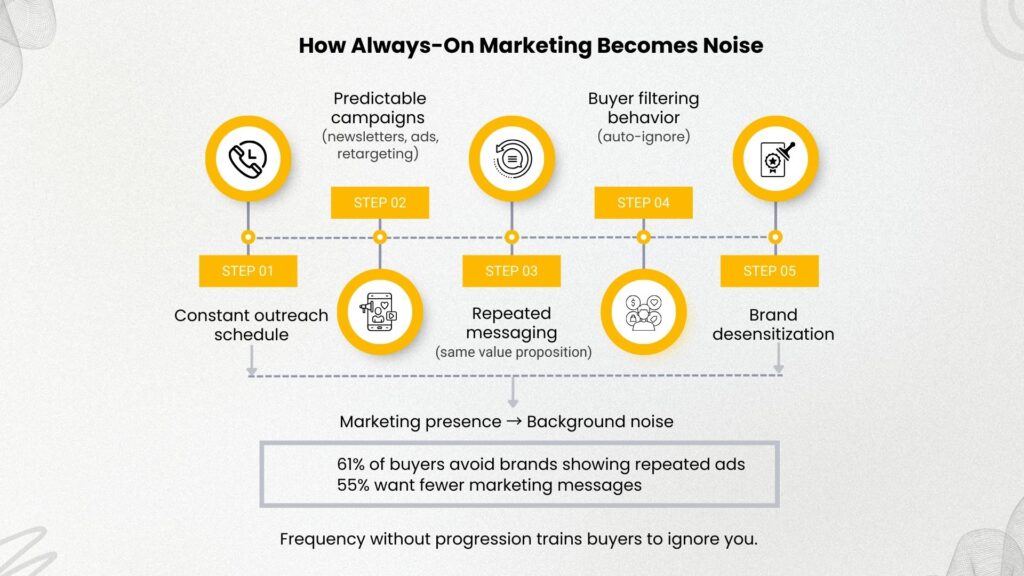
When a go-to-market strategy mainly focuses on targeting customers more frequently rather than with more relevant messages, it leads to repressive cycles.
Messaging That Becomes Too Predictable
Marketing automation makes messaging so regular and mechanical that the audiences simply understand the pattern and stop paying attention to it. A newsletter is sent out every Tuesday. A webinar goes to the inbox on the first Thursday of the month. Social posts just follow the same pattern.
Research shows 61% of consumers are less likely to purchase from companies that repeatedly show the same ads. When buyers set their calendar by your marketing schedule, they’ve learned to dismiss it. Brains develop automatic filtering for predictable stimuli. Your Tuesday email triggers instant mental dismissal.
The problem compounds in B2B contexts. A buying committee of eight receives your campaign eight times. What marketing views as presence, buyers experience as bombardment.
Overexposure Without Progression
Always-on campaigns maintain high frequency without advancing the conversation. Prospects receive touchpoints rehashing the same value propositions, repeating identical case studies, and repackaging previously delivered content.
Analysis shows 55% of customers actively want fewer messages. The issue isn’t purely volume. It’s that additional messages fail to deliver incremental value. When touchpoint six conveys the same information as touchpoint three, buyers interpret outreach as noise.
A prospect downloads a whitepaper in month one. By month six, they still receive emails promoting that same asset. Marketing appears to have learned nothing about their needs or journey position.
Brand Desensitization
Continuous exposure without significant progression in the story leads to habituation, where repeated stimulus causes weaker reaction stages gradually. Studies show that 70% of customers nowadays deliberately ignore brand message including service updates.
This sort of desensitization is almost permanent in its nature. Once prospects learn to dismiss your brand reflexively, regaining attention requires extraordinary effort. Unlike tactical failures, habituation represents fundamental relationship damage.
Buyer Expectations Vs Vendor Assumptions
Buyer research confirms that a rhythmic marketing strategy aligns better with actual preferences than always-on approaches.
Availability, Not Persistence
Buyers want to discover you at their fingertips when they need you most. They do not want to experience being stalked. Being available simply means being there when someone needs you. Persistence means continuing to appear no matter what.
A HBR study says that companies that teach rather than sell gain more loyal customers. Consumers nowadays want to have the power to decide when and how they will interact. They appreciate suppliers who efficiently get back to them when required, not the ones who keep on bothering.
Control Over Pacing
Today’s customer buying journey is far from simple and straightforward. Customers research, evaluate, and get the consensus decision in short bursts of time. There are also periods of inactivity between these periods. Vendors who are effective understand these cycles and do not try to continuously engage their customers.
Research has revealed that 81% of buyers want to be able to get away from marketing when they feel the need to. Buyers set the pace. Vendors who disregard this lead to the creation of friction and the hastening of disengagement.
Signals That Brands Pay Attention To
Buyers notice when communication reflects their behavior. A brand which interrupts its silence and communicates a very relevant, contextual message based on a certain trigger (funding announcement, new integration) gets far more attention from the customers than a brand which stays generic and calls presence daily.
Relevant signals are those which represent the communication aligned to the recent activity, the content which is changed according to the role or stage, and the timing that mirrors the buying signals. Thus, one gets a feeling that the vendor understands the context rather than being on autopilot.
Companies like ProspectVine place their signal-driven engagement at the very top of their list, thus preferring relevance and timing to volume. Attention is gained through responsiveness, not persistence.
Designing a Rhythmic Marketing Strategy: The Always-On Alternative
The alternative to always-on noise is not silence. It’s rhythm. ProspectVine stresses patterned intentional buyer engagement that respects buyer autonomy and tears down over time.
Intent-Based Pacing
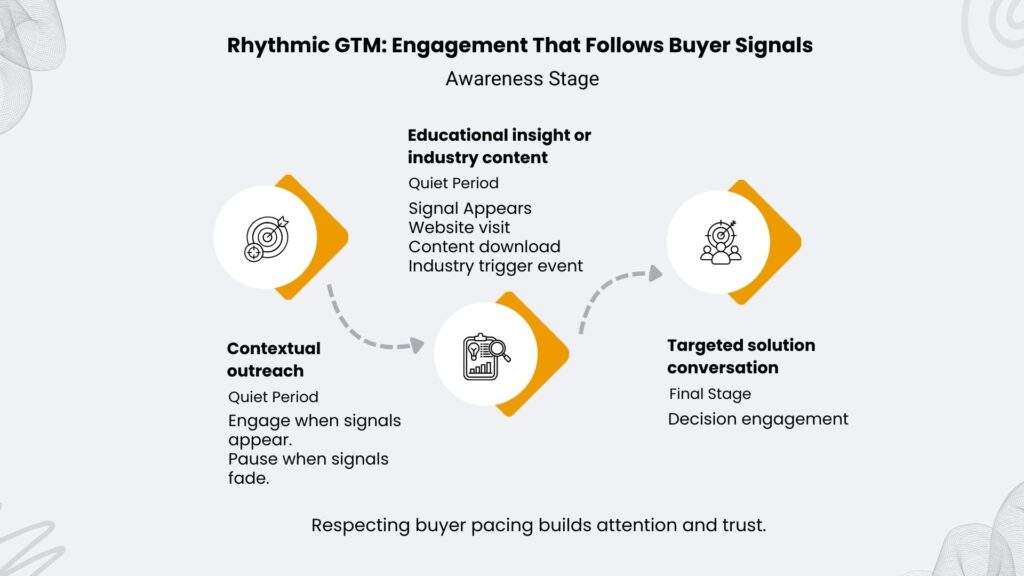
Engagement shall be intensified or moderated based on visible sign: website visits, content engagement, changes in the organization, and buying, stage indicators.
When interest bursts, action gets intensified. When interest fades, communication pauses. AI-verified targeting builds trust through personalized recall, pacing outreach based on genuine buyer intent rather than marketing calendars.
Strategic Quiet Periods
Silence carries power. Intentional pauses allow message reset, cognitive recovery for buyers, and space for competitors to become noise themselves. When communication resumes with new insight, it feels fresh.
Tactical implementation involves mapping buyer journeys to identify natural pauses: after major content delivery, following interactive events, or during predictable low-receptivity periods like quarter-end.
Earned Continuity
Continuity shouldn’t be assumed. It should be earned through value. Every touchpoint must deliver sufficient value so that recipients welcome the next interaction.
ProspectVine’s philosophy is all about gaining persistent support through targeted marketing that is based on verified intentions. Instead of blanket campaigns, focused engagement allows companies to concentrate their resources on accounts that show multiple signs of being the right ones.
The method focuses on personalization at scale by using different types of information such as firmographic intelligence, technographic data, and behavioral signals. When each contact point shows real comprehension, people reply with engagement rather than unsubscribing.
Most critically, earned continuity means respecting engagement signals. When prospects open emails or attend webinars, the system responds appropriately. When prospects ignore multiple touchpoints, the system scales back rather than accelerating. This bidirectional responsiveness transforms relationships from vendor-audience to genuine dialogue.
KPIs for Rhythmic Marketing Strategy Success
Rhythmic marketing strategy requires different success metrics than always-on approaches. Effective frameworks evaluate engagement quality and relationship health.
Engagement Recovery After Pauses
When brands go silent for two to four weeks then resume outreach, healthy rhythmic strategies show engagement recovery. Track email open rates on first message after pause versus baseline rates. If engagement improves after quiet periods, fatigue was present. Recovery metrics help determine optimal pacing intervals.
Message Fatigue Indicators
Key indicators include declining open rates across consecutive messages, increasing unsubscribe velocity, and reduced click-through despite improved content. Advanced systems implement fatigue scoring to identify when individual prospects show fatigue symptoms. When signals cluster, automated workflows suppress that prospect temporarily, allowing relationship reset.
Long-Term Brand Response Rates
The ultimate metric: how do response rates trend over extended periods? Always-on approaches typically show declining effectiveness as habituation accumulates. Rhythmic strategies aim for stable or improving long-term response.
Organizations should analyze response rate trajectories across 12 to 24 month periods. A brand that prospects respond to months later has maintained relevance without exhausting attention.
The Future of Rhythmic Marketing Strategy in B2B
The future belongs to rhythmic marketing strategy, engagement that respects buyer autonomy and attention.
Always-on marketing assumes visibility drives demand. The truth is that buyers nowadays are very protective of their attention, easily irritated with repetitive messages, and very fast in tuning out brands that do not respect their boundaries.
In the congested attention economy, one stands out by respect. Buyers’ attention should be treated as a scarce and valuable resource.
Organizations embracing rhythmic GTM gain competitive advantages. Prospects come to know, appreciate and empathize with communication that respects their time when they develop stronger relationships with The. Better engagement metrics is the result of people being more receptive to the messages rather than them just following a marketing calendar when touchpoints are scheduled.
Transformation requires courage. Marketing teams fear reducing frequency means reduced results. Executives worry pausing outreach cedes ground to competitors. But research and practice demonstrate the opposite.
The companies which will lead market penetration in the future are those that resemble broadcasters the least and partners the most in this regard. They engage when it is beneficial, they give space when it is not, and they come back with something new when the time is right.
Continuity without progression becomes noise while continuity with rhythm becomes trust. The competitive advantage is no longer being everywhere. It’s knowing exactly when to appear.