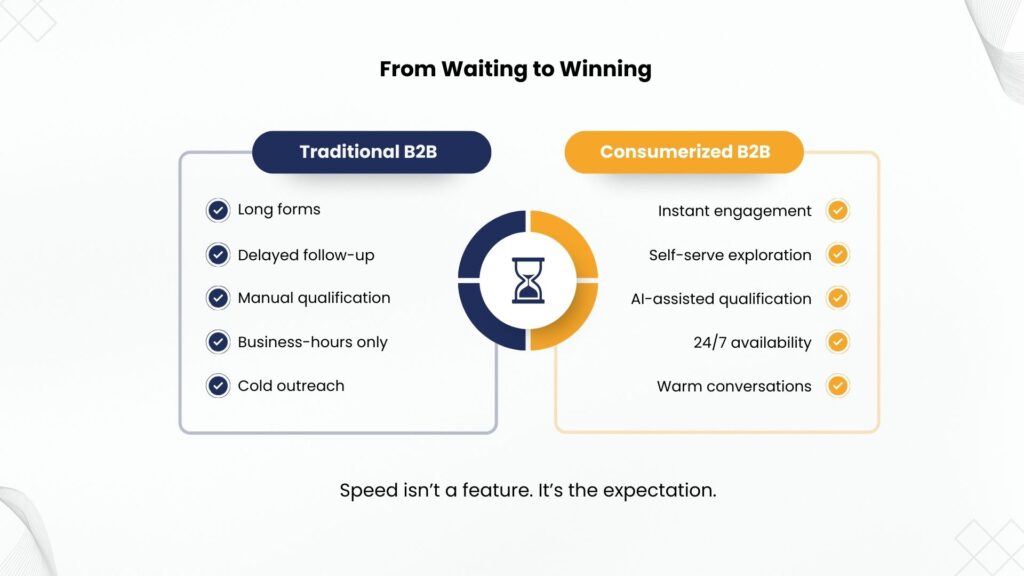
B2B lead response time has become the critical factor separating winning companies from those losing pipeline. Whether it’s your VP of Sales booking a rental in 90 seconds or your CMO ordering lunch with three taps, the expectation is speed. Even your procurement director expects a consumer-grade experience, finding and buying headphones on Amazon in less than five minutes. However, when they visit your B2B software website, they must fill out a demo request form and wait three days for someone to call them back. This B2B lead response time gap is killing your conversion rates.
This Experience Gap represents the primary driver of pipeline friction today. In 2026, the line between B2B and B2C expectations has essentially disappeared. We call this the Amazon-ification of the B2B buyer.
Millennials constitute 73% of all B2B buying decisions. They grew up with Amazon, expect self-service portals, and demand the same customer experience they get as consumers. Psychologically, buyers no longer separate their consumer self from their professional self. The same brain expecting one-click checkout at night expects frictionless engagement at work the next morning.
The pleasure principle states that people pursue experiences that minimize work and maximize benefits. If your purchase process is slow, lacks transparency, or feels burdened by bureaucratic hoops, prospective buyers will not be patient; consequently, they will lose interest and become unengaged.
ProspectVine’s core belief reflects this reality: if your sales process feels like work, your competitor will make buying feel like a win.
The 5-Minute B2B Lead Response Rule: When Interest Vanishes
The mathematics of B2B lead response time are brutal and unforgiving.
Research from MIT and InsideSales.com found companies contacting leads within 5 minutes are 21 times more likely to qualify leads compared to waiting 30 minutes. A Harvard study of 2.24 million leads showed waiting one hour instead of five minutes makes you 7 times less likely to qualify them. Wait 24 hours? You’re 60 times worse off.
After 5 minutes, the odds of qualifying a lead plummet by 80%. The decline isn’t gradual. Even more striking, 78% of customers buy from the first company responding to their inquiry.
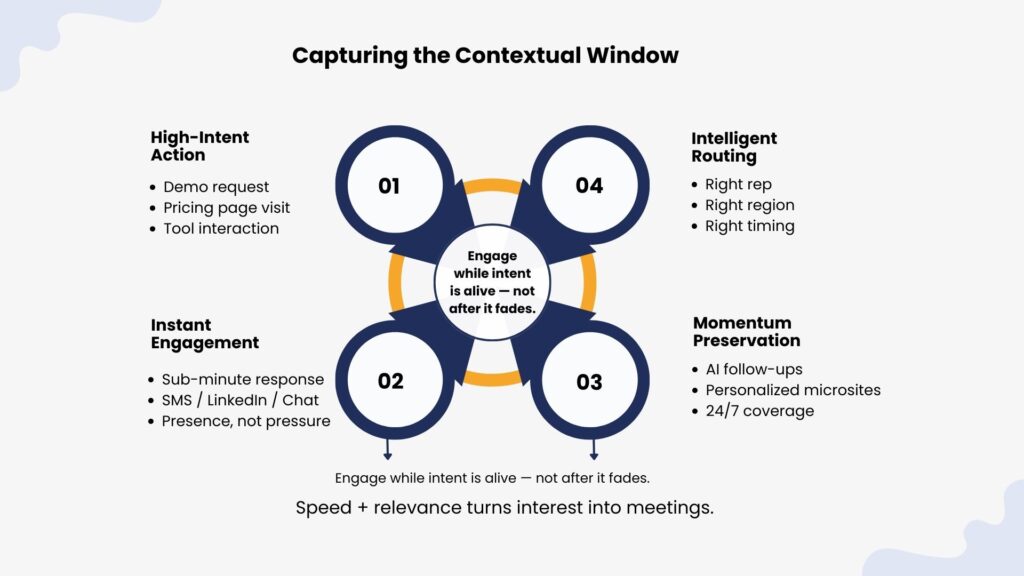
Response Time Psychology: The Contextual Window
Why does this happen? Two things happen at once. First, your lead is in a focused moment, they’re thinking about their problem right now. They’re researching, comparing options, and ready to engage. But the moment they shift attention, you’re no longer competing with other vendors; you’re competing with their inbox, their next meeting, and everything else in their day.
The challenge for most B2B teams? Most teams take about 42 hours to respond to a lead; not 42 minutes. 58% of businesses never respond to inbound leads. This represents billions in wasted marketing spend pursuing leads who are never contacted.
Instant Engagement and Intelligent Routing
ProspectVine designs for this contextual window, not against it. Instead of waiting for manual follow-ups, ProspectVine optimizes B2B lead response time by triggering instant multi-channel handshakes after high-intent actions like pricing page visits. Welcome SMS or LinkedIn DM arrive within seconds. Smart, AI-timed nudges maintain presence without feeling intrusive.
The system recognizes urgency varies by source. A “request demo” form submission demands sub-minute response. A whitepaper download gives you a brief 10-15 minute window to reach the lead. Smart routing immediately connects them to the right representative, while automated follow‑ups keep the conversation moving after business hours. The goal isn’t to push, it’s simply to stay present while their intent is still high.
Moving Past PDFs and Toward Interactive Microsites
The traditional gated whitepaper is quietly dying. Gated whitepapers convert at 3.8% while interactive tools hit 6-8%. In a post-spam world, modern buyers view a 20-page PDF as homework they don’t have time to complete.
Real-Time B2B Lead Response: Dynamic Personalization
The shift moves toward intelligent microsites. Intelligent microsites are not simply static landing pages. Instead, they are dynamic environments that constantly adapt to the visitor, in real, time. They create a self, guided journey where the content changes in response to the behavioral cues of the user.
If a lead lingers on the Security section, the microsite automatically prioritizes SOC2 reports and compliance certifications. Using firmographic data through IP tracking or form data, the site recognizes the visitor’s company and personalizes the experience: “Welcome, Company Name Team. Here is how we specifically help firms in the industry sector.” Product recommendations adjust based on company size, technology stack, and engagement signals.
Data Intelligence and Self-Service Preferences
ProspectVine treats these sites as data hubs. Every section read, every video played, every comparison chart accessed generates intelligence. Sales rep get alerts like this: “The decision-maker from a Target Account spent 8 minutes on the pricing page, downloaded the ROI calculator, and viewed the competitive comparison.” Instead of making a cold and generic follow, up call, the rep’s call becomes warm and knowledgeable.
This is in line with the preferences of buyers. 70% of B2B buyers would rather make their purchase online than go through traditional methods. They want self-service options letting them research, compare, and progress on their own schedule. Forrester predicts over half of large B2B deals valued at $1 million or more will be completed through digital self-serve channels by the end of 2025.
Hybrid approaches win: quick-check tool into personalized PDF into calculator equals 232% conversion lift and 47% cheaper SQLs.
24/7 Lead Response: AI as Your Instant Concierge
Form fatigue is real and behavioral. Requiring a C-suite executive to complete a 10-field form in 2026 would probably be regarded as one of the great insults to their time. Buyers are becoming less willing to answer the same qualification questions or wait for basic details. Today, 80% of B2B buyers want answers right away, thanks to the instant‑response expectations set by consumer apps.
Natural Qualification and Real-Time Responses
Companies using AI chatbots see 35-50% better conversion rates and respond 25–40% faster. Instead of rigid Budget/Authority checklists, conversational AI moves toward natural qualification. AI agents ask: “What’s the biggest bottleneck in your pipeline today?” or “Which tools are you currently using?” This dialogue feels human while collecting qualification data.
The AI provides immediate answers to pricing questions, security concerns, feature comparisons, and implementation timelines rather than the frustrating “A rep will call you” response sending prospects to competitors.
Capturing High Intent Through Constant Availability
The instant close matters most. AI qualifies intent, provides key information, and books meetings directly into a sales rep’s calendar during the chat session. There is no follow-up because the connection happened at the moment of highest intent. The prospect’s intent is highest during the conversation. Capturing commitment immediately converts interest into scheduled action.
A conversational AI operates 24/7, capturing after-hours and weekend demand traditional business-hours sales teams miss entirely. When a European prospect researches solutions at 3 PM their time, the AI engages immediately. When a West Coast buyer browses at 8 PM Pacific, automated responses maintain momentum until human handoff occurs.
Fintech companies saw 37% uplift. Martech companies saw 61% more meetings booked.
How Transparency Builds Buyer Trust
Recently published Gartner research shows that 61% of B2B buyers prefer not to deal with a sales rep until they are ready to sign. They complete a lot of self-directed research before getting in touch with sales because they often feel flooded with irrelevant correspondence.
Trust Through Self-Directed Research
Transparency is the bedrock of trust. Winning companies build buyer confidence by offering proof-driven sales journeys. ProspectVine advocates for a sales process allowing buyers to conduct deep research without the pressure of a salesperson. This includes providing upfront access to transparent pricing guides, detailed case studies with measurable ROI, and interactive product demos. No gates. No “contact us for pricing” opacity frustrating modern buyers accustomed to transparent consumer marketplaces.
The goal is engineering recall. By providing a superior, transparent experience, your brand becomes unmissable. You aren’t getting a lead alone. You are building a relationship based on the buyer’s terms.
The Power of Recall and Website Content
Buyers treat vendor websites as invaluable first-content channels. 56% say easy access to content on vendor websites is important. Nearly 70% of respondents notice ads from vendors they eventually choose, and nearly 40% say those ads positively impact their view of the company.
ProspectVine’s differentiator isn’t speed alone. It’s recall. Being first to respond matters. Being the brand they remember matters more. When experiences are immediate, relevant, and frictionless, recall becomes automatic. Buyers don’t respond alone. They return.
Real Results: 30% Lift from Faster B2B Lead Response
To illustrate the power of immediacy, consider a mid-market SaaS provider struggling with a global audience.
The challenge: The company was losing 40% of their leads because their sales team only operated during EST business hours. Leads coming in from Europe or Asia during after-hours went cold by the time the US team woke up. International prospects and after-hours researchers never received timely follow-up. Revenue leaked.
Strategy Implementation and Global Coverage
The organization deployed a 24/7 AI conversational agent handling initial engagement, qualification, and meeting booking. Personalized microsites replaced static landing pages for every ad campaign. Content adapted to visitor behavior, industry, and engagement signals. Smart reminders maintained nurture sequences when immediate sales handoff wasn’t possible.
The results: 3x increase in appointments booked within the first month. 30% lift in MQL-to-SQL conversion. The solution captured previously lost after-hours and weekend demand. The company realized many senior decision-makers do their research on Saturday mornings, a time when traditional sales teams are offline, but AI is always active.
The Compounding Effect on Revenue
This demonstrates the compounding effect of addressing multiple friction points simultaneously. Fast response time alone improves conversion. Interactive content alone boosts engagement. AI chatbots alone extend coverage. Combined, they create exponential improvement in pipeline quality and quantity.
Speed didn’t improve efficiency alone. Speed unlocked revenue already there.
The Race to Instant B2B Lead Response
Technology has made patience obsolete. Your competitors are one click away. B2B ecommerce grew 10.5% in 2024, reaching $2.297 trillion. By 2028, it’s expected to account for 27.5% of all online sales, up from 23.7% in 2024. This growth reflects buyers demanding consumer-grade experiences in professional purchasing.
ProspectVine doesn’t build demand alone but builds an engine of immediacy. Not generating demand but capturing the instant demand emerges. Fast follow‑up, engaging experiences, 24/7 availability, and transparency all matter. This isn’t a bonus anymore, it’s the baseline.
Is your B2B lead response time killing ROI? Audit current response times. Measure conversion rates by response speed cohort. Calculate revenue lost to delayed follow-up. Then implement systems turning silent visitors into scheduled meetings before competitors even see the lead notification.
The race to now isn’t slowing. Organizations treating immediacy as operational priority rather than aspirational goal will dominate the next era of B2B growth.