Pre-Send Gate: The B2B Email Campaign Qualification System

Sending a B2B email campaign has never been easier. Within hours, a team can build a list, write the copy, configure a sequence, and push 50,000 emails into the market, with AI compressing even that timeline. But in most organizations, one question goes unasked before the send button is pressed: should this campaign go out at all?
The answer requires a pre-send email campaign gate: a structured qualification checkpoint that sits between final approval and send. Without it, you're not running demand generation. You're running noise.
What a Pre-Send Email Campaign Gate Actually Is, And How It Works
The Pre-Send Gate is not about spell checking or link auditing. Rather, it is a mandatory checkpoint in the decision-making process located somewhere between final approval and send out. It can be compared to a pre-flight checklist where pilots don’t skip it because they feel very confident. They need to run it just because they are too confident.
There are three key aspects that are checked by the gate:
Audience readiness checks whether the segment is ready for the message to be received. Firmographic match will tell you whether the organization can be a customer. Readiness indicators check if it is the right time to send the message. Engagement, stage of purchase, intent data, and account-based triggers make up the inputs that distinguish between qualified and unqualified audiences.
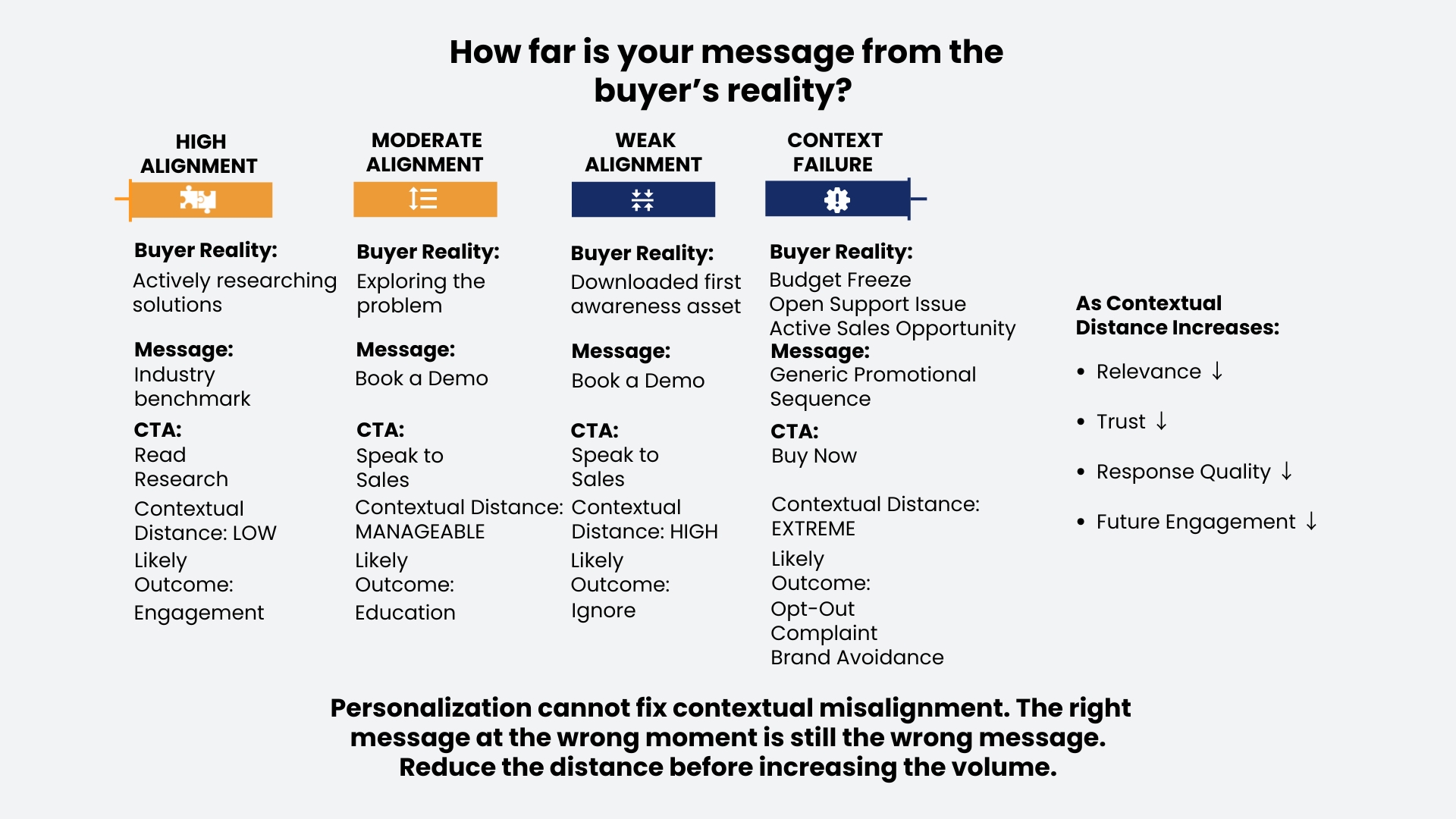
Message-context-fit means asking whether the message is aligned to the buyer’s reality at that particular time. It doesn’t mean his or her role in general or the business sector in which he or she operates. Contextual distance is the distance between the reality of a buyer and where the message assumes he or she is. A company experiencing budget constraints should not be sold products whose growth depends on investment. An organization having just downloaded an initial report should not have an appointment set the following day.
Campaign intent looks at the specific impact this send is meant to achieve. Responses such as “create awareness” or “build engagement” are too general to help make an actual deployment decision. Better examples of intent include: re-engaging fit prospects who are inactive for 90 days, discovering potential buyers on the pricing page for business discussions, or progressing mid-funnel prospects to product comparisons. When the intended impact is impossible to quantify, do not run the campaign.
Why B2B Email Campaigns Fail Before the Send Gate Runs
Typically, underperforming programs don’t falter in the inbox; they falter in the planning stage, with structural issues being built into the program long before the copy is ever written. The problem gets identified based on poor results: low open rates, low reply rates, declining conversions. The team fixes the subject line and tweaks the CTA. But what went wrong was sending the message in the first place.
The most common structural problem is sending the wrong message to the wrong contact at the wrong time in the process. A middle-of-the-funnel nurturing program being sent out to a lead who lost interest three months ago isn’t just ineffective and a waste of budget. It may shut the door on future engagement forever. A competitive displacement campaign sent to companies that have started the purchasing process with a competitor will produce “opt-out” responses from the buyer, who is irritated by the intrusion instead of helped.
The lack of sequencing logic further exacerbates the problem. B2B customers do not follow linear customer journeys. A lead who just downloaded the pricing sheet cannot be sent an awareness email after three days. However, such sequences are usually automated on a timer rather than actions. This serves only one purpose – to signal to the lead that the sender neither knows nor cares about them.
Another, more subtle issue is the mismatch between the context of the message and the situation the buyer is currently in. An email related to quarterly planning sent to a financial services firm in the middle of its fiscal year-end closure will not just be ignored. It will train buyers to ignore all your messages from now on. The personalization of messages with name and job titles does not fix this problem. Contextual accuracy is what makes your message get through to the customer.
To learn more about B2B messaging, click here.
How to Design Your Pre-Send Gate Evaluation Layer
Building an effective Pre-Send Gate means encoding judgment into process. It requires three operational components:
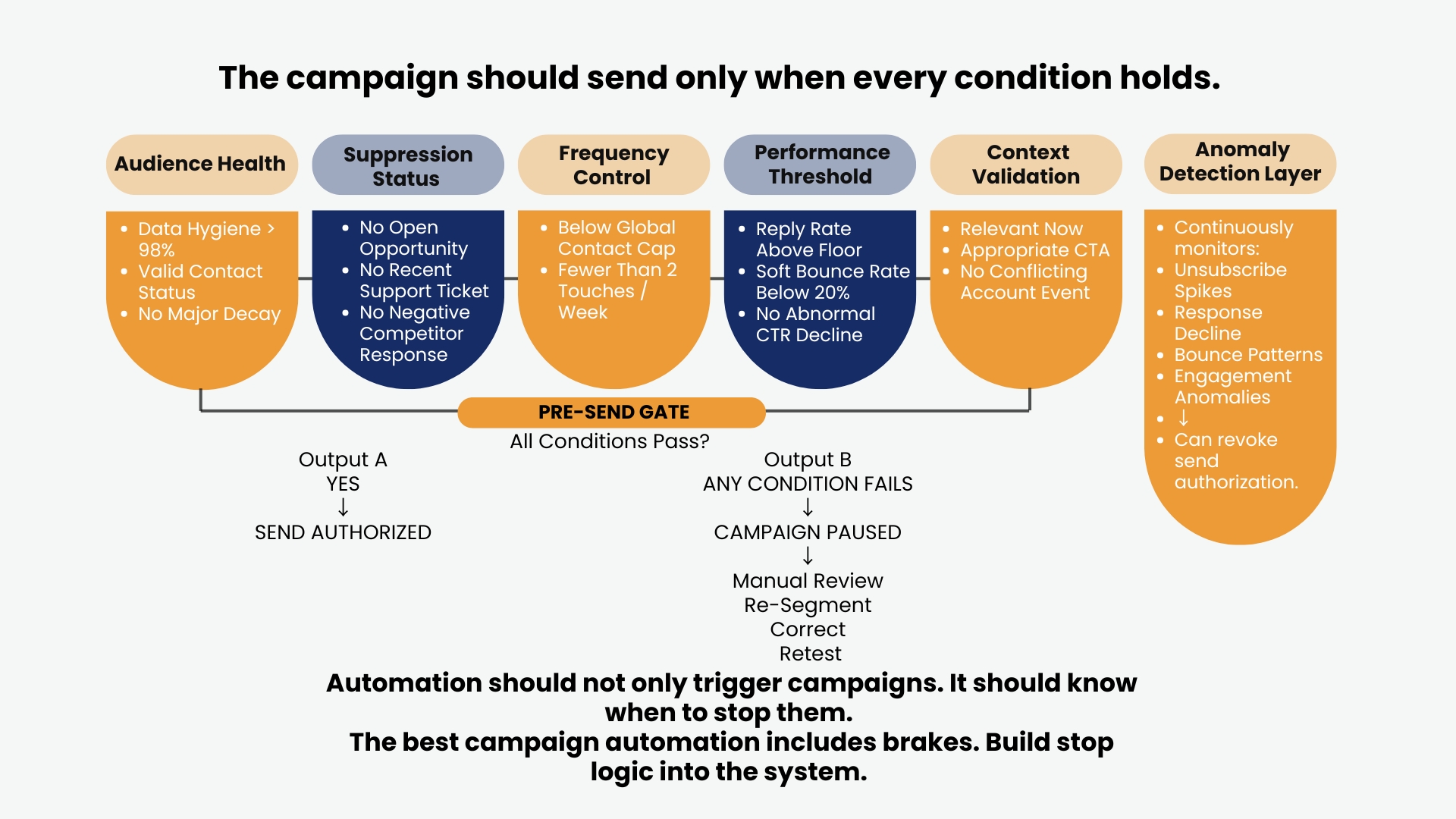
The audience qualifications need to happen in real-time based on the current CRM and marketing automation database at the moment of send, and not when the list was built. These lists get old very quickly. Any contact who hasn’t been engaged across any of the brand’s touchpoints for 180+ days must be explicitly qualified for re-engagement before being added to a new campaign. Those contacts who have an open opportunity, open support ticket, or known relationship with the brand’s executive must also be suppressed. In terms of data quality, if 2% or more fail their basic hygiene checks, then we must pause the entire campaign.
There is no need for contextual alignment scoring to be overly complicated. A well-conducted internal audit process with only three questions is enough to identify cases of misalignment: Would this individual find this email to be relevant based on their business situation now? Does the call-to-action ask them to do something that is within their capabilities now? Is there any account-based signal, such as a corporate news or industry event, that will make this particular message sound inappropriate? The point here is to move the assessment process from inside out to outside in.
The internal approval process must remove any variance without creating friction. In the case of high-volume campaigns, there is a final approval from RevOps or Campaign Ops to confirm that the send has gone through its paces with respect to suppression and qualification logic. This is not a creative review but an operational one.
Automating Pre-Send Gate Stop Conditions at Scale
The most strategic change in campaigning is shifting from manually reviewed stop conditions to automated stop conditions, meaning conditions that require the sends not to be triggered unless certain criteria are fulfilled.
Suppression criteria are at the core of the system. In addition to unsubscribes and hard bounces, suppression criteria should include accounts engaged in sales processes, those who have opened support tickets in the last 30 days, accounts displaced by competitors and reacted negatively to it, and any contact under global frequency cap. Not one contact should be touched more than twice within a week, no matter which department or system initiates the message.
A threshold-based blocking approach adds a quantitative component. In cases where the reply rate is lower than the set floor level from the test segment of the campaign or where the percentage of soft bounces exceeds 20%, the process should be paused and then passed through a manual review. Frequency of the emails sent is a factor responsible for more than 50% of the influence on the deliverability outcomes, as seen in research concerning sender reputation. Sending fewer but targeted emails to more qualified contacts will increase delivery to the inbox.
An anomaly detection approach is what is coming up next. Whenever the previously performing segment starts experiencing high percentages of unsubscribes and abnormal drops in click-through rate, this is an alarm that needs to be spotted ahead of time before any emails in the queue are dispatched. A software company that introduced anomaly detection into its nurture campaigns found out that 14% of its scheduled sends had anomalies. Out of those flagged sends, 60% were fixed before sending and thus prevented degradation in database health by an estimated 12 to 18% during the quarter.
Measuring the Business Impact of Running a Pre-Send Email Gate
It’s difficult to quantify what didn’t happen with demand generation, but that signal does exist.
The reduction of the negative signals is the first sign. Opt-outs, complaints, and remove requests are not vanity metrics. Any rate above 0.1% is treated as a deliverability warning sign by Gmail and Outlook. All of the reputation points hurt add up and make it harder to deliver future emails in the inbox.
Response quality is the second metric. The fewer emails that are sent to disqualified and non-alignment-based contacts result in high-intent responses. Less time is required for sorting through the bad responses received. The resulting conversations are more likely to resemble a genuine buying situation. The signal-to-noise ratio is better in the whole sales pipeline.
The success rate is downstream of conversion. If a demand generation group sends out 30% fewer emails yet increases the MQL-to-SQL conversion rate by 25%, then the demand generation group has not done worse; rather, it has focused on pipeline quality, as opposed to pipeline volume. This is the difference in thinking.
The Pre-Send Gate Checklist: Five Questions Every B2B Campaign Must Answer
Before rolling out any campaign, there should be five key questions that your team can easily answer.
- Why this audience? What is the reason for targeting these people apart from meeting the requirements of ICP?
- Why this message? Why is the content addressing a real pain point, interest, or business situation?
- Why now? Why the need to contact this particular customer through an email at this particular time?
- Why this channel? Why email is the best medium through which we have to reach out to them?
- What will happen next? In case of engagement, what is the next step that the GTM system should take forward?
Without a proper answer to these questions, there’s no hope of saving the campaign through an improved subject line.
The Pre-Send Email Gate Mindset: Why Sending Less Is a Competitive Advantage
For decades now, technology in marketing has been developed in pursuit of a single goal: the capacity of the organization to do more things. More campaigns, more contacts, more automation. With the decrease of the cost of producing content due to AI technology to close to zero, the art of knowing which pieces of communication should be created becomes the rare and valuable resource.
Attention of a potential customer is limited. Those companies that stand out from the crowd and get through to the prospects are those who produce communications with high signal-to-noise ratio, high contextual relevance, and the capacity to terminate irrelevant campaigns.
A Pre-Send Gate will not hinder the process of demand generation; rather, it will channel it and preserve the sender's reputation, minimize waste and ensure that every email being sent deserves to be there. In a market in which trust is the most scarce resource and attention is the most contested, such capability is not a restriction; it's the competitive advantage.
It's not about how well prepared your email is for sending; it's about building the system that decides whether it shouldn't be sent.