
Your B2B messaging dilution problem starts after Series A success. Your pitch deck had three sentences so sharp that investors repeated your differentiation verbatim; that clarity powered your first 50 deals. Two years later, that messaging consistency has fractured across channels, and your GTM narrative edge has blurred. Your LinkedIn ads emphasize something else. SDR sequences pitch a third angle. Sales decks highlight different benefits entirely.
This problem strikes 73% of B2B companies that scale past $50 million ARR, eroding positioning strength by an average of 61%. Growth introduces channel teams, campaign variants, and stakeholder input that fracture your core narrative. What begins as controlled expansion becomes uncoordinated divergence.
The cost shows up in pipeline metrics you may not be connecting. Consideration rates drop. Demo show rates decline. Win rates weaken. Sales cycles extend. The pattern repeats: you're generating more visibility but less velocity because buyers cannot clearly articulate what makes you different.
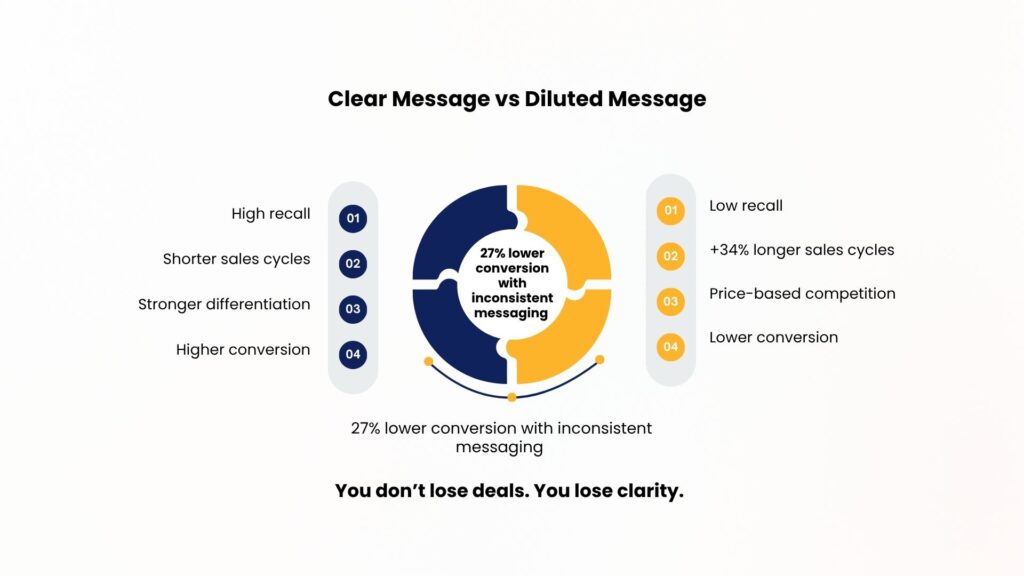
In markets where customers exposed to inconsistent messaging convert 27% less often and take 34% longer to decide, dilution is not a branding issue. It is a revenue constraint disguised as a messaging problem.
What B2B Messaging Dilution Actually Looks Like in GTM Teams
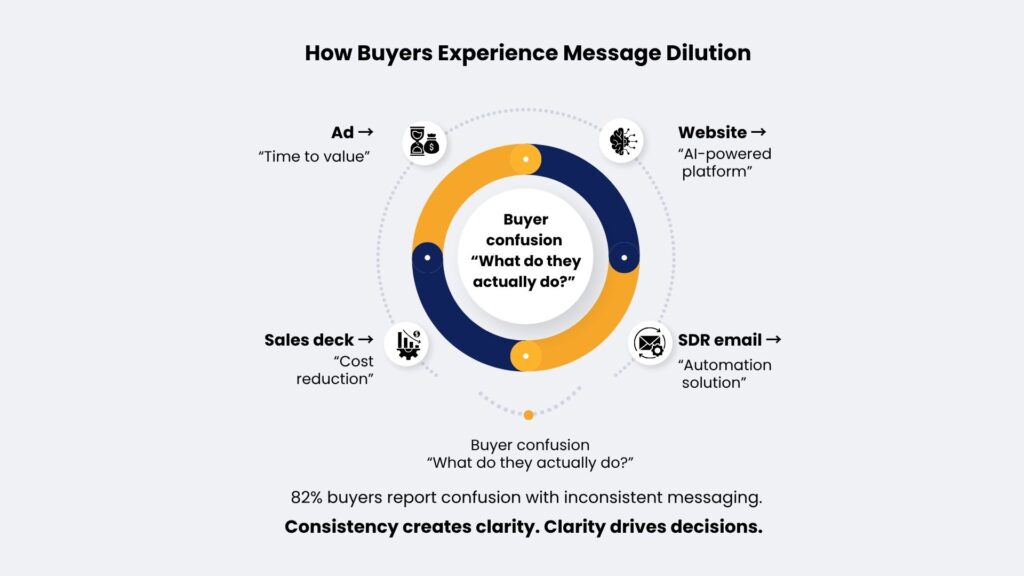
The Many Acceptable Messages That Don’t Reinforce Each Other
Message dilution does not announce itself with obviously bad copy. This B2B messaging dilution manifests as multiple acceptable messages that fail to reinforce each other.
Your VP of Product launches a feature emphasizing enterprise security. Marketing runs ABM campaigns focused on time-to-value. Sales enablement creates decks highlighting cost reduction. Demand generation tests messaging around workflow automation. Each message performs adequately in isolation. Each team has data supporting their angle.
However, when prospects engage with your brand through three points of contact within the space of one week, they are exposed to three separate companies. The CIO looks at your G2 page that focuses on your integration ability, attends your webinar related to your AI-enabled analysis, and gets an SDR email suggesting that you’re a Salesforce competitor. In such situations, buyers can’t make the connection.
How Dilution Compounds and How to Spot It
The dilution compounds through predictable patterns. Your original positioning transforms from "the only platform that unifies customer data without requiring warehouse migration" into "comprehensive customer data solution" on paid search ads. Comprehensive. The adjective companies choose when they have forgotten why customers actually bought.
Symptom checks reveal the gap between what you believe your message is and what buyers actually hear. When asked "What does this company stand for?" in surveys, 82% of buyers exposed to diluted messaging report confusion. The homepage could belong to multiple competitors. Sales teams consistently revise marketing materials before customer meetings. Content generates engagement but weak brand memory.
Why B2B Teams Still Allow GTM Messaging Dilution
The Paradox of Stakeholder Multiplication and Campaign Velocity
The paradox: B2B messaging dilution accelerates fastest in well-resourced, analytically mature organizations.
Stakeholder multiplication creates narrative fragmentation. Your seed-stage company had one person writing all customer-facing content. By Series B, demand generation writes ads, product marketing writes launches, sales engineering writes technical content, customer success writes case studies, and field marketing writes event messaging. Each team optimizes for channel metrics rather than narrative coherence. Companies with more than 10 contributors to messaging show 3.2 times more positioning variations across channels than smaller teams.
Campaign velocity overwhelms governance. When your demand team launches two campaigns monthly instead of one quarterly, there is no time for narrative review. The imperative becomes shipping on schedule, A/B testing creative, and optimizing conversion rates. Message consistency becomes a constraint to avoid rather than a discipline to maintain.
Why Success Masks the Problem Until Pipeline Stalls
Success masks the problem until pipeline stalls. Your funnel grew 40% last quarter even as messaging diverged across channels. Why fix what appears to be working? Because you are measuring reach, not recall. You track how many people saw your message, not whether they remembered it clearly enough to repeat it internally during evaluation. The lag between message dilution and pipeline impact spans six to nine months, the gap between initial awareness and purchase readiness.
The Hidden Pipeline Tax of B2B Messaging Dilution
Differentiation Collapse and Sales Cycle Extension
Inconsistent messaging does not kill deals outright. It taxes every deal with friction you have normalized.
Differentiation collapses when positioning varies by channel. Research shows 68% of B2B buyers cite clearly differentiated positioning as a top-three vendor selection factor. But differentiation requires consistency. When your message shifts based on touchpoint, buyers default to comparing you on the universal constant: price. Dilution does not just weaken your brand. It commoditizes your offering by forcing buyers to evaluate you on the only dimension that stays consistent.
Sales cycles extend when internal champions cannot build coherent narratives. Enterprise deals require selling to six to eight stakeholders before purchase. If your messaging varies, champions run fragmented internal sales processes. The CFO sees your focus on cost savings, CTO believes you have the answers for seamless integrations, and COO recalls something about AI skills. Without a consistent positioning strategy, transactions that should be closed within three months now take five, with 23% more transactions stalling at the last minute.
The Dark Funnel Cost of Fragmented Brand Recall
Brand recall weakens in dark funnel channels you cannot track. Most buyer research happens in Slack discussions, internal documents, and peer conversations. When someone asks "What does this company do?" the answer depends on which touchpoint that person remembers. Inconsistent messaging means you compete against your own narrative variations for mental real estate.
You can read more here.
Building a B2B Messaging Framework That Prevents Dilution
The Three-Tier Message Hierarchy and Narrative Ownership
The answer is neither a by-committee messaging strategy nor an overmanaged brand that delays launches. It is a process of architecture – crafting a structure for your narrative that allows for variation without dilution.
Create a tiered message system consisting of three parts. The 20-word narrative you deliver tells your audience who you serve, how you transform their world, and why it matters. This will never change. The supporting messages rephrase the narrative for specific personas or applications, preserving its core insight. The contextual messages give creative freedom and experimentation within channels but always refer back to the supporting messages.
For example, a key message in a revenue intelligence solution is: "Helping GTM teams prioritize deals that will actually close through the buyer engagement insights missed by traditional CRMs." Supporting messages focus on prioritizing deals for sales leadership, accurate forecasting for RevOps, or pipeline visibility for executives. Contextual messaging experiments with various creative approaches for LinkedIn or Google Ads. However, an ad with key messages about "AI-powered insights" not related to deal prioritization or buyer engagement insights goes against this hierarchy.
Assign narrative ownership, not just approval authority. Messaging dilutes when no single role treats narrative coherence as their primary success metric. This is not about centralizing content creation. It is about centralizing narrative architecture. One leader, often senior product marketing or a VP-level brand strategist, owns the message framework and has authority to flag dilution before launch.
Instrumenting for Recall Instead of Reach
Instrument for recall, not just reach. Add one question to win/loss interviews: "How would you describe our platform to a colleague?" If their answer does not align with your core narrative, you have message dilution regardless of impression metrics. Track positioning recall as rigorously as you track MQLs.
Scaling B2B Messaging Without Dilution: Channel Playbooks
Channel Playbooks and Continuous Coherence Audits
Growth should amplify your message, not dilute it. Companies that scale messaging successfully treat variation as controlled adaptation, not unrestricted experimentation.
Create channel playbooks that define how core narratives translate to specific contexts. A brand guide says "use these colors and do not change the tagline." A channel playbook defines which supporting messages work for which contexts, how to adapt the core narrative for different buyer stages, and what variations have tested successfully. When demand generation launches campaigns, they select from pre-tested message variations that ladder to the core rather than starting from scratch.
Run continuous message coherence audits. Monthly, pull every active customer-facing asset: ads, website copy, sales decks, email sequences, and case studies. Map each to your message hierarchy. Flag outliers. The discipline is not about limiting creativity. It is about making dilution visible before it compounds across quarters.
Testing Variations Within the Framework, Not Against It
Test message variations within the framework. Your demand team should test different hooks, pain points, and creative approaches. But constrain the test space: you are testing how to best communicate your core differentiation, not whether to maintain it. A/B test subject lines, value propositions, or calls to action. Do not A/B test what your company fundamentally does.
When Visibility Fails to Create Pipeline
Why Exposure Metrics Mask Message Dilution
Traditional demand generation optimizes for impressions, clicks, and conversions. But those metrics measure exposure, not understanding. You can reach 10,000 target accounts and still fail to build pipeline if none of them clearly understand what you do differently.
Message dilution explains why some companies generate massive top-of-funnel volume that never converts. Why sales complains that marketing leads do not understand the product. Why win rates hold but deal velocity slows. The pipeline impact is not binary. It is a drag coefficient that compounds across every stage of the buyer journey.
At ProspectVine, we see this pattern consistently: companies that maintain narrative discipline through scale create compounding pipeline advantages. Buyers encounter the brand five times and hear one coherent story told five ways. That repetition builds the recall that drives consideration set inclusion, shortens sales cycles, and increases win rates.
The Choice Between Erosion and Amplification at Scale
The question is not whether your messaging will face pressure to dilute as you scale. It will. The question is whether you have built the systems to preserve signal while expanding reach, or whether you are normalizing the slow erosion of the one asset that separated you from everyone else making similar promises.
Your original pitch deck had power because it had clarity. Scaling should not change that equation. It should prove you know the difference between visibility and memorability. Growth does not mean getting louder. It means getting clearer and more consistent. When your message is sharp, every campaign amplifies it. When your message is diluted, every campaign weakens it further.