
Your marketing dashboard is not lying, it is omitting. Every week, qualified buyers move through the dark funnel in their B2B buying journey: visiting your pricing page incognito, evaluating competitors via AI tools, and building consensus in private Slack groups your CRM will never see. By the time they fill out a form, the shortlist is already set.
Gartner research is specific on this: in complex B2B purchases, buyers spend just 17% of their total journey in direct conversations with vendors. The rest happens in spaces traditional tracking was never designed to see.
This hidden arena is the Dark Funnel. And for most B2B revenue teams, it is where pipeline is won or lost before they ever know a deal exists.
What the Dark Funnel Actually Is (and Why It Controls Your B2B Pipeline)
The Dark Funnel is not a technology failure. It is a behavioral reality.
Today’s B2B buyers are self-directing and distrustful of controlled content. Researchers conduct studies in places that cannot be monitored easily: closed Slack and Discord groups where professionals discuss real-world experiences with vendors, LinkedIn streams where executives read thought leadership content without clicking or revealing their identities, and research using AI intermediaries where buyers analyze competition with large language models without using any form of search.
Analytics capture only about 25% to 30% of the buyer’s journey. The remaining 70% to 75% is conducted via these untrackable channels.
Three structural shifts are accelerating this problem. Privacy-first browsing has degraded traditional attribution significantly as ad blockers and cookie deprecation push more behavior into the anonymous web. Peer-led discovery has replaced search-led discovery for a large segment of the market. And multi-threaded buying committees, averaging six to ten stakeholders per purchase, mean that even when one person converts on a form, the rest of the committee remains invisible.
The result is a dangerous illusion. Tracked activity does not equal buyer activity. It represents a fraction of the actual decision process.
Signal vs. Noise: Separating Intent from Activity
The real demand generation problem in a dark funnel B2B era is signal extraction, not data scarcity.
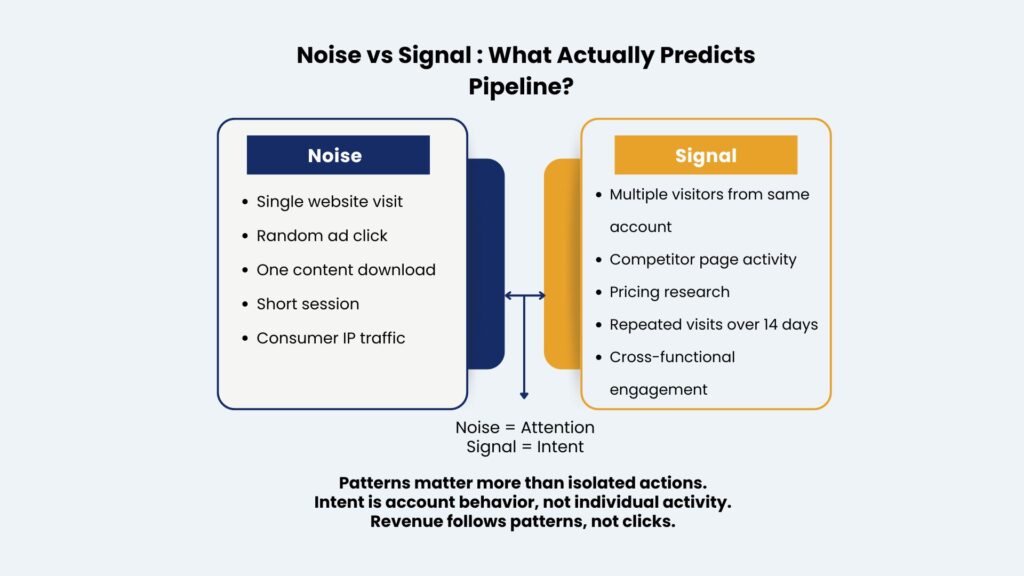
Most behavioral data reflects attention, not intent. Page views, impressions, and session counts indicate that someone noticed something. They do not indicate that a company is moving toward a purchase.
Intent looks different. It is an account-level cluster of activity: multiple employees from a single enterprise domain reading a case study, reviewing security documentation, and visiting a competitor comparison page across a two-week window. No single action is definitive. The pattern is.
This is where the distinction between signal and noise becomes a revenue driver. A spike in random, single-page visits from consumer IP addresses is noise. The network team from the same financial institution spent hours on API documentation across 14 days, creating a high-fidelity intent signal, even if not one form was submitted.
The solution lies in using intent analysis software that correlates first party behavior data like website visitor records anonymized via reverse IP lookups with third-party networks measuring content consumption on the open web. The result will not be a lead, but an ordered list of company accounts based on behavioral data: who visited, what did they research, how deep was their involvement, and how did it change over time.
A mid-sized SaaS company with 10,000 website visitors per month successfully identified 340 companies in the market compared to just 80 found with standard tracking methods, despite only tracking 12 percent of visitors. They secured deals worth many times more than those generated through standard tracking methods.
Dark Funnel Presence In Your B2B Journey: The Recall Advantage Most Teams Miss
The vast majority of demand generation campaigns optimize for engagement in the moment: CTR, form fills, demo requests. There is something that is being missed with regard to how the actual process of B2B buying takes place.
A potential customer who thinks back to you six months from now when a problem occurs could very well be worth much more money than one who clicks your sponsored post right now. Recognition, created through repetition, becomes power at the moment of purchase, not at the moment of impression.
It is not about driving clicks; it is about building recognition by the accounts most likely to be part of your market. Thought leadership that is absorbed on LinkedIn without clicking is preference-building. Community recommendations create shortlists. The companies that do the most work to create recognition in the places where their buyers learn and not just convert become part of shortlists others never even know about.
Programmatic as an Activation Tool, Not a Reach Tool
Once you have identified the B2B accounts demonstrating dark funnel intent, the next strategic move is using programmatic advertising to activate that intent, not to generate broad reach.
Intent-activation programmatic logic differs from traditional display logic. The objective is to serve decision-stage content to a known-but-anonymous account at precisely the moment they are evaluating your category, so that when they eventually raise their hand, your brand is already associated with a solution.
In practice: your intent data identifies 40 accounts showing elevated research activity in a given week. No form fills, no CRM records, but their behavioral pattern indicates active evaluation. Those accounts are loaded into a programmatic campaign using IP-targeted audience segments, and served content that matches their decision stage. Competitive comparison guides for accounts browsing differentiation pages. ROI calculators for accounts on pricing. Implementation case studies for accounts on integration documentation.
Your brand becomes familiar during the highest-intent phase of the research process, when shortlists are forming. And when buying committee members do eventually click through, they arrive pre-educated rather than cold.
A budget deployed against broad ICP impressions produces vanity metrics. The same budget deployed against high-intent accounts with stage-matched creative produces pipeline.
From Dark Funnel Signals to Precision Outreach That Converts
Intent data without an activation playbook is expensive analytics. The most commercially critical step is converting behavioral intelligence into outreach that converts without feeling intrusive.
The core principle: intent signals should change your sequencing logic, not just your timing.
When an account shows concentrated activity on pricing and competitor comparison pages, context-informed outreach works far better than a generic sequence. Referencing an observed challenge among similar companies, or a recent development relevant to their likely use case, closes the gap between cold and contextual.
Where you get intent data that identifies several people from an organization across different parts of your site, you have yourself a formed committee. Lead nurturing should begin by starting with the individual who is more likely to convert into revenue and addressing the need for evaluation without giving away the fact that you have been watching.
The fact that the cold lead has shown renewed activity after months without communication means that they are now a reengaged lead. A timely approach mentioning how their interest in a certain capability can be satisfied along with a new product offering works better than a reengagement sequence.
As a guidepost for context, intent data makes lead nurturing seem natural.
A Framework for B2B Dark Funnel Capture
Organizations that operationalize dark funnel intelligence at scale share a common structure across four components.
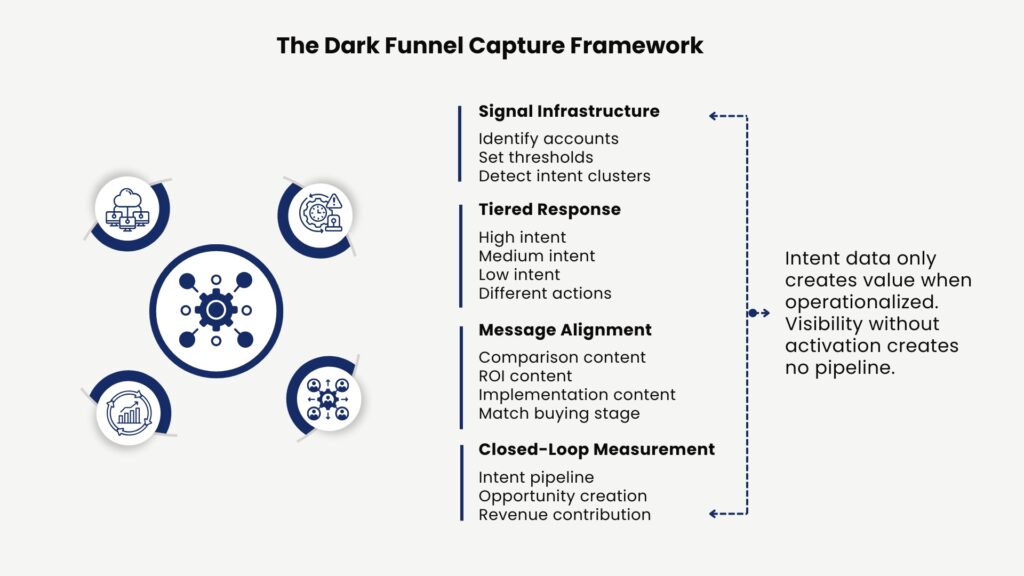
Signal Infrastruture
Do not deploy intent data on contacts; do so on accounts only. Accounts are signal, contacts are noise. Apply threshold requirements prior to activation, such as 10+ visits within 14 days, or visits to three or more content categories.
Tiered Response Strategies
Not every intent signal demands a prompt SDR response. High intent triggers an instant personalized sequence. Medium intent triggers a programmatic nurturing workflow. Low intent triggers automated remarketing campaigns.
You can read more about the sales handoff process here.
Message Alignment
Programmatic creative and email messaging must reflect the buying stage implied by the intent signal. A company on comparison content needs differentiation messaging. A company on pricing needs ROI validation.
Closed-Loop Measurement
Track pipeline from intent-activated accounts separately from standard inbound. Over time, this produces a comparison dataset that grounds budget decisions in revenue data rather than activity metrics.
The Competitive Advantage Is Epistemic
The companies that will dominate pipeline generation over the next three years are not necessarily those with the largest advertising budgets. They are the ones that know more about their buyers’ state of mind, earlier in the journey, than their competitors do.
The Dark Funnel is not a problem to solve, but a permanent feature of how sophisticated B2B buyers make decisions in an era of information abundance and vendor skepticism. Your buyers are moving through it right now. The question is whether you have the infrastructure to see them.
Visibility is not pipeline. But intent intelligence, programmatically activated and operationally embedded in your sales motion, converts invisible demand into traceable, closeable revenue.
The buyer’s journey did not start when they filled out a form. It started weeks ago, in a Slack channel or peer conversation you will never see. Capturing intent before the click does not require seeing everything. It requires knowing enough, early enough, to be the brand they think of when they finally step into the light.