AI-Powered Telemarketing: The B2B Playbook for Signal-Based Outbound

AI-powered telemarketing is no longer a contradiction in terms, it is the competitive edge separating growing B2B pipelines from stalled ones. Your meetings are up, your dials are up, but conversion has flatlined. The issue is not execution. It is signal.
Today’s B2B buyers are doing a great deal of their purchasing decision before they even speak to someone from your company. Gartner estimates that only 17% of the actual B2B buying process involves direct interaction with a salesperson. The rest is self-research, silent comparisons and creating internal consensus. By the time your SDR calls the buyer, they may have already shortlisted other suppliers, completed their requirements and identified objections they have to your products.
However, the majority of outbound strategies continue as if nothing like this ever took place.
The response rate to emails has sunk to as low as 1% to 5% due to email automation. The success rate for cold calling is at an all-time low of 2.3%. Volume doesn’t matter anymore. The companies generating their pipeline are not those making the most number of calls. Instead, it is those making the right calls to the right prospects at the right time.
This is the new face of telemarketing.
Why AI-Powered Telemarketing Replaces Schedule-Based Cold Calling
Moving From Assumption to Intent
Classic telemarketing assumes all accounts on the ICP list are equally ready to purchase. This assumption is the root cause of outbound ineffectiveness.
Intent-driven outreach eliminates assumptions by focusing on actual indicators. Platforms like Bombora, 6sense, and G2 monitor behaviors associated with certain groups within third-party research forums, review websites, and category-specific information. The moment a particular account demonstrates behavior linked to your offering, you know there is a live purchasing window at play.
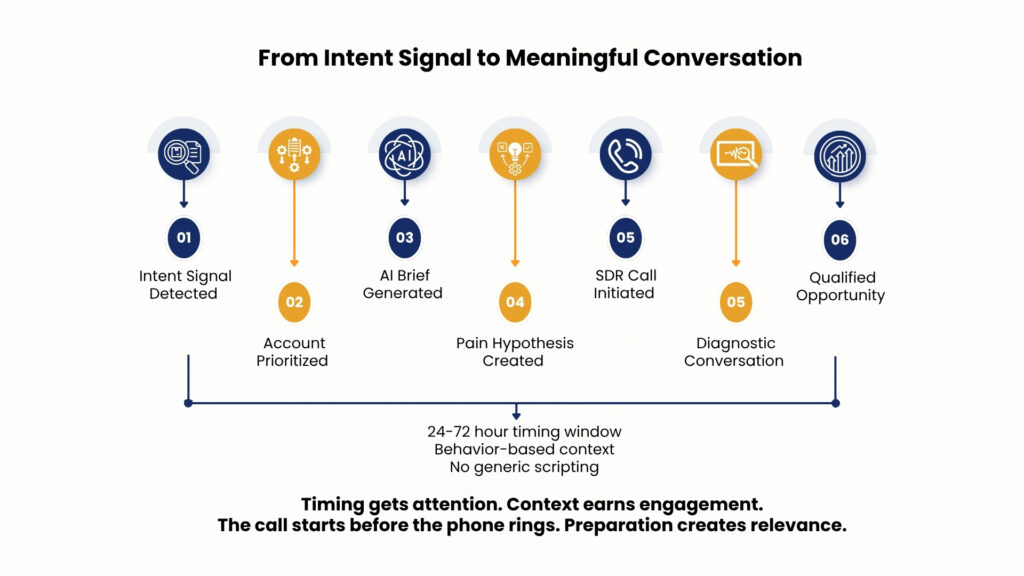
This means the time sensitivity aspect has become much more clear. Studies have revealed the best timing for reaching potential clients based on their intent signal – this period of time occurs 24 to 72 hours from receipt of said intent signal. Contact before this window opens, and the need has yet to fully emerge. Contact after, and the decision-making process has likely moved past the opportunity point. But artificial intelligence tools can now flag accounts in this timeframe to route to an SDR’s sales queue.
This intent-driven shift is what defines AI-powered telemarketing from its predecessor.
The Diagnostic Conversation and Results
As a result, this changes the way conversations start completely. When an SDR makes a call to the CFO’s team and knows they have been consuming content on financial close automation, he is no longer going to ask, “Is this a good time to talk?” Instead, the SDR provides what is called a “diagnostic,” such as, “We help finance teams just like yours and those in your situation who frequently encounter problems when trying to reconcile their accounts and grow beyond a specific amount of transaction activity. Does that match your current situation?” Instead of being a sales pitch, this is simply presenting a relevant hypothesis. This gives the SDR the next 90 seconds of the call to maintain the level of relevance.
Companies that shifted from purchasing demographic lists to using a signals-based approach have reported a 40% decline in the amount of phone calls they make while simultaneously increasing the amount of scheduled meetings they have by 28%.
The Pre-Call Intelligence Brief: How AI-Powered Telemarketing Prepares SDRs
Timing gets them on the phone. Context keeps them there. AI-powered telemarketing works because context follows timing.
Typically, SDRs get a list with the contact’s name, company name, and their LinkedIn profile. What they don’t usually have is context in the form of an overall synthesized understanding of what is currently going on with the account. The lack of which results in failure to hold the prospect’s attention for 30 seconds.
AI-driven pre-call brief provides that context. Prior to the call, an advanced intelligence system gathers information in terms of intent signals clusters, website activity, technographic data, media consumption habits, and corporate news events into one concise briefing. In other words, it reduces the time required to research the potential client from 15 minutes to less than 1 minute. Let’s see how this works in practice.
Without the brief, the rep makes a general spiel on data latency reduction. But with the brief, the rep starts the call knowing that the prospect’s account recently implemented an open-source analytics database that suffers from certain scaling issues under high transaction loads. The call starts out with identifying the current pain point, rather than pitching a solution.
Prospects react more positively to the latter option because it shows them that you have done your homework before bothering them with your call. This isn’t a software sell anymore. Instead, it shows your understanding of their environment before asking for any of their valuable time.
You can read more about building the credibility before the call here.
That’s the way ProspectVine arms their callers: every call needs to start with a testable theory regarding the pain point of their prospects, using behavioral data, not just personas. This approach turns the callers into consultants, not telemarketers.
Intent-Based Qualification: The 50% Pipeline Standard in B2B Outbound
The worst metric of all in traditional outbound is meetings booked in absolute numbers.
When SDRs are paid to set appointments, they go and do just that. The end result of that behavior is a pipeline filled with leads who are not really evaluating anything. AE capacity is wasted talking to low-intent prospects. Conversion ratios plummet. So does morale.
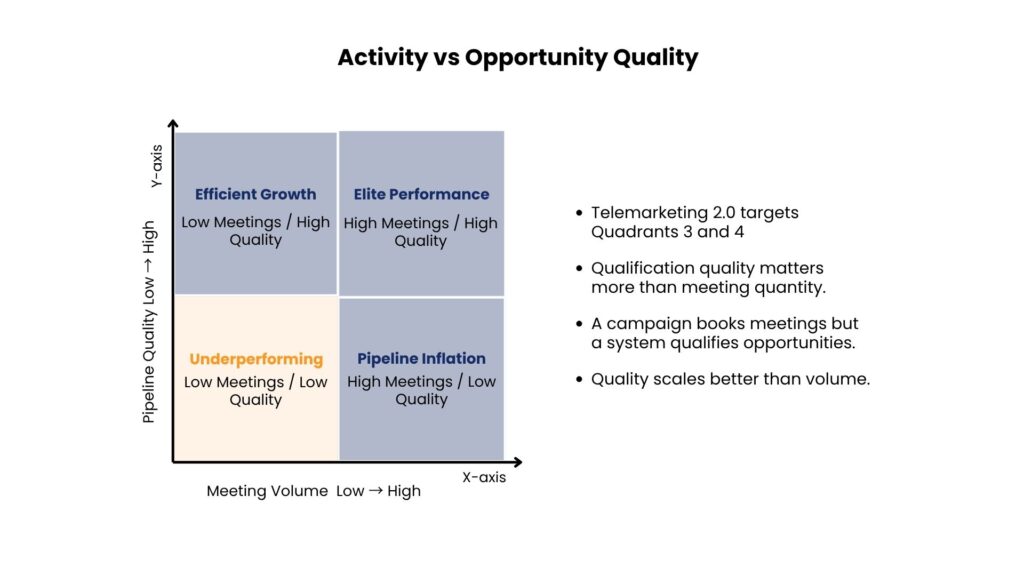
AI-powered telemarketing reframes qualification from BANT to probabilistic scoring. Rather than asking whether a call resulted in setting an appointment, Telemarketing 2.0 asks whether there is at least a 50% chance of moving an account forward into pipeline.
This probability threshold demands a new kind of qualification process altogether. BANT qualification is one option, but it is binary. Probabilistic scoring using artificial intelligence takes it a step further by taking the behavioral and firmographic traits that predict future deal closure and applying weights to them in scoring. RevOps organizations can learn, for example, that leads who regularly visit commercial pages, have multiple visitors from their own companies within 14 days, and are hiring employees in related roles enter a high-velocity sales process.
This was exactly how one enterprise software firm transformed its qualification approach based on this principle. The reps would have an organized 10-minute pre-qualify chat prior to booking any meeting with a lead using diagnostic questions that aligned with the signals identified by the AI model that predicted success. The result? A 35% decrease in meeting volume, 22% increase in qualified opportunities, 18% boost in average deal size, and 15 percentage point lift in close rate in Q1 following implementation.
This is a case of systems versus campaigns. A campaign books meetings while a system qualifies them. This is exactly the difference that separates qualified pipelines from inflated ones in your CRM.
Metrics That Matter: Measuring AI-Powered Telemarketing Performance
If you measure your telemarketing program using dials, connects, and booked meetings, then you are measuring activity. Not progress.
There are two indicators, however, that better predict the status of your pipeline.
First is average call duration. The call that lasts 90 seconds and the prospect is speaking in monosyllables does not provide any meaningful information. The one that lasts 12 minutes with many follow-up questions about implementation, integration, and pricing indicates that they have moved into the evaluation stage. Research done by conversation intelligence companies demonstrates that calls over 15 minutes last more often lead to scheduling a second appointment, compared to calls that lasted fewer than five minutes. Average duration is no vanity. It is a predictor of engagement.
Second is conversion progression rate. It measures how many percent of calls result in advancing to the next stage of the process. Does the call end up resulting in an evaluation? Was there a stakeholder meeting following the evaluation? Is there a legal review of the proposal? Measuring the progression rate for each call, by type, by messaging theme provides the insight needed to continue to optimize the telemarketing campaign.
An example of a SaaS firm operating in the domain of HR technology incorporated a conversion progression dashboard and realized within two quarters that calls initiated using an operations-based opening resulted in a 40% higher conversion rate compared to those initiated on a product basis. It was just one of the observations made possible through data analytics and not through guesswork.
That is the difference between feedback and a black box.
Building a Signal-Based Outbound Motion: The Telemarketing 2.0 Framework
Building an AI-powered telemarketing motion requires coordination at three levels. The first is having the right data stack. You need to stitch your first-party data stack (CRM and marketing automation) with third-party intent platforms for account intelligence. Absent a proper architecture, signal orchestration is impossible and briefings lose relevance.
Then, create automation scoring that will automatically add accounts into your SDR queue when a relevant intent cluster is found. The idea here is to ensure that reps don’t have to manually prioritize their workload but focus on conversations and not research.
Lastly, change the training and incentive structures. Every rep needs to have an actionable hypothesis when dialing into a prospect. This means having an understanding of the pain point they will address.
The Competitive Reality
Visibility is not a pipeline. Every CMO is publishing their thoughts and engaging in ABM initiatives and buyer retargeting efforts on LinkedIn and display. Visibility is abundant in a crowded market devoid of trust.
Human interaction is unique in its ability to connect and relate to another being. It has the ability to hear and understand hesitation and the subtext behind statements such as, “We are looking at several options.” It cannot be replicated digitally.
AI does not replace the ability, but rather helps to facilitate it. Intent-based data alone doesn’t sell solutions. Representatives who join a conversation with the understanding of what issue they are trying to solve for and when that should occur do.
The companies that are going to emerge victorious will not be the ones with the greatest number of automations or the highest call volume. The companies that value their telemarketing as a premium channel that targets only those accounts which show signs of serious business interest, utilizing callers who have knowledge.
The winners will treat AI-powered telemarketing as a precision channel, not a volume play.