
The B2B Pipeline Problem You're Not Seeing: Timing, Not Engagement
Your lead scoring model fires. A prospect has downloaded three assets, attended a webinar, and visited your pricing page twice. Your SDR reaches out. Silence. Eight months later, that account closes with a competitor. This is the defining challenge of B2B demand generation: most pipelines are full of engaged leads, but very few are decision-ready. The gap between familiarity and buying intent is costing you deals, not because of your message or product, but because of your timing
This is the hidden leak in most B2B pipelines. Marketing celebrates engagement while Sales chases MQLs. Yet conversion rates stay flat, forecast accuracy drifts, and pipeline keeps thinning. The root cause is a fundamental misread of what a "good lead" actually signals.
Familiarity is not readiness. A buyer can know your brand and consume your content for months while remaining completely unable to buy. They are curious, not committed. The moment you treat curiosity as intent, you misallocate your most expensive resource: sales time.
The organizations winning in B2B demand generation are not producing more content or running longer sequences. They are building systems that detect when a buyer transitions from passive to active, and responding before that window closes.
Why Most B2B Leads Aren't Bad; They're Just Not Decision-Ready Yet
Traditional demand generation was built on a logical but flawed assumption: more engagement means closer to purchase. A buyer who downloads five assets must be "hotter" than one who has downloaded one.
Engagement often reflects exploration, not evaluation. B2B buyers spend six to twelve months doing research even before any buying activity can take place. Buyers attend webinars, conduct trend reports, and even benchmark vendors without any plans to buy. This is when your scorecard cannot tell apart an analyst researching for the background information from a VP reviewing tools to solve an urgent issue with the company’s infrastructure. One of them will not take your call for another year.
According to a 2024 study by Wynter of 1,400 B2B decision-makers, 58% of them had interacted with the vendor's content at least three to five months before reaching the decision-making stage, and 72% of these buyers did not turn into customers for the vendor they contacted too soon. The expense is significant because the pipeline ages, the forecast becomes distorted, and buyers feel tired of being contacted too soon.
The insight is simple, but most GTM systems are not built around it. The best lead is not the one who knows you best. It is the one who needs you right now.
What Triggers a B2B Decision Window (And Why Your MQL Model Misses It)
Decision-ready B2B leads don't emerge randomly, they're produced by specific internal and external triggers that shift a buyer from passive monitoring to active evaluation. None of these triggers appear in a standard lead score.
Budget triggers are the most immediate. Renewal of a contract, budget transfer events, cost savings initiatives, or expansion funding all generate urgency due to deadline pressure, spurring buyers to purchase quickly. For example, a company buyer whose existing platform contract expires in three months is inherently working against an urgent deadline that engagement cannot mimic.
Then there are internal triggers, which are just as important and can happen very quickly. New CXO hires are always an easy trigger. New CXO hires are always going to make some major technological decisions in the first 90 to 180 days on the job. The last thing they have done is select the stack of technologies being used. Usually, when they arrive, they change that stack. Similar triggers include organizational restructuring events, teams expanding, and changes in strategic direction. The lead who has been inactive for six months can suddenly become very active because something happened at work, and you had nothing to do with it.
External forces complete the picture. Changes in regulation, new competitors, and economic trends will sometimes transform a low priority project into an emergency. Where urgency hits externally, speed becomes paramount. This is one reason some transactions seem to come out of nowhere even though there was no activity for years before.
The crucial point: Urgency is something you cannot create via marketing. You can only react to it.
Why Traditional Lead Scoring Is Blind to Buyer Timing
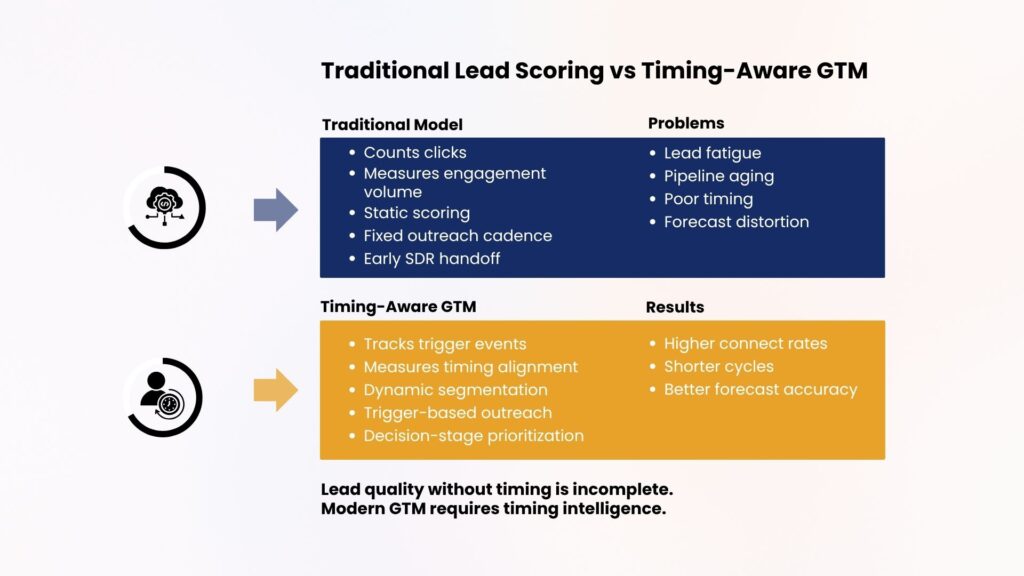
Most MQL frameworks reward behavioral volume. Email clicks, page views, content downloads, webinar registrations. These metrics are easy to capture and satisfying to report, but they measure familiarity, not readiness.
The deeper problem is that these models are static in a buying environment that is dynamic. A lead is scored, passed to sales, worked, and then recycled or abandoned. There is rarely a mechanism to re-evaluate that lead when new context changes their readiness: a leadership change, a contract renewal approaching, a competitive product launch. The buyer's situation evolves. The lead model does not.
Consider the practical consequence. A target account scores 65 points from three content downloads and two webinar registrations. The SDR reaches out, gets no response, and marks the lead as not ready. Nine months later, that same account is actively shortlisting vendors. Your system has already deprioritized them. Worse, your team burned that contact's attention with a sequence that arrived six months before they had internal alignment to act.
Lead scoring without a timing layer is a photograph of a moving target. You are qualifying buyers based on who they were, not who they are today.
How to Read B2B Buyer Timing Signals That Indicate Active Evaluation
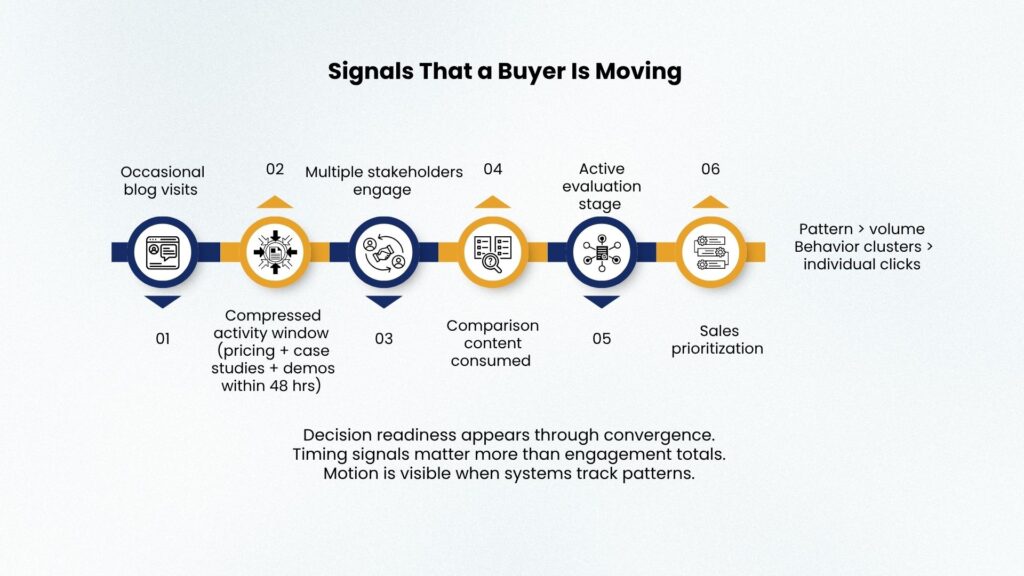
The shift from interest to active evaluation is detectable, but only if your systems are built to look for the right patterns.
The first signal is compression and cross-asset action. If the prospect is reading your blog post once a week, then the individual is exploring. If the prospect visits your pricing page, goes through two customer success stories, and views your product demo within a span of 48 hours, the prospect is evaluating.
The second signal is multi-stakeholder activity. B2B purchases involve an average of six to ten stakeholders. When a single person engages with your content, that is interest. When a director of demand generation, a VP of RevOps, and a technical lead from the same organization all access related assets within a short window, a buying committee is forming. The buying process has moved from individual curiosity to internal alignment.
The third signal involves migration to content types. Prospects that have not actively shown interest will consume educational material like industry trends, thought leadership, and an introduction framework. Buyers who are analyzing will consume content related to technical specifications, pricing calculators, competitor comparisons, and other implementation material that shifts them from “what is this” to “can this work for us.”
None of these signals require guesswork. They require systems designed to track pattern, not just volume.
Building a Timing-Aware Demand Engine
Fixing the conversion gap means changing how you segment, route, and measure. The goal is to build a system that finds decision-ready leads at the moment they enter an active buying window.
Replace binary MQL qualification with stage-based segmentation. Buyers move through recognizable stages: awareness, exploration, active evaluation, decision. Each stage requires different treatment. Awareness-stage leads need educational nurture. Leads showing convergent signals in the evaluation stage need immediate sales prioritization, regardless of their historical score. The handoff criteria should be based on decision proximity, not touchpoint accumulation.
Shift from sequence-based outreach to trigger-based outreach. Fixed cadences assume timing can be manufactured by persistence. It cannot. Systems based on triggers initiate outreach once the buyer gives off signs that they are ready to engage: increased account activity, indication of leadership changes, approaching contract expiration in 90 days, etc. Once such a trigger is hit, an SDR touch happens within hours, not days. This makes a huge difference in connection rates.
Align marketing and sales on a shared definition of readiness. Marketing cannot generate leads and hand them off based on engagement scores alone. Marketing must provide timing context: what this account has researched, where they appear to be in the buying process, and why the moment matters now. A RevOps team that restructured handoff criteria to include a detected leadership change or a contract renewal within 120 days saw SDR connect rates improve by 40% within two quarters. Volume did not change. Timing did.
Metrics That Measure Buyer Timing, Not Just Activity Volume
Pipeline health measured only in MQL volume obscures the timing problem entirely. Timing-aware systems require different metrics.
Time-to-conversion reveals how long it takes from first meaningful signal to closed deal. Leads with strong timing alignment convert significantly faster. If they do not, your timing signals need recalibration.
Lead aging patterns expose where timing mismatches accumulate. A high proportion of pipeline that has been in-funnel longer than your average sales cycle is not a sales execution problem. It is a qualification timing problem. Those leads were captured too early and are waiting for a decision window that has not yet opened.
Conversion velocity by timing alignment is the most revealing metric. Segment your closed-won deals by how many timing signals were present at the point of initial outreach. Deals where sales engaged during an active decision window consistently show higher win rates, shorter cycles, and larger average deal sizes. That comparison makes the case for restructuring qualification criteria more clearly than any engagement report.
Buyer Timing Is the Variable Most GTM Systems Ignore
Visibility does not create pipeline. Engagement does not guarantee urgency. Familiarity does not equal readiness.
The strongest demand generation systems understand what most GTM models miss: buyers convert when business conditions create pressure for action, not simply because they recognize a brand. Recall still matters. Long-term brand familiarity creates future opportunity. But timing determines when that opportunity becomes revenue. You can read more about it here.
The organizations that will build efficient, predictable pipeline are those that combine both: brand memory that sustains familiarity over time, and timing intelligence that identifies the moment a buyer crosses from interested to in motion.
Recall beats reach. Signal beats noise. Systems beat campaigns.
That is how you build a pipeline of decision-ready B2B leads instead of a backlog of informed but inactive ones.