B2B Sales Handoffs: Why the First Conversation Matters Most

Your pipeline does not have a lead problem; it has a conversation problem. And most of that problem lives in the B2B sales handoff process, the moment a qualified lead becomes a real person on a real call.
Revenue teams in today’s B2B environment have worked for years on increasing their volumes – more leads, more touches, more sequences. The dashboards read higher numbers of MQLs. Intent indicators pop. Demos get booked. And despite all that work, win rates remain the same, the sales cycle doesn’t decrease, and prospects start tuning out when they were about to buy.
What’s even more unsettling is that you can qualify your ideal lead perfectly and still lose the deal within the first 90 seconds of your discovery call. Not because the product was not a good fit, not because the salesperson said anything inappropriate. But because the conversation seemed to be starting from scratch.
As reported by Gartner, 77% of B2B customers feel that the last sale they made was extremely complicated. One of the main reasons why sales become complicated is having to explain themselves all over again each time they interact with a vendor. In a recent 2025 RevOps benchmark of 42 B2B businesses, 63% of buyers stated that their first conversation felt like starting from scratch despite their interaction with the company on many occasions before. Out of all lost sales, 47% lost because of poor quality of the first conversation.
This is the pipeline leak that the dashboards do not account for.
Why the B2B Sales Handoff Leaves First Calls Starting Cold
It’s easy to map the structural process. The buyer downloads a competitive comparison guide, joins a webinar about pipeline attribution, reads three articles about revenue operations, and submits a demo request form. Marketing feels victorious. The prospect is handed off to an SDR.
The SDR logs into their CRM. They see a first name, a company name, a title, the lead source marked “Website,” and a lead score. They dial up and ask, “Well, can you share some information about what problem you’re looking to solve?”
The prospect who has been interacting with your content for the past six weeks is starting from zero.
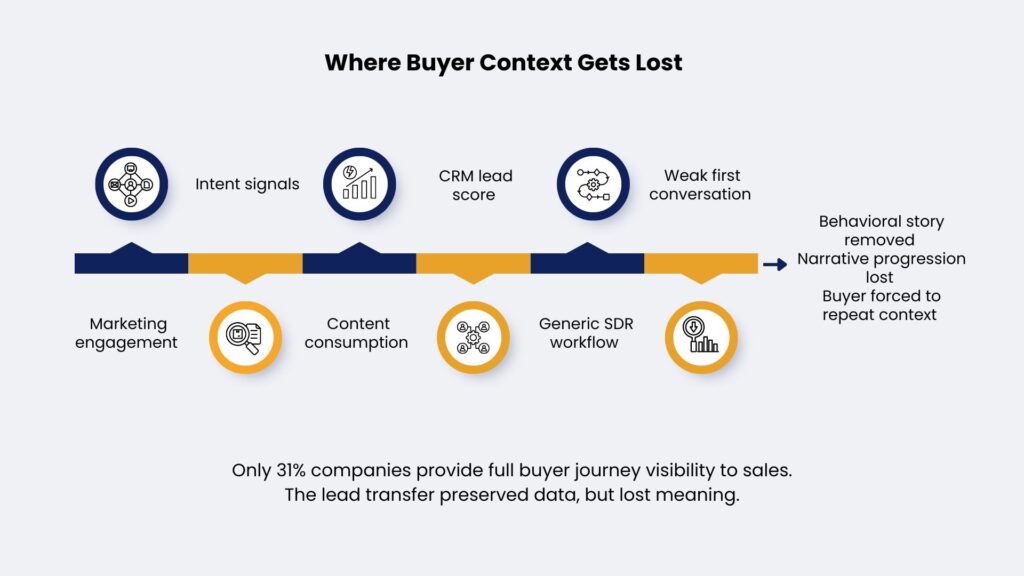
It’s not an SDR problem. It’s a system problem. Marketing gathers a huge amount of behavioral data and delivers it to sales as a thin, flat contact record. The entire history of the buyer is reduced to a score. And a score is abstract, not contextual.
This produces an immediate negative impact. Fatigue kicks in on the side of the buyer. Trust becomes difficult due to the unpreparedness of the seller. The discussion remains surface-level, so no depth is established. The buyer also hinders velocity since they need many touch points for understanding.
Conversation-Ready Leads: What the Handoff Must Transfer
The industry has spent years developing lead qualification processes; the BANT, MEDDIC, CHAMP methodologies have answered whether it makes sense to contact someone or not. None of these tools answer whether there will be anything meaningful to talk about.
It turns out that qualifying leads is not equivalent to getting them conversation-ready, and mixing these two concepts up means missing out on deals. Even though the lead has all the attributes you look for to qualify him/her, that doesn’t mean he/she’s psychologically ready for dialogue.
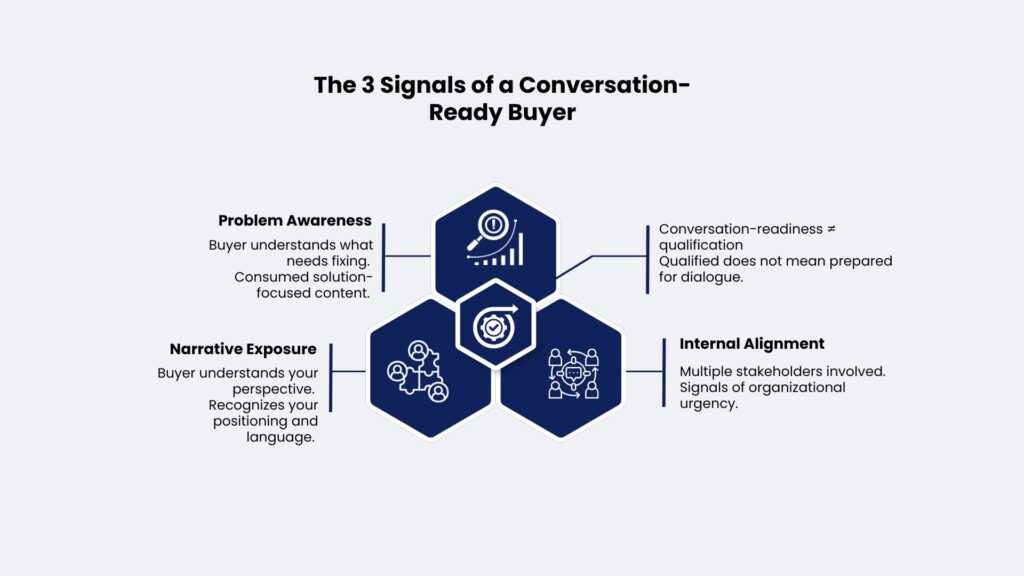
Being conversation-ready entails meeting three separate criteria:
Problem Awareness
The buyer has advanced beyond a state of mere interest to know what needs fixing within their current system. The buyer knows what’s at stake. The material consumed focuses on solutions rather than pure thought leadership, which makes this evident.
Narrative Exposure
The buyer has been exposed to your unique perspective, not just your category of products. Your differentiation narrative, your strategy and your way of speaking has been internalized by this buyer. Such a buyer would bring mutual understanding during the first contact. Studies from the LinkedIn B2B Institute confirm that mental accessibility and brand recall over the long term play a crucial role in B2B buying behavior. Recall sells where mere exposure doesn’t.
Internal Alignment
However early, there are indications that the issue has internal resonance. Several players have gotten involved, peers have conducted consultations, or leadership has sent signals about an associated initiative. The buyer moves away from lone researcher to a decision participant.
An analysis of buyer behavior conducted in 2024 showed that leads satisfying all the above conditions had conversion to opportunity 2.4 times faster than those satisfying just firmographic or scoring requirements, with a win rate 31% higher and sales cycle 20% shorter.
Where the B2B Sales Handoff Loses Buyer Context
The Illusion of Data Integration
The data is out there. It is precisely that point that makes this challenge so maddening.
Marketing automation tracks behavior histories. CRMs hold interaction logs. Intent platforms uncover buying triggers. And yet, when the lead gets to sales, most of those buying triggers have been boiled down into a simple number that strips the story out of context and turns it into something else entirely.
Information is lacking between systems. Marketing tools and sales tools typically do not communicate effectively about meaningful buyer behavior. An audit of 18 B2B organizations conducted by a 2025 RevOps study revealed that just 31% of companies had visibility on buyer journey insights that included content consumption, page visitation, email interactions, intent indicators, and event attendance. For the other companies, salespeople had visibility only on leads, lead scoring information, and selected contact fields – the entire story hidden from them.
The Cost of Superficial Data-Driven Processes
Then, the process becomes data-driven from a superficial perspective. Without context, the rep falls back on the qualification scripts – questions related to budget, timing, and power that imply to the prospect they are a process, not an individual. According to the results of a 2024 survey, 68% of SDRs and AEs believe they do not have sufficient context to adapt the first meeting, and 54% of them spend 10 to 15 minutes at the start just collecting more information known to marketing.
Inconsistency in the messaging gets even worse. Marketing focuses on strategic transformation. Outbound messaging centers on pain. Then, sales quickly shifts to product qualification. The process stops making sense to the buyer – there is no narrative progression; only whiplash. Consistency equals business maturity; inconsistencies equal dissonance. Buyers know the difference: according to a 2025 benchmark, 46% of them identified inconsistent messaging across departments; of them, 32% reported reduced trust in the brand because of that.
The Buyer's Internal Experience of a Bad First Call
Buyers are not complaining about bad discovery calls on review websites. The silence speaks for itself.
Yet the buyer’s internal dialogue always follows a clear pattern. They spent valuable time on reading your content, filling out forms, attending events. And then the representative is asking them to start from the very beginning. Each repetitive question shows that they don’t value the buyer’s time or efforts and they won’t recall their situation in the course of future interactions. This indicates problems with the post-sales experience as well.
Misaligned questions look generic and repetitive. Buyers interested in pricing content wouldn’t appreciate the question if they are the deciders. Buyers downloading your technical framework will not be happy to answer the same question: “What led you to us?”
Without depth, the client holds back. They won’t divulge their true problems, internal dynamics, or what success means to them. Shallow agreements stall, go quiet, or slowly drift to an alternative vendor who previously demonstrated understanding.
A recent study of buyers published in 2024 revealed that 59% of lost deals reached their tipping point in the first or second conversation. Why? Because “I didn’t feel understood.”
Redesigning the B2B Sales Handoff Process
The fix is not better sales training. The fix is reworking the handoff process to include the transfer of context just as seamlessly as leads transfer into sales.
History is better than statistics
Lead scoring is about assigning numbers. Behavioral history is about telling stories. What has this individual read, watched, reviewed, and what order did these actions take place? The order shows progress: an individual that starts by reading a thought leadership piece, then reads a case study, then moves onto the pricing page is in a totally different mindset than someone who read a white paper six months ago and did not come back. Tell your stories, not just scores.
A middle market SaaS company with a highly developed demand gen engine discovered that their first meeting to opportunity conversion was stuck at 22%. After an audit, they realized their SDRs were working from lead profiles containing only four fields: name, company, MQL score, and source of lead. Their seven pieces of content viewed over a period of four weeks with three visits to the pricing page sat hidden in their marketing stack. Once they fixed their B2B sales handoff process and included a behavioral history, they converted 34%.
Narrative continuity across touchpoints
If your marketing had launched a campaign on that pain point, and the buyer interacted with it, you start the conversation from this point. Not because it is smart but because it is honest; you recognize that the conversation started long ago. Buyers experiencing narrative continuity in messaging between marketing and sales teams are 2.1 times more likely to perceive the vendor as trustworthy, according to a 2024 buyer experience benchmark report.
You can read more here.
Context summarization with the help of AI
Sales reps do not manually map buyer journeys across multiple disconnected systems. Context summarization with the help of AI layers in CRM/middleware converts behavioral signals into pre-call notes: what the buyer was researching, what story he was reading, what questions he probably brings to the call. Companies running a pilot project with AI-powered context summaries in 2025 saw their first call preparation reduced by 34%, first call quality scores boosted by 29%, and win rate uplifted by 17%. The purpose is not to have more data. It is better conversational preparation.
Redefining Readiness: The Handoff as a Sales Advantage
It’s no longer feasible to consider sales readiness something that only the buyer should take into account. This does not just boil down to qualifying leads, but considering whether the salesperson is prepared for that particular lead.
The conversation-ready handoff will yield a rep that can draw upon the frame of reference of the problem the buyer has explored, refrain from asking questions already asked by the behavior cues provided, start off with a hypothesis rather than an interrogation, and build common ground.
That’s the difference between a discovery call and a diagnostic call. Discovery involves asking qualifying questions, while a diagnostic call moves mutual understanding towards a decision point. The former focuses on reps. The latter focuses on buyers, and this is where modern B2B sales is heading.
According to a 2024 RevOps pilot study, the companies that changed their definition of readiness from qualification metrics to being conversation-ready achieved a 28% reduction in unproductive calls for their SDRs, increased meetings turning into opportunities by 22%, and improved pipeline quality by 19%.
The Deal Starts Before the First Call
Revenue leaders talk about the proposal, the demo, the business case. These are the seen actions. The unseen action, the factor that decides whether any of the above will happen at all, is the quality of the first call. A strong sales handoff process is the hidden variable behind every won deal.
If it sounds like a start, you've already fallen behind the eight-ball. If it sounds like the next chapter in an ongoing dialogue, you've created something unique in today's business-to-business sales landscape: trust in the first call.
Those businesses winning the pipeline battle today aren't creating more leads. They're creating less wasted conversations. They are creating processes that smoothly pass marketing context into sales execution, turn buyer behavior into conversation intelligence, and ensure that the very first live engagement from the buyer reaffirms rather than discredits the brand promise made through content.
Demand generation doesn't stop at lead creation. It stops, or gains its right to go on, in the first call.
Start there. Everything else will follow suit.