Category Entry Point Strategy: Win B2B Buyers Before They Search

Your best B2B customers next year are already searching, just not for you yet. A category entry point strategy is built around this reality: buyers identify vendors during problem recognition, weeks or months before any formal evaluation begins. Most shortlists form not from advertising spend, but from whoever showed up first when the buyer could only name their problem. That moment is invisible to most revenue teams, yet it drives more pipeline than any bottom-of-funnel campaign.
According to research by 6sense, 94% of B2B buyers pre-select their vendor shortlist prior to any formal procurement process beginning. Gartner echoes this – buyers spend only 17% of their journey engaging with vendors. The rest of the time is spent learning, searching, and forming opinions in your absence.
If your demand generation strategy is based on waiting for the buyer to search for your product category, you are not creating pipeline; you are merely inheriting it.
Why B2B Buyers Never Search for You First (And What Category Entry Points Fix)
A VP of Sales watching deals stall in late-stage pipeline does not search for "sales enablement platform." She searches for "why deals are stalling after proposal" or "how to reduce close-rate drop-off." A customer success director facing rising churn does not open a software comparison site. She searches for "early warning signs of account health decline."
These searches happen weeks or months before any vendor evaluation. They are Category Entry Points (CEPs): the specific problems, operational failures, and situational pressures that trigger a buyer to begin looking for a solution. CEPs are defined by the buyer's felt experience, not your product taxonomy.
The distinction is critical. Buyers in early-stage awareness use language anchored in their own operational reality. A RevOps leader searching for pipeline visibility problems does not use the phrase "revenue intelligence platform" until someone teaches it to her. Whoever shows up first with clear diagnostic thinking earns the right to define the solution space and to shape what the buyer expects from every vendor that follows.
The 95 Percent You Are Not Reaching
The Ehrenberg-Bass Institute's 95:5 rule is one of the most consistent findings in B2B marketing research: at any given moment, only 5% of your target market is actively evaluating a purchase. The remaining 95% are doing their jobs, not shopping for your solution.
Typical demand generation budgets are designed to grab onto that 5%. Paid search ads will focus on bottom-of-the-funnel intent: "best CRM software," "pipeline analytics software vendors," "enterprise marketing automation pricing." These are expensive searches because it’s very competitive and the buyer has already done their homework. You are trying to win second place in a race someone else has started.
Meanwhile, the 95% who will eventually enter the market are being shaped by whatever content and brands they encounter during this latent period. Mental availability, how easily your brand surfaces when a specific problem arises; is built during that window. By the time a buyer enters active search mode, recall has already been established. The brands inside the building do not need to knock.
A 2025 benchmark of 58 B2B companies found CEP-driven demand generation produced 42 to 51% shortlist inclusion, compared to 18 to 24% for traditional product-centric approaches. Pipeline conversion rates were nearly three times higher. Sales cycles ran 21% shorter. These results came without additional spend or traffic, the only change was when and how those organizations showed up.
Three Demand Generation Failures That Keep You Off the B2B Buyer's Shortlist
Understanding why most organizations miss CEP moments requires diagnosing three recurring patterns.
Failure 1: Product-Centric Messaging That Ignores Category Entry Points
Most B2B websites and campaigns are written from the inside out. They describe features, announce capabilities, and assume the reader already knows they need the solution being pitched. But search behavior at the problem-recognition stage is anchored in the buyer's situation, not your product architecture. Content that leads with what you sell speaks to no one who is still trying to name what is broken.
Failure 2: Targeting Buyers Too Late in the B2B Journey
When campaigns activate only after explicit vendor intent appears; demo requests, category comparisons, pricing searches the shortlist has already been formed. The buyer is now seeking confirmation, not consideration. CAC is high, conversion is competitive, and the brands that shaped the problem definition are already preferred.
You can read more about competing for the buyer’s time here.
Failure 3: Early-Stage Influence You Can't Measure (and Therefore Don't Fund)
Most marketing and revenue operations teams cannot connect early-stage content engagement to pipeline. If a prospect read your article on diagnosing churn risk six months before a sales rep reached out, that touchpoint rarely appears in any attribution model. The measurement gap becomes a resource allocation gap. Teams deprioritize what they cannot see, even when it is doing the heaviest lifting.
Building a Category Entry Point Strategy
Shifting to a category entry point strategy is a systems decision, not a content calendar refresh. It requires three structural moves.
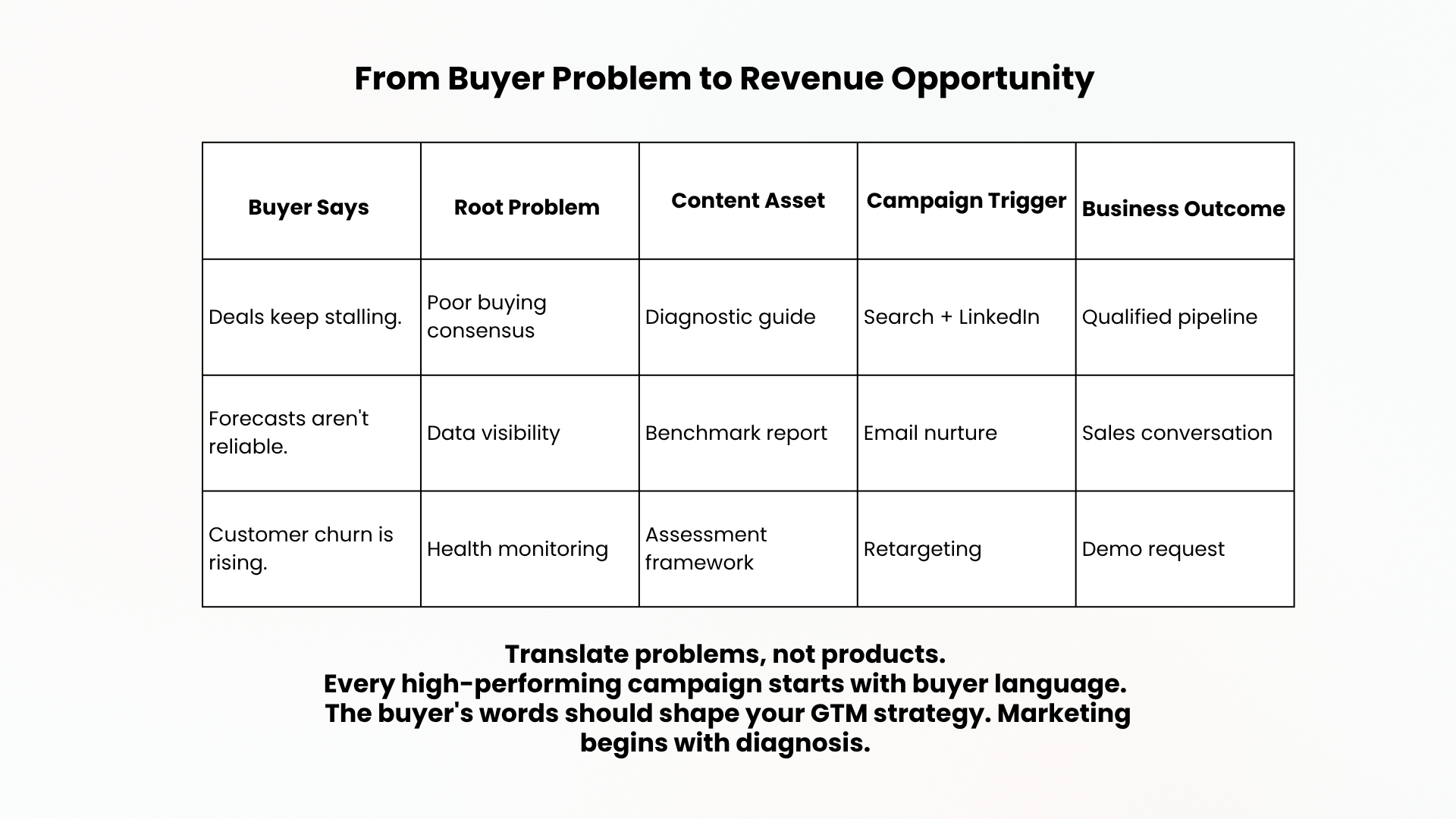
Map buyer problem triggers, not personas
Traditional persona work captures roles and demographics. CEP mapping captures situations. For each buyer type, ask: what operational failure, missed metric, or strategic pressure activates their search? Interview recent customers not about why they bought, but about what was breaking inside their business the week they launched an internal research initiative. Isolate the specific frustrations, data failures, and team dynamics that forced them to act. Group these into four to six clusters of related entry points. Trying to own dozens of CEPs dilutes your investment. Choose the moments where your brand is most credible and become associated with those.
Build content around situational demand
Problem-based content fulfills a very different role compared to product-based content. Problem-based content does not seek to convert buyers right away; it seeks to position itself as the solution to the problem at hand through content that is long-form, diagnostic in nature, provides frameworks for buyer self-assessment, and offers benchmark data that gives buyers an urgency as well as confidence in solving the problem. One cybersecurity company saw a threefold increase in traffic from problem-savvy buyers within just two quarters by switching from zero-trust architecture explainers to "how to audit identity sprawl before a compliance review," while content-influenced deals were 40% larger than cold outbound deals. The content did not change the product; it changed the buyer's mind.
Align campaigns with search behavior, not buying stages
The traditional funnel model assumes linear movement and clean handoffs. Buyer behavior does not comply. CEP strategy requires aligning campaign triggers to search moments: the specific queries, content formats, and distribution channels that match where buyers are mentally. This means always-on programs rather than quarterly campaigns. It means SEO investment with an 18-month horizon. It means accepting that some of your highest-leverage touchpoints will not close in the same quarter they influence and measuring accordingly.
Three Questions to Pressure-Test Your Category Entry Point Strategy Right Now
Before your next planning cycle, audit your current demand generation strategy against these questions.
For each buyer segment, what are the five most common searches they make before they know they need your category? If you cannot answer without guessing, you have a content calendar, not a category entry point strategy.
What percentage of your organic traffic comes from problem-stage queries versus solution-stage queries? A healthy CEP-oriented program skews toward problem-stage. If more than 80% of your search traffic is solution-stage, you are arriving after the decision has been shaped.
Can you trace any pipeline influence back to content engagement that happened more than 90 days before first sales contact? If your attribution model cannot look back that far, you are making resource allocation decisions without the most important data.
The Long-Term Competitive Advantage of Owning Category Entry Points
The real return on CEP strategy is not traffic or short-cycle leads. It is mental availability, the structural likelihood that your brand surfaces in a buyer's consideration set when they are ready to evaluate vendors.
Byron Sharp's research on how brands grow, applied to B2B: brands do not win simply by being preferred. They win by being recalled in the right moment. In B2B, those moments are category entry points. If your brand is absent during problem definition, you are invisible to the buyer's shortlist regardless of product quality.
There are three compounding benefits associated with running a consistent CEP strategy.
The first one is early buyer awareness: The account familiar with your CEP will be aware of your offer prior to your competitors becoming involved. They will be warmer on contact, since the problem you talked about is the problem they have.
Second benefit is a gravitational pull of your category: With time, dominating a mental space occupied by a particular class of problems becomes unbreakable even with new product releases and advertising campaigns from your competitors.
Third benefit is high inclusion rate into consideration set: According to Forrester research, 74% of B2B purchasers do more than 50% of research prior to interacting with any seller. If you were not there at the research stage, you were not in the race, not because you lost, but because you weren't even there.
The compounding return of a category entry point strategy is not traffic or short-cycle leads; it is mental availability.
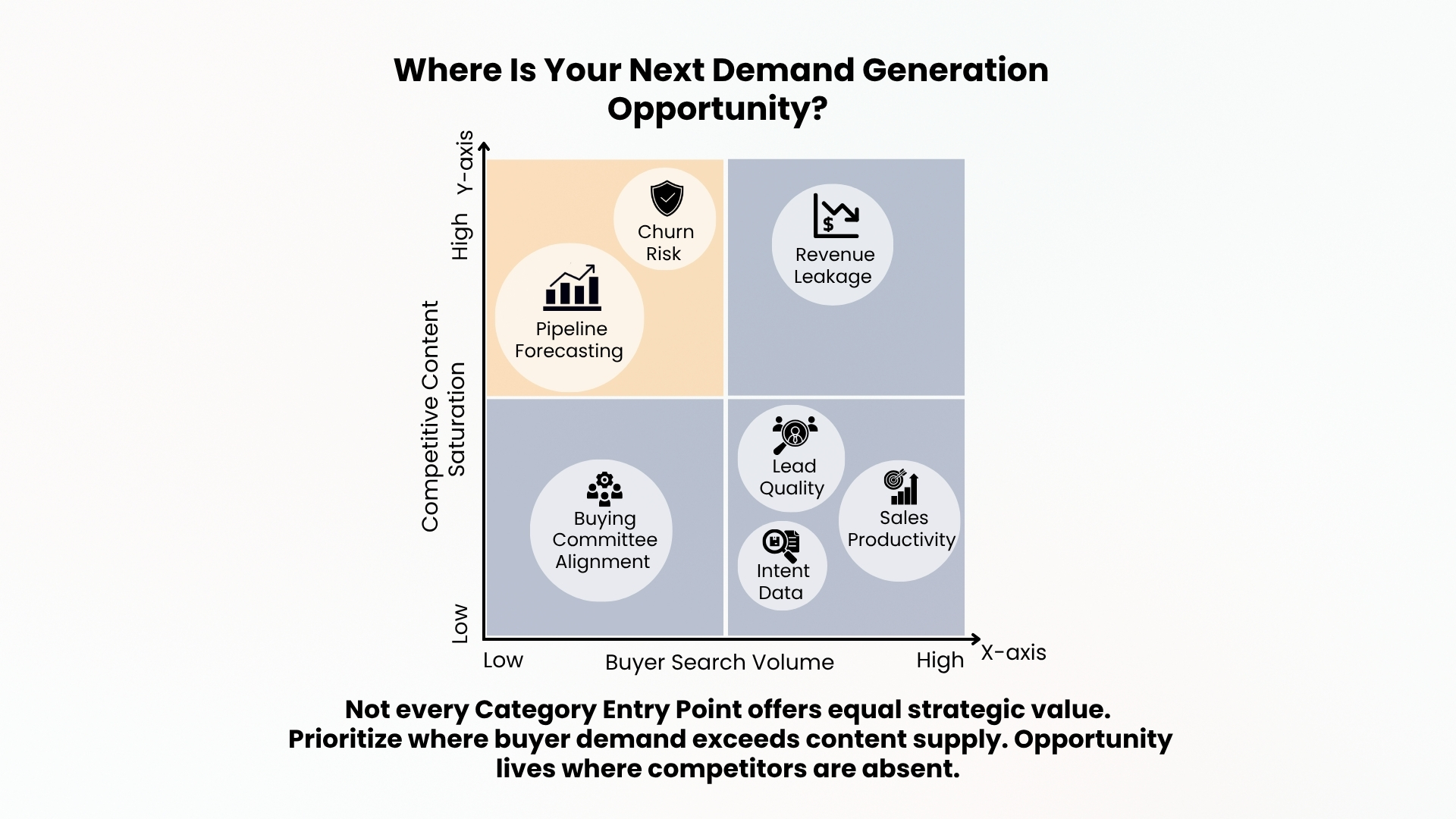
Conclusion
The B2B buyers who will become your best customers next year are searching right now. Not for you; for their problem. They are trying to name what is broken, understand why it is happening, and determine whether it is worth solving.
The question is not whether this is true. It is whether your go-to-market strategy is built to show up in those moments or built to show up after someone else already did.
A category entry point strategy is a commitment to being present at the beginning of the buyer's journey, not just the evaluation stage at the end. The organizations that make this shift do not simply generate more pipeline. They generate a different kind of pipeline: buyers who already associate your brand with the exact problem they most need solved. In complex B2B markets, that is not a marketing advantage. It is a structural one.
The companies that shape the problem are the ones that win the opportunity.