B2B Mid-Funnel Pipeline Fix: Why Leads Stall and What to Do

Every quarter, B2B marketing teams celebrate the same win: lead volume. MQL targets hit, dashboards go green. But three months later, the B2B pipeline has stalled; sales cycles stretch, revenue stays flat, and the CFO wants answers. The issue isn't lead acquisition. It's everything that happens in the mid-funnel, after the lead is captured.
According to Forrester research, less than 1% of B2B marketing leads end up converting into revenue. And according to the SiriusDecisions data, up to 80% of the leads transferred to sales never see any follow-up action. The point is that those leads did not disappear; they have got stuck somewhere in the middle of the process – the middle-of-the-funnel (MoFu) stage of the customer journey that most B2B companies tend to ignore.
And this is the very point when pipelines either materialize or evaporate. In most cases, it is the most underdeveloped stage of the entire demand generation process.
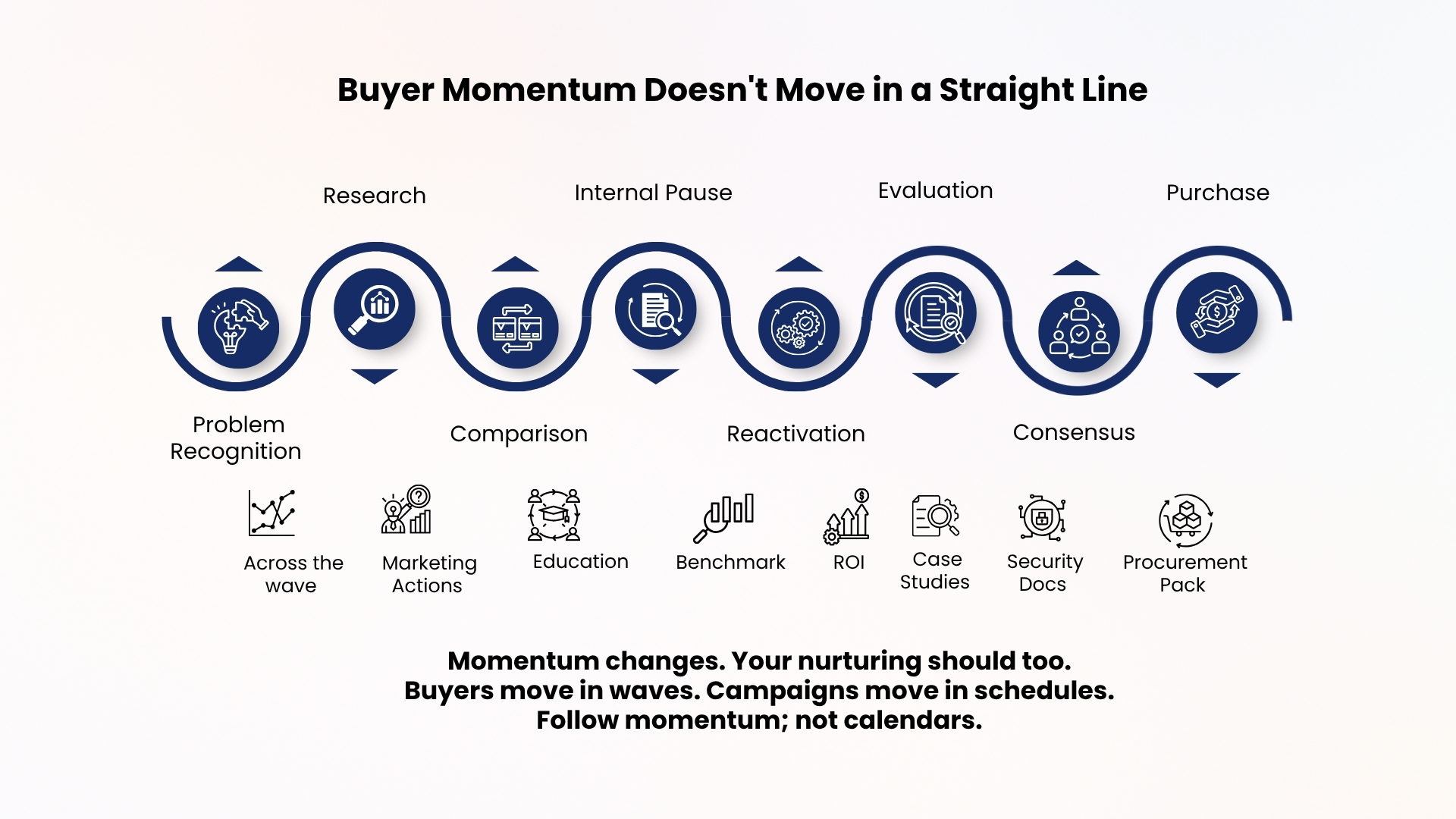
Why the B2B Mid-Funnel Is Where Pipelines Are Won or Lost
This is where the B2B mid-funnel pipeline either gains momentum or collapses entirely.
The old funnel made certain assumptions: from awareness to interest, to consideration, and then to an opportunity. Those assumptions are not valid anymore.
According to Gartner research, B2B customers conduct up to 80% of the buying process before interacting with the vendor. The customers are conducting their own research and making decisions without any input from the vendor. The buying committee can start the process, stop it, resume it, consult other people, or just abandon it.
MoFu has evolved into a process that covers a great deal of the actual path to purchase. It’s where prospects confirm that the issue warrants spending money on it, gauge the risk of implementation, and lower their uncertainty level. Nothing here results in a form fill or an inquiry. But everything determines whether any pipeline is generated at all.
Businesses concentrating on generating leads are optimizing for something that has already been achieved. The edge goes to those who control what happens after.
Three Structural Mistakes That Stall B2B Mid-Funnel Pipelines
The three most common causes of B2B mid-funnel pipeline failure all stem from one of three fundamental problems. These are not execution problems. They are inherent design problems that exist within the very way demand generation systems have been designed.
Generalized Nurturing That Bypasses Stage of Buying
Most nurture systems are based on content calendars rather than customer journeys. The prospect downloads a whitepaper and follows a set process where they get the same emails, the same pace, and the same messaging, no matter what their stage of purchasing or how urgent they are.
For example, there could be two firms that download the same cybersecurity whitepaper. One firm has had some kind of breach recently. The other is just looking at options for general research.
Analysis done by a RevOps team for another SaaS company showed that 60% of the nurtured leads received mid-funnel content without even doing any discovery activity such as visiting the price page, comparing features, or asking for a demo. Timing-based logic was used instead of intent-based logic for sending the mid-funnel content. Their pipeline to close ratio got increased by 38% in just two quarters.
Treating Engagement as Intent
The measurement of engagement will give you an insight into whether someone has interacted with your material or not. The intent data gives you the reason behind that interaction. These two are completely different kinds of insights, and making the mistake of confusing the two can cost a lot when it comes to demand generation.
Someone who regularly interacts with your emails but has never visited your pricing page is very different from someone who has visited your pricing page twice in a week after 45 days of silence. The former is habitual engagement, whereas the latter is a reactivation event.
Intent layering involves taking first-party behavioral data and layering it with third-party intent data, such as topic surges provided by platforms such as Bombora, G2, or 6sense. This allows you to see which accounts are conducting research within a certain category despite never having communicated with you.
The optimization becomes less about “are we getting our emails open?” and more about “who is currently researching this category?” Reach allows you to reach the right people, while recall ensures that you’re reaching them at the time they are in the research phase.
The Sales Handoff Context Gap
In situations where marketing creates a nurturing system that works, handing off to sales will undo all the work that has been done. This is because the handoff comes too early, too abruptly, and without all the information needed by the SDR.
This is because of the normal workflow of the MQL process. The lead scores highly and is handed over to the SDR. The SDR will then send an automated email mentioning how the lead originally downloaded some content a while back. But the truth is that lead has been on the pricing page comparing two products.
According to Forrester, the improper implementation of handovers leads to the loss of about 25% of qualified pipelines between marketing and sales. The lead was there. The interest was there. The implementation gap wiped out both.
The solution is a shared layer of data. When the SDR sees the complete behavioral data history of the company (the pages they've visited, the content they've consumed, how recently they have engaged), the communication becomes precise instead of being just a matter of probability.
You can read more about the sales handoff process here.
How Intent Data Reactivates Stalled B2B Pipeline Accounts
The cold MQL bucket represents one of the least-used opportunities for B2B pipeline management. These are MQLs that have been scored, handed off to sales, did not convert within 30 days, and were then put back into a generic nurture pool. Most companies treat them as low-priority. Intent data turns them around completely.
One data integration services provider learned that 22% of its cold MQLs, which were dormant for 60 days or more, displayed spikes in third-party intent for data integration tooling within six months of first contact. This was not about reviving dormant leads. Rather, these leads were part of a longer buying cycle that had gone back into active research mode.
This company triggered follow-up when intent score increased, rather than time lapsed, and thereby salvaged a lead pool that otherwise would have been deprioritized. In the case of outreach, it cited specific categories of research by the account rather than sending a generic touch point. This difference is significant. Generic follow-up is disruptive. Context-driven follow-up builds on an ongoing internal conversation.
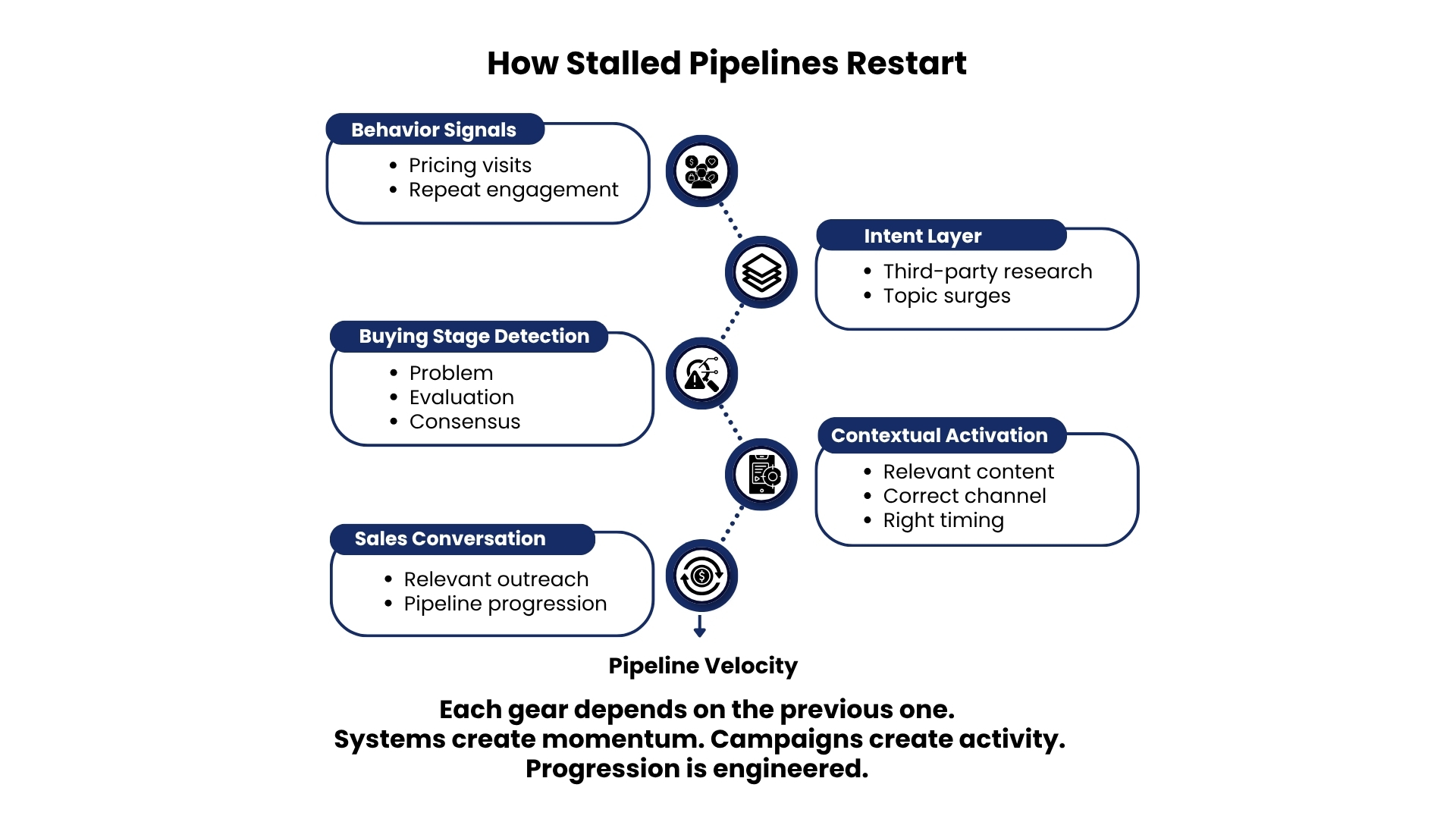
Aligning MoFu Actions with Buying Stages to Unblock Pipeline
MoFu strategies that are more long-lasting depend on buying stage-based logic rather than funnel stage-based logic. Funnel stages indicate what stage of the process the lead is at. Buying stages, on the other hand, represent the point at which the buyer is in his/her decision-making process. The two do not always match up.
This is why a three-stage content strategy works as follows:
Problem Aware, Not Solution Aware: The buyer is aware of a pain point, but does not see it as a buying opportunity. Here lies the opportunity for diagnostics, benchmarking reports, and category education. Comparison of products and price lists is premature and usually counterproductive.
Solution Aware, Evaluating Options: The buyer is evaluating vendors. Most marketing teams under-deliver when it comes to mid-funnel programs. Vendor differentiation, ROI calculation tools, peer testimonials via case studies, and detailed product descriptions do most of the work during this stage.
Decision Stage, Building Internal Consensus: The buyer is not the only one making decisions. Now executive summaries, security documentation, implementation manuals, and procurement guidelines matter. Most marketing teams stop creating content at this point since it is not considered “marketing.” It is the most commercially valuable content you can produce.
This is how mapping your content to these three states, based on behavioral markers indicating which of the three states any particular account is in, distinguishes demand generation from demand generation campaign.
A Practical Framework to Fix Your B2B Mid-Funnel Pipeline
Five focus areas show where the majority of your MoFu leverage lies.
- Move away from static sequences and toward dynamic trigger flows. Create nurture flows based on actual behavioral triggers: pricing page views, competitor comparisons, multiple content consumption, stakeholder involvement. The flow needs to follow the buyer, not the clock.
- Score the account, not just the contact. B2B purchasing involves committees of up to six to ten decision makers. An individual lead score does not indicate organizational buying momentum. Opportunities where 60% or more buying committee penetration occurs close at significantly higher percentages than those involving single contact interaction.
- Define explicit handoff criteria backed by data. Not just downloading a white paper is qualification. It's a pricing page view in combination with a competitor comparison and two or more stakeholders from the same account interacting in a specified timeframe. Without agreement between Sales and Marketing on what constitutes a qualifying handoff, leads will continue to slip through the cracks.
- Audit your content to ensure that decision stage topics are addressed. The vast majority of B2B content banks have great coverage in the awareness stage and poor coverage in the consensus building and decision validation stages. Generate content that will address stakeholder conflict on the issues of security, finance ROI, and IT integration.
- Measure progress, not just action. Measure expanding the buying committee size, increasing account engagement, time between buying stages, and the rate of opportunity creation. These will uncover where your pipeline is getting hung up. Email opens don't tell you anything about sales momentum.
Systems Fix B2B Pipeline Stalls. Campaigns Can't.
Organizations that consistently generate B2B pipeline growth aren't creating more leads; they're fixing the mid-funnel system that processes them.
There needs to be a change in mindsets. From campaign mindsets to system mindsets. Campaigns are built to maximize on outputs: Impressions, MQLs, Clicks.
Systems, on the other hand, focus on progression: Is this account progressing towards making an informed buying decision and can your actions move them faster?
MoFu is not a nurturing issue and certainly is not a content issue but a data and activation issue that people mistakenly believe is a content issue. Solving it will compress sales cycles, improve win rates and create a strategic advantage that campaigns cannot achieve.
The pipeline was not missing. The pipeline was stalled. And stalled pipelines, unlike lost ones, can be restarted. Build a system that understands how to interpret the signals already available to you.