
Every quarter, demand generation teams repeat the same ritual. A target account spends months downloading resources, attending webinars, and engaging with mid-funnel content. Then it goes dark. The lead score drops, the contact gets archived, the campaign is marked a non-convert, and a portable lead quietly walks out the door.
This is the defining blind spot in portable lead demand generation. Most marketing systems treat the account as the unit of commercial pursuit. The assumption is that a lead's value is permanently tied to the account where it was first captured.
That assumption is wrong. And it is costing you pipeline you cannot see.
Why Account-Centric Models Miss Portable Lead Value
Account-based thinking has made B2B marketing more precise. But it introduced a blind spot. Companies do not carry brand memories. People do.
An account cannot recall a webinar from two years ago, develop confidence in a vendor after reading its research, or carry a positive sales experience into a new buying decision. Individuals do all of that, and individuals move.
A study found that, in technology and SaaS, median tenure for VP-level buyers is just under three years. For individual contributors who influence shortlists, it is closer to 18 to 24 months. A significant share of the buyers your marketing touched last year are now sitting in different organizations, some in accounts you have never targeted, some in verticals you are only beginning to enter. A subset already hold a formed opinion about your brand, shaped by campaigns and conversations they had before their last job transition.
That opinion did not reset when they updated their LinkedIn profile.
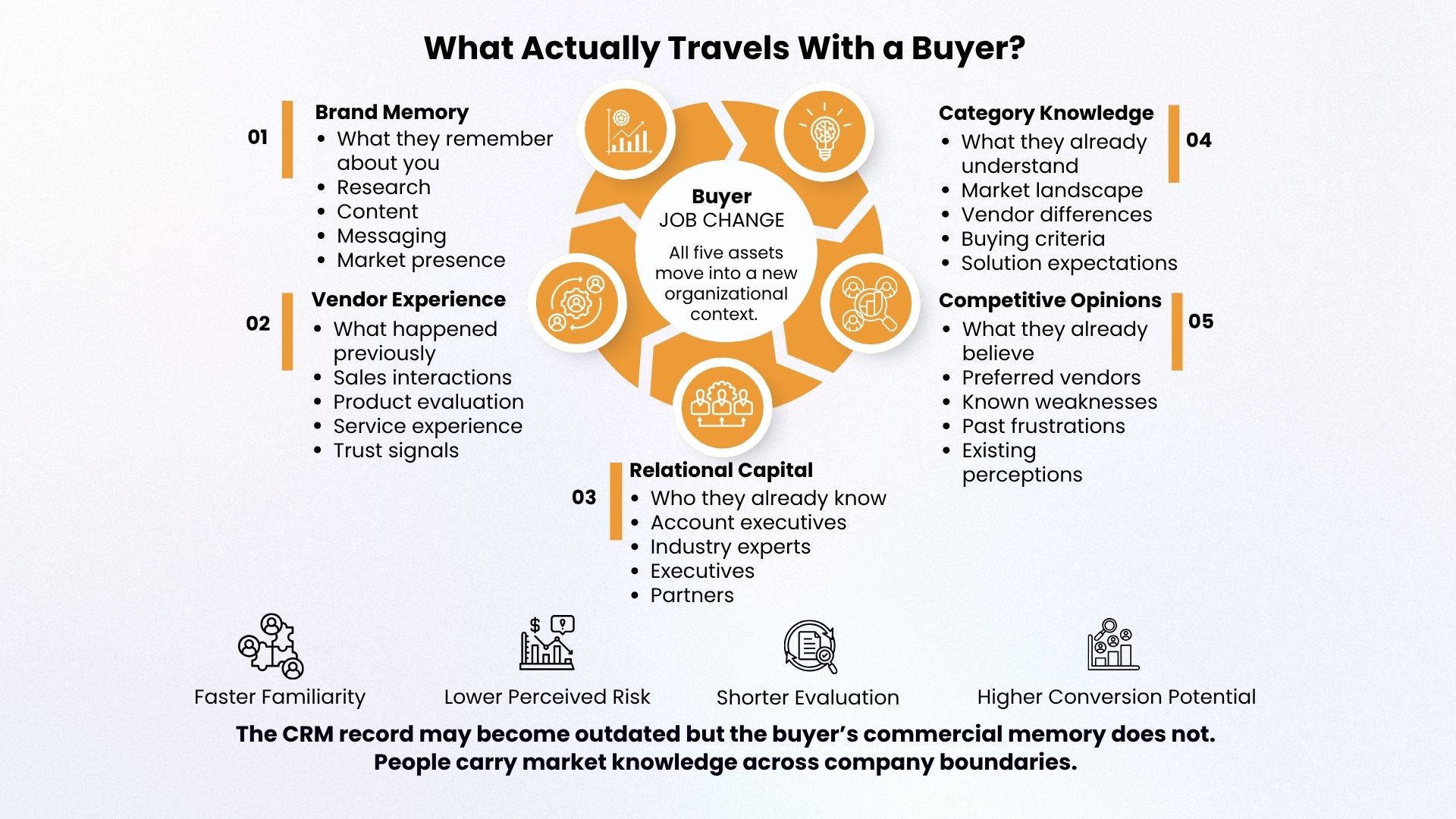
What a Portable Lead Carries Across Job Changes
When a senior buyer changes employers, they do not arrive as a blank slate. They carry commercially relevant assets that appear nowhere in your CRM.
Previous vendor experiences shape their shortlist before a single outreach is sent. A positive relationship with your brand can surface you faster than any inbound campaign. A frustrating experience with a competitor can eliminate them before the evaluation begins.
Trusted relationships create warm lines into cold accounts. If your account executive built a real relationship with a buyer who later moved companies, that connection is now a direct path into a net-new account that traditional prospecting would approach from zero.
Brand familiarity reduces perceived risk. Buyers in new roles rarely launch exhaustive searches. They rely on pre-existing mental real estate, the companies they already know, trusted, or evaluated.
Knowledge of the market means they are not starting from scratch. A buyer who spent six months evaluating your category at a previous company arrives with a mental map already drawn. Your positioning either fits that map or has to fight its way in.
This is what makes portable lead demand generation so structurally different from account-centric models: commercial familiarity, experiential memory, and relational trust that travels with the individual across organizational boundaries.
Rethinking Lost Leads as Portable Pipeline
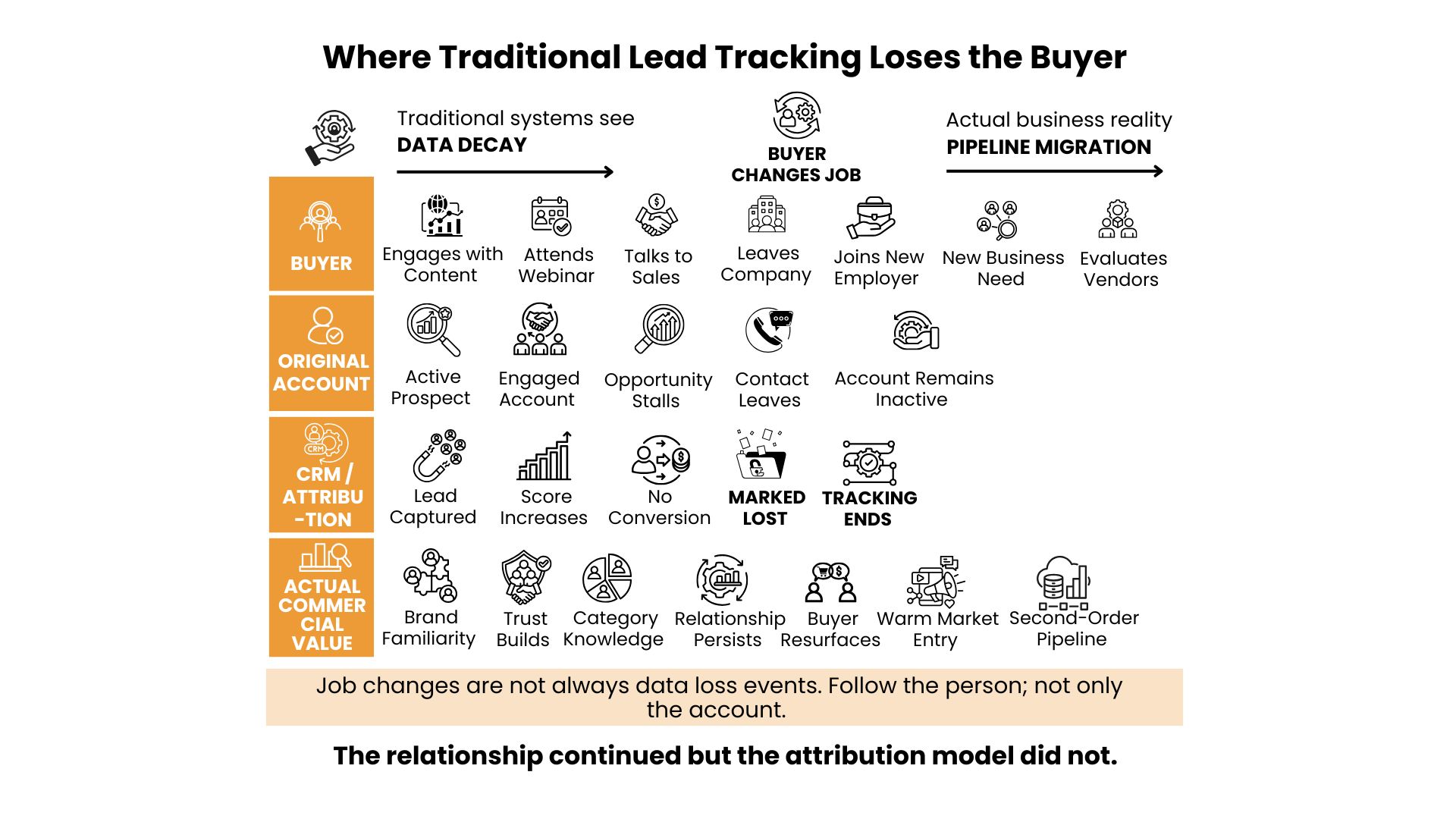
Consider a scenario most demand generation teams have lived through. A VP of Operations downloads a benchmark report, attends a webinar, engages with follow-up emails, then goes quiet. Six months later, she leaves without converting. The account is marked stalled. The contact goes dormant.
Eighteen months later, the same VP takes a Head of Operations role at a fast-growing company that matches your ideal customer profile exactly. She remembers your brand, not in detail, but positively. When her new company starts evaluating vendors, she mentions your name in the first internal meeting.
Your SDR, following standard protocol, reaches out as a cold prospect. The email lands in her inbox. She recognizes the brand and replies within an hour.
This is not luck. It is a predictable outcome of sustained brand investment, one that the original campaign's attribution model never captured and never will. The portable lead did not fail. The measurement system failed to follow it.
A 2025 B2B mobility benchmark found that teams using person-centric lead models saw 24 to 29 percent long-term conversion from non-converting leads, compared to 12 to 16 percent for account-centric teams. Sales cycles with returning contacts were 22 to 26 percent shorter. Win rates were nearly double. Non-converting prospects are not failed outcomes. They are future market entry points.
Why Transactional Demand Generation Misses This Value
The structural problem is attribution logic. Most demand generation frameworks measure conversion at the account level within a defined window. Non-converting contacts get classified as lost. CRM hygiene practices archive or delete stale records. Campaign ROI calculations never account for downstream value created outside the original account context.
B2B databases decay at 22-30% per year due to job changes, role transitions, and company shifts. Most organizations discover stale data reactively, when an email bounces or a deal stalls because the champion left. The result is a system that treats every job change as a data loss event. Many of them are actually pipeline migration events.
There is also a content incentive problem. Gated assets optimized for immediate lead capture push buyers toward a transactional relationship. A prospect who fills out a form to download a basic whitepaper does not carry meaningful brand affinity into their next role. A prospect who found your research genuinely useful three years ago still associates your brand with credibility today, regardless of how many employers have come and gone.
You are not just failing to track mobile leads. You are often failing to create the kind of value that makes tracking them worthwhile.
Building the Brand Equity That Makes Portable Leads Work
Capturing portable lead demand generation value requires a shift in what you are actually trying to create. The goal is not a lead at this company. It is a brand relationship that persists across professional lives.
Create value that outlasts the campaign. Benchmark data, category-defining frameworks, and research with actual depth create a different kind of memory than a product-feature nurture sequence. Generic emails and aggressive follow-up do not travel. Useful, well-timed engagement does.
Maintain consistent positioning. Companies that reposition with every product update fragment the mental model a buyer is trying to hold. Buyers encounter your brand multiple times across a career. Consistency compounds brand equity. Inconsistency erodes it.
Avoid over-contact. A prospect who is not ready to buy should not enter an endless sales sequence. Over-contact turns positive familiarity into active avoidance. The goal is to remain relevant, not permanently present.
Treat every interaction as part of a longer relationship. A buyer who attended your conference two years ago at a different company is a warm contact in a new context, not a cold prospect in a new account. The systems that surface this history, and the reps trained to use it, create a genuine competitive edge.
You can read more about building a brand memory here.
Measuring Portable Lead ROI Across Accounts
Standard lifetime value calculations in B2B are account-bounded. But if brand-familiar buyers migrate into net-new accounts and accelerate sales cycles there, the true commercial return on your original marketing investment is larger than any single-account attribution model captures.
Forward-thinking RevOps and CMO functions are beginning to measure second-order pipeline: deals influenced by previous brand exposure in a different organizational context. This requires tracking contact reappearance across accounts and flagging known contacts who surface at new employers as warm entries rather than cold prospects.
Tools like Clay, Cognism, ZoomInfo's mobility signals, and LinkedIn Sales Navigator job change alerts now offer early infrastructure for this. Teams winning the long game layer these signals into sequencing logic so a contact who resurfaces after a job change receives an acknowledgment of the prior relationship, not a generic cold introduction.
The measurement implication matters at the executive level. If portable leads are generating accelerated pipeline at new accounts, the ROI of brand investment in content and long-form demand generation is materially higher than campaign attribution suggests. Reach gets you in front of buyers. Recall gets you considered when they are ready to act, even if that is at a different company, in a different role, two years from now.
Your Brand Is a Traveling Credential
The most durable asset in portable lead demand generation is not the account list. It is the impression your brand leaves on every buyer it touches, because that impression travels with them across organizations, roles, and years.
A lead that does not convert today is not a failed outcome. It is a future market entry point waiting for the right context to activate.
The demand generation teams that outperform over the next five years will not be the ones running the most campaigns. They will be the ones building brand relationships strong enough to survive a job change, and the systems smart enough to recognize when those relationships resurface.
The question is not whether your prospects will move. It is whether your brand moves with them.