B2B Incumbent Displacement Strategy: The Role of Brand Recall in Mature Markets

Most demand generation is built on a false assumption: that buyers are actively looking for something new. They are not. In mature B2B markets, the dominant condition is incumbent displacement; your target accounts already have a vendor, a legacy system, or an internal workaround doing the job you want to own. They are not searching for alternatives. They are managing what they have, tolerating its limits, and moving on to other priorities. This is where most demand generation quietly fails, not through lost deals, but through leads that never convert because brand recall was never built before the displacement window opened.
The real gap is not in reach or volume. It is in what happens inside a prospect's mind during the months or years before they start evaluating alternatives. That is where the most commercially valuable leads are built or lost.
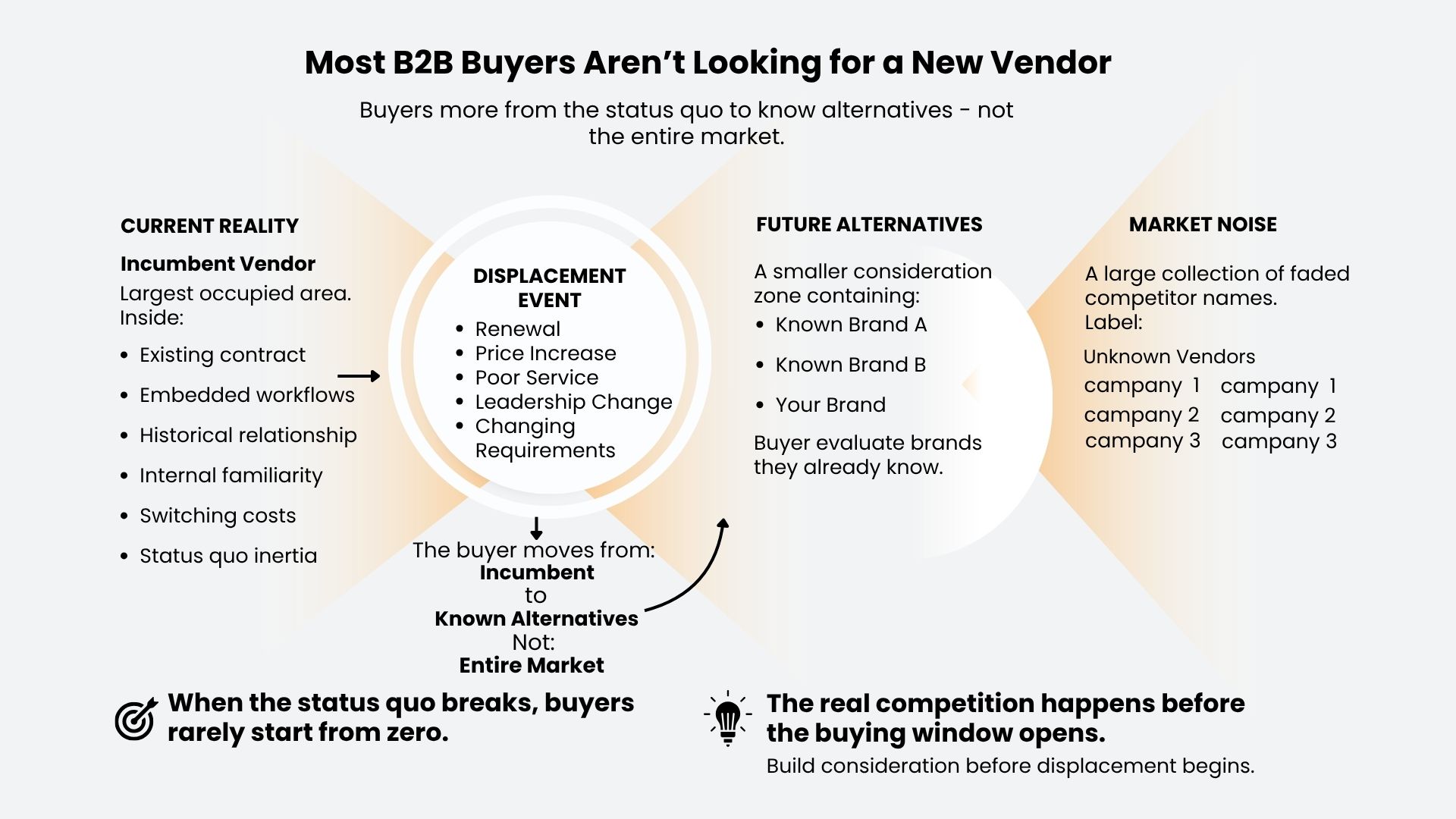
Why Incumbent Vendors Hold the Advantage (and When They Don't)
Understanding these structural advantages is the starting point for any incumbent displacement B2B strategy.
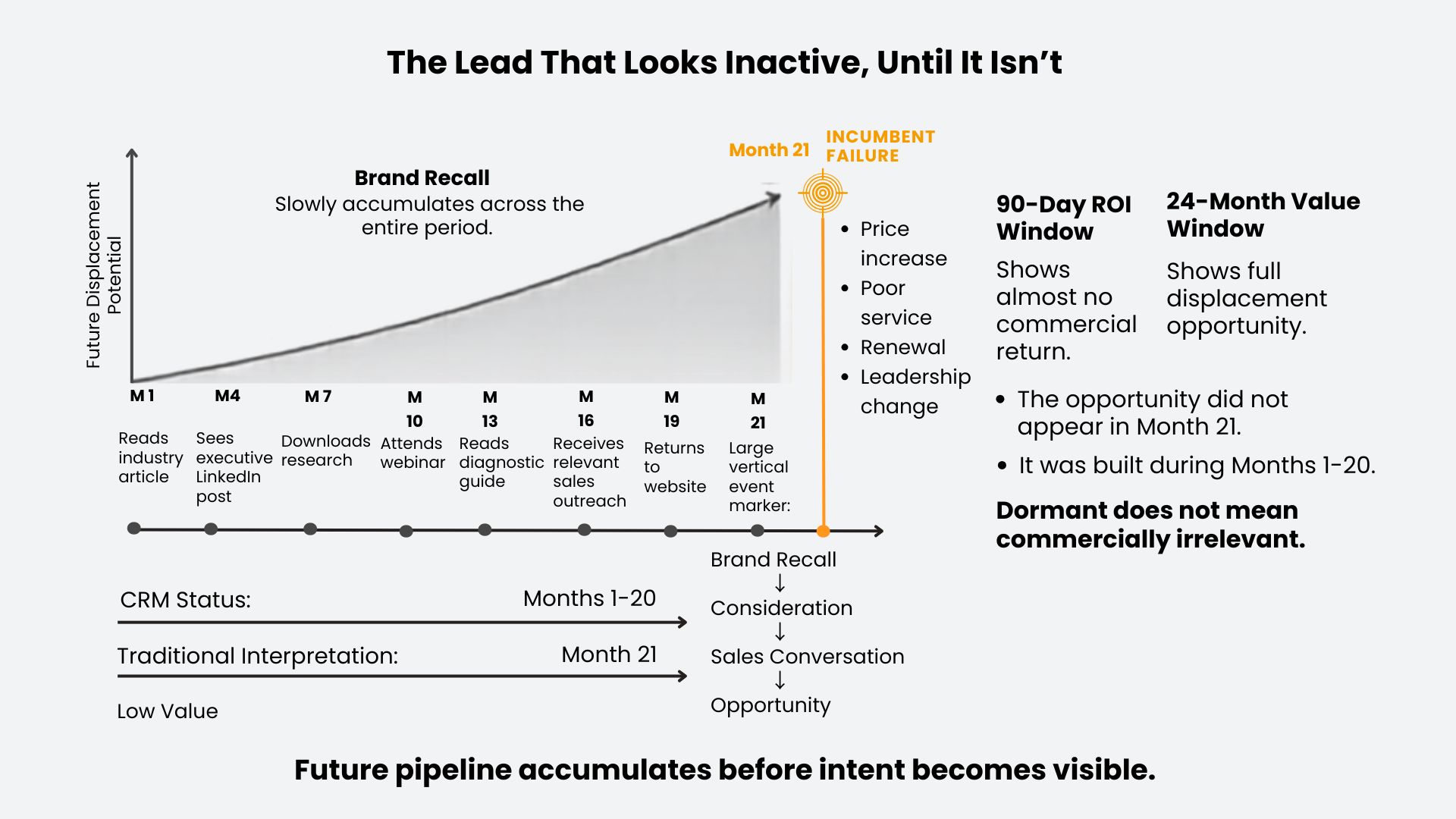
When most target accounts already have a solution in place, generating interest is not the same as creating future consideration. Buyers who find your research valuable may still have zero intent to switch. A decision-maker who attends your webinar may remain fully committed to their current provider. Traditional lead metrics interpret this as failure. A longer-term view sees something different: the early formation of an available alternative.
The costs associated with switching are much more than just financial ones. Moving data, reengineering workflows, training employees, and the exposure of the person who initiated the initial purchase decision are some of the costs involved in the process. Studies reveal that 68% of buyers choose not to switch to another brand even when they are unhappy, while 54% wait for the renewal period of the contract to arise.
This means your marketing has two distinct jobs in incumbent-heavy markets: generating short-term interest and building long-term consideration. Confusing them is expensive.
Displacement Windows: When B2B Incumbents Become Vulnerable
Incumbent relationships can appear stable for years before breaking quickly. The trigger is almost never a marketing campaign. It is a business event that shifts the buyer's internal calculus.
Poor service experiences erode trust gradually. A single missed SLA may be manageable. Three in a quarter create active resentment. Contract renewal windows compel companies to re-examine relationships which otherwise continue by dint of inertia; all of a sudden, the budget comes under review, discontented stakeholders are given official sanction to voice their discontent, and the issue of renewal turns into one of exploring the alternatives.
Major price hikes trigger procurement reassessment that otherwise would never have been conducted. The evolution of company needs, such as acquisitions, product diversification, and geographical expansion, may transform a previously satisfactory supplier into an unsatisfactory one through no fault of theirs. Leadership changeovers, especially those of C-level officers, are among the most dependable catalysts of displacement – newly appointed CMOs, CROs, and CIOs examine inherited vendor relationships with a jaundiced eye, and the brands that come into the picture are invariably those that they came across in their earlier jobs.
These are displacement windows. The question that determines whether you win is simple: does the buyer already know who to consider when that window opens?
Brand Recall Gap: Why Unknown Vendors Miss B2B Displacement Opportunities
Dissatisfaction does not distribute opportunity equally across the market. When a buyer becomes frustrated with their incumbent, they do not conduct an open-market search. They activate a consideration set that already exists; brands recalled from industry content, peer conversations, conference interactions, and previous sales conversations.
Research on brand recall in B2B incumbent displacement consistently shows that 82% of buyers only evaluate brands they already know when switching, and 64% never consider an unknown vendor even when they are genuinely unhappy with their current provider. Mental availability: the probability that your brand comes to mind in a relevant buying situation, is a stronger commercial predictor than preference or brand sentiment. Buyers do not choose the best option among all possible alternatives. They choose from the options they can actually recall under time pressure.
This is where reach and recall diverge. Traffic, impressions, and even MQL volume can look healthy while a brand remains commercially invisible in the accounts that matter most. A company that generates hundreds of leads from buyers locked into multi-year incumbent contracts is building a pipeline that will sit dormant until those incumbents create the conditions for re-evaluation. Whether that brand is still top of mind when the window finally opens is the only thing that determines if the investment pays off.
Building Leads That Challenge the Status Quo
Winning B2B incumbent displacement requires a fundamentally different demand generation posture. The objective at this stage is not immediate conversion; intent will not exist for months, sometimes years and to establish a differentiated position before the displacement window opens.
Introduce differentiated value before buyers consider switching. The most effective content in this model does not describe your product. It describes the problems your buyer will face; problems your product addresses, in enough specific detail that the buyer recognizes the situation when it materializes. An article about the warning signs that an analytics stack is becoming a liability does not generate immediate demand. It creates a cognitive anchor. When the buyer's analytics stack later shows those signs, the brand that described them is the one that comes to mind.
Maintain visibility without constant selling. Aggressive outbound sequences may increase activity while steadily reducing goodwill. Effective long-term demand generation creates valuable, repeated exposure through research, executive perspectives, practitioner communities, and well-timed conversations; not daily sequences asking for fifteen minutes. The buyer does not need to be constantly contacted. The brand needs to remain mentally available. Industry publications, analyst relationships, and conference presence are not vanity investments. They are the infrastructure through which an unknown brand becomes a familiar one over time. Sales cannot outwork a familiarity gap. That gap has to be closed upstream.
Connect your brand to problems buyers may experience later. Base your perspective on the very problems that are consistently created by the incumbents: inadequate after-sales support, inflexibility in pricing, inability to scale up, low data accuracy. Once the incumbent makes mistakes along any of those lines, then the company that has talked about it for 18 months becomes the natural choice next time around.
You can read more about how competitive displacement is extended by CEP strategy here.
How to Measure B2B Incumbent Displacement Potential
Standard funnel metrics provide limited visibility in incumbent-heavy markets. Organizations need additional measures that capture future competitive position rather than current conversion activity.
Track competitor-associated accounts entering pipeline and separate their performance from greenfield opportunities. Displacement deals close at lower rates but, when they close, deliver significantly higher lifetime value through larger initial contracts, stronger adoption, and more expansion. Conflating their metrics with greenfield performance causes organizations to defund the exact programs that create long-term competitive positioning.
Monitor opportunities created around renewal windows, leadership transitions, pricing changes, and acquisitions. These events are commercially distinct from inbound demo requests and warrant different sales plays. Treating them as equivalent flattens data that should be driving differentiated action.
Measure the time between initial engagement and active evaluation. In mature markets, the lag is often 12 to 24 months. Marketing teams that do not track this interval systematically will consistently undervalue the pipeline they are building and cut the programs that generate it; precisely because the output looks like nothing is happening until the trigger event arrives.
Brand Recall Is a Commercial Asset in B2B Displacement Markets
In incumbent displacement B2B, brand recall is not a soft metric, but the asset that determines whether you are on the list when the window opens. The organizations that win in established B2B markets are not the ones that sell hardest when buyers are in-market. They are the ones that built mental availability so consistently, over such an extended period, that when dissatisfaction finally creates an opening, they are already present in the buyer's consideration set.
This requires a structural shift in how marketing ROI is measured. Programs evaluated at 90-day intervals will never capture the value of a brand becoming the preferred alternative in a competitor-locked account over 18 months. Leaders who fund only what converts in a quarter will consistently underinvest in the capabilities that create displacement potential over a year.
The best lead you get from your demand generation process today might take up to 18 months to engage in any dialogue at all. This lead might be patiently waiting for the right event to occur, while continuing to use the competitor’s product, dealing with its shortcomings and waiting for an event that will make the switch worth the trouble. At that point, they won’t conduct a full-fledged search either. They will be comparing two or three brands that they already know.
Build the system that puts you on the list. The pipeline of tomorrow is built by the visibility decisions of today.