B2B Data Confidence Score: Why Binary Validation Is No Longer Enough

While most B2B companies still evaluate data quality in binary terms, verified or not, that model was built for slower markets. Today it poses serious risk. A B2B data confidence score replaces this all-or-nothing framework with a probabilistic measure of reliability, and the teams adopting it are compounding the advantage. According to Gartner, poor data quality costs organizations $12.9 million annually on average, before accounting for hidden costs like pipeline inflation and misdirected campaigns.
It is the revenue teams that will spot this sooner who will have the compounding advantage in pipeline creation.
Why Binary Data Validation Fails B2B Revenue Teams
Binary validation was developed to ensure database hygiene: Is the email valid? Is the phone number format correct? Are the fields completed as necessary? This process ensures that clear errors will not enter the campaigns. This becomes an issue when technical validity is viewed as commercial certainty.
Imagine two contacts on your list. One was recently verified within weeks, through multiple sources, and has role data and behavior data. The second one was verified 8 months ago through a single source, with no recent behavior data and no supporting data at all. In a binary model, they will be treated as "valid" contacts and be included in the same contact sequence with equal effort being invested.
These are contacts that have vastly different certainties. Viewing them as equals is not a matter of the data. It's a matter of the decision. The binary model transforms uncertain data into certainty of action. And that's how GTM fails to execute.
What a B2B Data Confidence Score Actually Measures
A B2B data confidence score replaces binary verification with a probabilistic measure of reliability. Not "is this data verified?" but rather, how probable is it that this data is relevant, actionable, and up to date.
That makes a fundamental difference to how data quality fits into go-to-market planning.
A contact could be assigned an 88% confidence score since the data is recent, verified by multiple reliable sources, consistent across the database, and backed up by recent interaction. The other contact might get a 54% confidence score since the data comes from one source only, with no supporting evidence or interaction at all. Neither one of those contacts is automatically removed or engaged. GTM action will simply adapt to the level of evidence.
That turns uncertainty from a weakness into an asset.
Why Binary CRM Validation Breaks at B2B Scale
Binary validation generates three types of structural errors into the sales funnel.
The false positive is the costliest. The record validates through syntax checking and single-point verification of the email address and is marked valid and pushed into high-velocity processes. However, "valid" meant there was an existing inbox at the time of verification but had nothing to do with deliverability now, role accuracy, or purchasing authority of the recipient. Studies show that up to 25% to 33% of B2B contact information expires in just one year because of employment changes alone. Binary cannot capture such deterioration.
The false negative generates hidden costs of opportunity. An individual whose email address does not meet a certain binary criteria gets blocked from consideration at all. Such individuals could be highly qualified prospects doing active research on your category.
The danger of becoming overly confident in bad data could be the most deceptive mistake. Once the data has been marked as "verified," people no longer question it. Marketing relies on the segments. Sales relies on the leads. And leadership relies on the dashboard. The RevOps leader from the Series B SaaS company explained it all: "We had 40,000 verified contacts, thinking we had 40,000 usable leads. But we had 18,000 good data points covered up with 22,000 bad ones, and we were using them both equally."
With the rise of AI and automation technologies within an organization, the problem gets worse. Automation doesn't eliminate bad data quality; rather, it amplifies it.
How to Build a Multi-Layer B2B Data Confidence Score
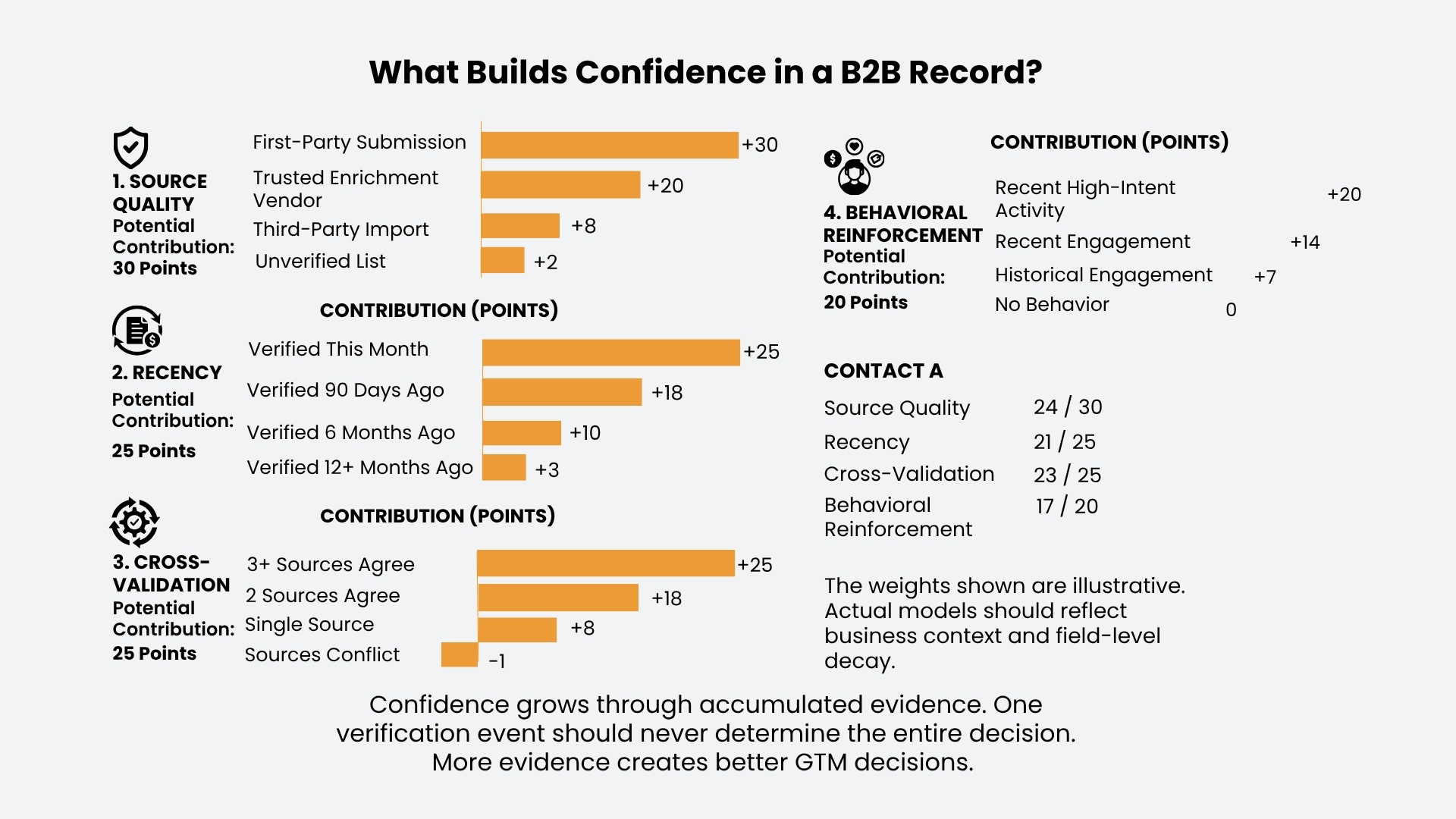
A robust B2B data confidence score draws on four tiers, each supplying its own weighted input to an overall, ever-changing score.
1. The quality of the source is key. All sources are not created equal, nor are they all equally trustworthy. First-party submission forms and direct opt-in sources have the strongest baseline confidence. Verified databases from reliable data enrichment vendors have medium confidence. Cold list append and unverified third party import sources have low confidence and need to prove themselves. The point here is not to identify a single, perfect source of information. The point is to determine how much relative weight that source adds to any particular decision.
2. Recency decay is the second tier. Data degrades, but not evenly. Phone numbers degrade faster than company URLs. High-turnover company titles expire more quickly than those of executives at steady companies. Confidence scores need time-based decay functions that correspond to the real-world degradation rates of individual data fields, not merely days since last verification.
3. Depth of cross-validation is where confidence levels become significant. Multi-sourcing increases match rates from 30% to 60% to 80% to 95%. Each independent source validating each data point should raise the score. Each discrepancy should reduce the score and mark the record for investigation rather than always choosing one or another figure. If three companies agree that the individual is a CMO, it means something. If they disagree on the same thing, it also means something, and the binary system cannot reveal anything of the kind.
4. Behavioral reinforcement is the most reliable real-life indicator. The contact who opened an email last week, browsed the pricing page, and attended a webinar is certainly reachable and engaged. Behavioral confirmation should constantly feed the confidence score with new information. Engagement history is not just a targeting signal. It is a constant validation layer.
Putting B2B Data Confidence Scores to Work in GTM Decisions
Your B2B data confidence score only has value if it changes behaviour, specifically, what gets routed, what gets enriched and what stays out of outreach.
Teams use it in a practical way in three ways:
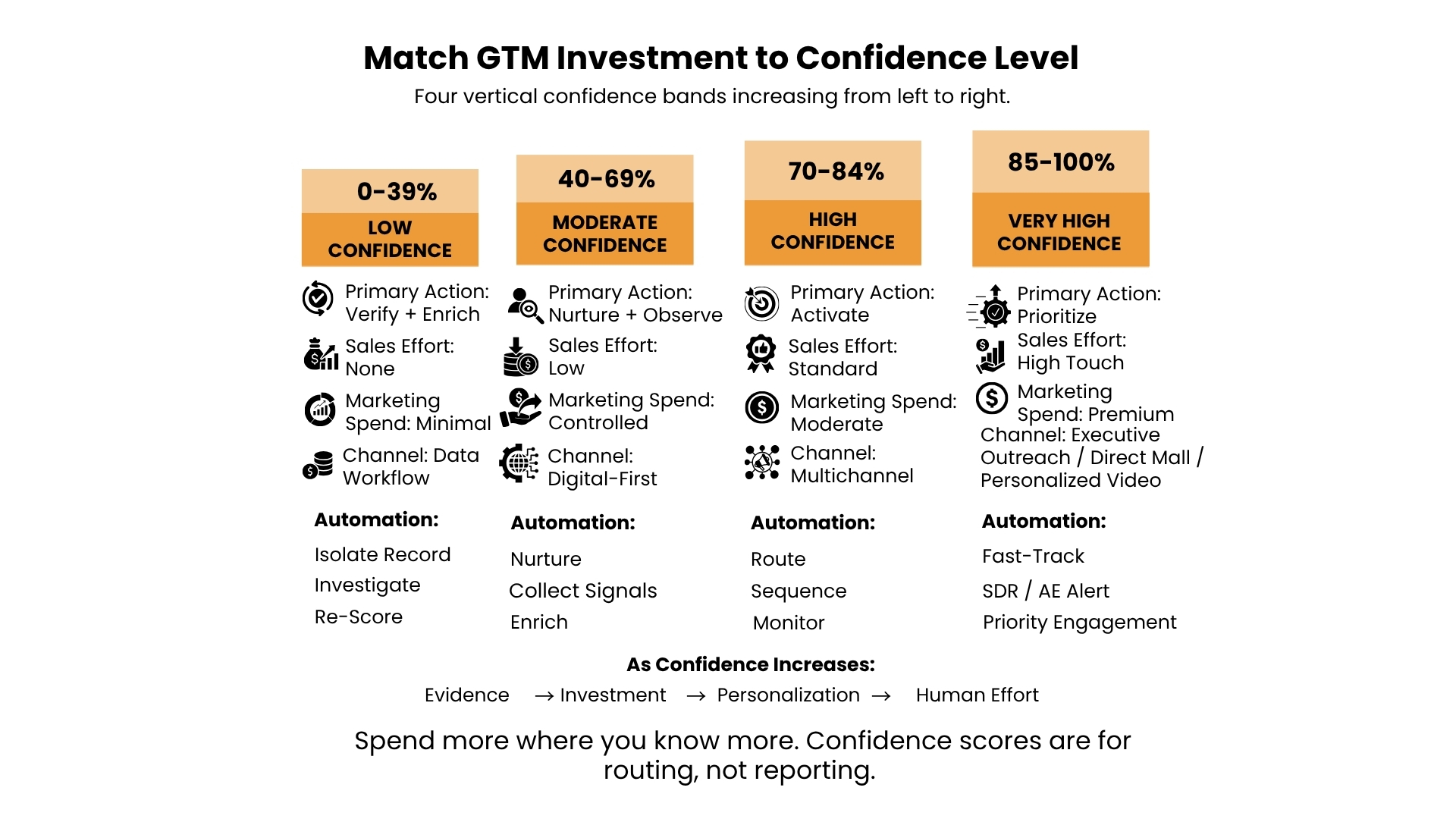
1. Prioritization logic allocates precious resources in the right places. High confidence leads to instant high touch workflows. Mid confidence records go into nurture programs while enrichment fixes issues in the background. Low confidence gets isolated for data integrity purposes ahead of any outreach efforts. This ensures teams don’t equate database size with opportunity size, which is the biggest driver of pipeline bloating.
2. Outreach intensity calibration avoids waste. When an SDR team put confidence gating in place such that reps needed records to be above a certain score before being able to make a call without manager approval, their connect rate went up 34% in just two quarters. They didn’t make any more calls but simply made the right ones.
To read more about the sales handoff process, click here.
3. Channel selection through signal strength guarantees that the budget is commensurate with the quality of the information being considered. Highly confident records with strong behavioral reinforcement can use channels like direct mail, personalized video or executive engagement initiatives. Moderately confident records would use digital-first channel sequencing. It’s wastage of outbound budget to use on any records that score low. The same spend on a high-scoring record with buying signals will be justified.
Confidence scores are meant for routing, not reporting.
Operationalizing Confidence Scoring in Your B2B Tech Stack
The implementation process involves three infrastructure questions.
First, you need CRM integration. B2B data confidence scores need to live as native fields in your CRM, visible to reps and triggerable by automation. A confidence score that is located within your data warehouse only accessible to your analytics team won’t impact the behavior of your SDRs. You have to keep in mind that the transparency of your scoring algorithm is crucial – otherwise, it just turns into one more random number that will be eventually ignored by sales. Your sales reps should understand why a certain lead received a particular confidence score.
Next, your scoring thresholds should be set as hard guardrails rather than guidelines. For instance, what is the minimum score for SDR outreach? What triggers enrichment workflows and executive sequences?
Finally, score-based automations lead to a self-healing data ecosystem. Poor scores will automatically direct the record to enrichment applications. Higher scores will initiate re-entrance into the live pipeline. Deteriorations in the score will pause communications and direct the record for inspection. When these cycles continue, the process will improve on its own.
B2B Data Quality Is a Probability System, Not a Checklist
There is a particular mental shift shared by all revenue teams who create sustainable advantages through their pipeline. Instead of asking whether data is good or bad, high-performing teams ask a more precise question: what does their B2B data confidence score allow them to do and what does it tell them to wait on?
This mental shift influences what an SDR focuses on, how budgets are allocated for demand generation, how the RevOps team creates automation logic, and how the leadership looks at pipeline quality vs quantity.
The binary validation method was made for another time and place. Today's B2B purchasing landscape is powered by job mobility, digitally native buyers, fast sales cycles, and real-time data. There can be no binary validation in such a world. It needs a probabilistic one.
The advantage goes to the team that knows how much to trust what they have and acts accordingly.