
Your CRM dashboards are green, email validations check out and firmographic fields are full. Yet the campaign launches and delivers low response rates, disqualified leads, and no pipeline movement. This is the activation integrity gap, and it costs demand generation teams more than dirty data ever will.
The cost of poor data quality in organizations averages to be $12.9 million annually but such calculations factor in only systemic flaws: duplicates, formatting problems, field errors. This calculation does not consider a far bigger problem: data that is accurate but irrelevant at the point of activation.
That is the Activation Integrity Gap. For most demand generation leaders, it represents the true pipeline loss.
What the Activation Integrity Gap Actually Means
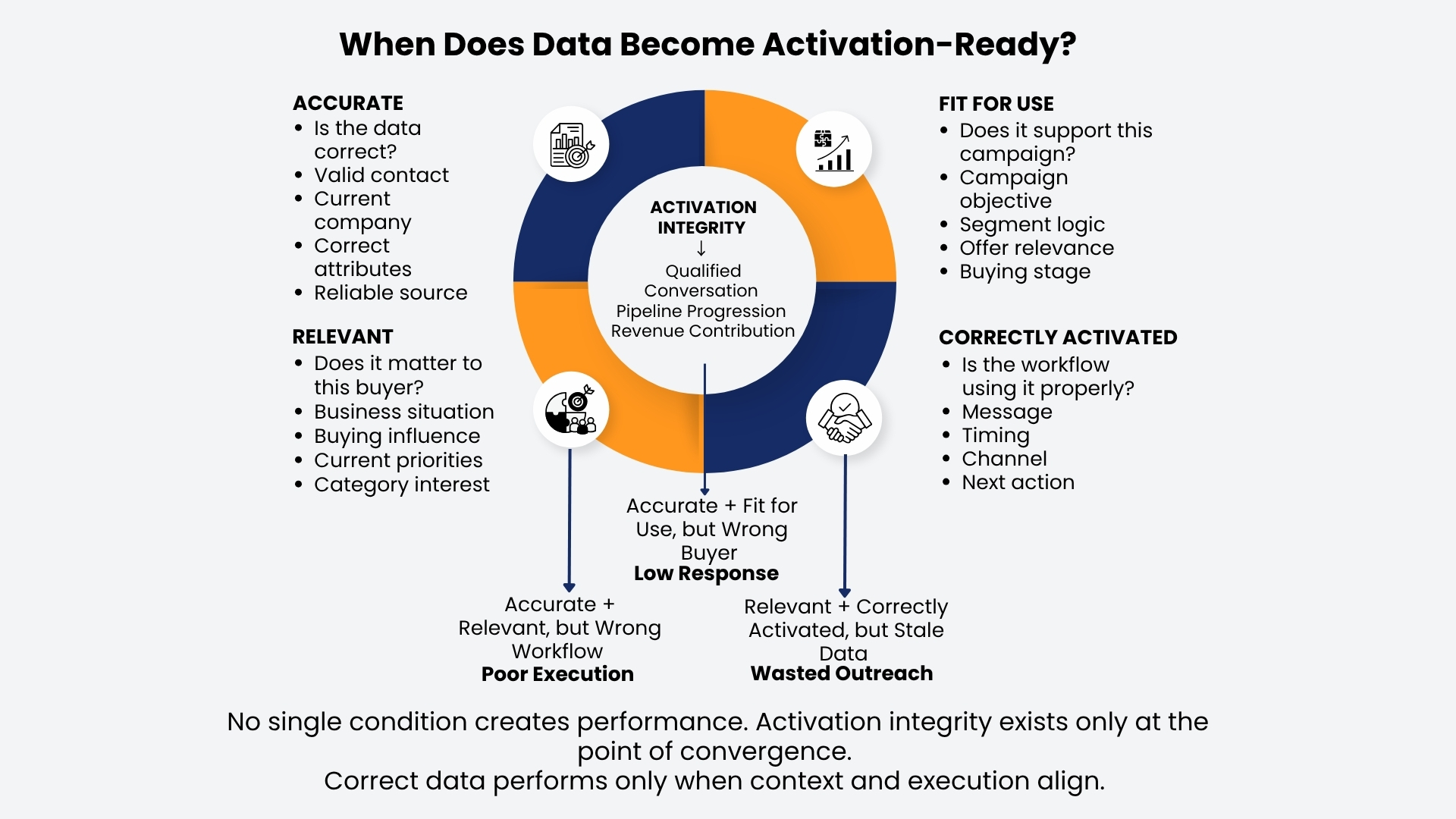
Activation Integrity is not a data hygiene metric but an execution concept.
Validation asks, "Is this data structured correctly?" While activation integrity asks "Will this data deliver the intended output after being activated within this workflow/segment/message?" Confusion between the two is where most GTM systems fail.
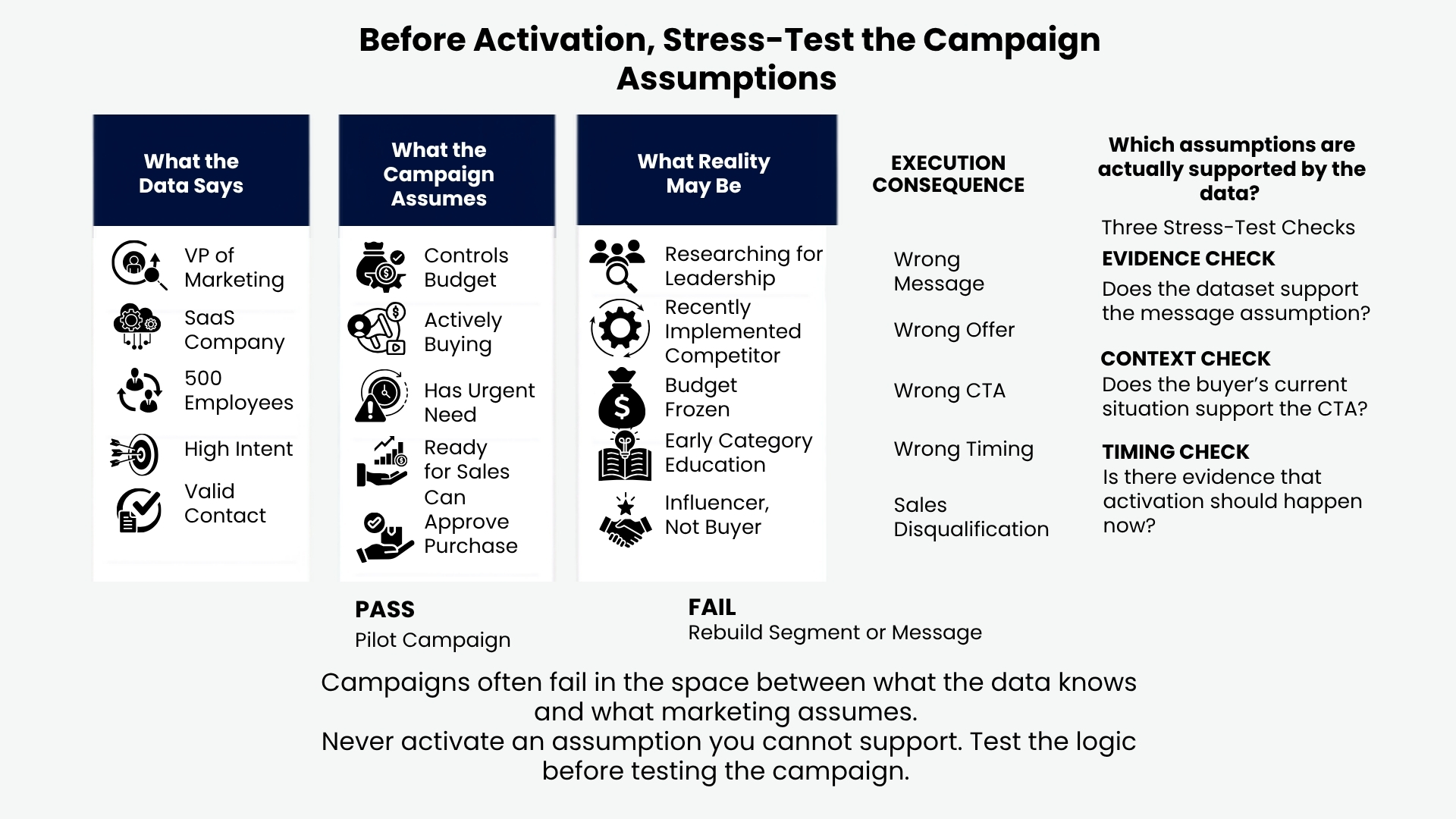
The data may be 100% accurate and 100% wrong for a particular campaign. A VP of Marketing of a 40-person Series A start-up and a VP of Marketing of a 2,000-person enterprise will have the same title. But that's about all they'll have in common - no shared budget influence, no shared sense of urgency, not even the same set of triggers to respond to the marketing outreach. Messaging will be created on a per persona basis, but data will be segmented by title. Campaigns will ship with pre-programmed misalignment between the two. The data will be accurate, but its usage wrong.
Actual activation integrity depends on the convergence of four factors: the data is accurate; the data means something for this particular buyer, the data fits this particular use case for the campaign; the data is used properly within the workflow. Understanding the activation integrity gap starts with separating validation from execution.
Where the Data Activation Gap Breaks Down
Message-Data Mismatch: The First Activation Failure
Intent data is the perfect example of where this falls apart. The demand gen team selects an account based on high research activity in their category. The intent is real. The team runs an outbound cadence. Outcomes are abysmal: subpar reply rates, too many unsubscribes, two enterprise companies asking to be taken out.
It wasn’t the data’s fault. It’s IT managers researching on behalf of a purchasing committee they never found. There was always an assumption of a decision maker, but there was an influencer. There was no effort to close the gap before going broad.
Intent signals reflect categories of interest, not purchase-readiness. The email goes to the right person but says the wrong things.
To learn more about the right type of messaging, click here.
Database Segmentation vs. Buyer Reality
CRM-based segmentation is largely based on the availability of the data rather than on the need of the buyer journey process. Firmographic fields are easily searchable, hence the creation of the segments is done on the basis of firmographics. However, the thing is that firmographics refer to business characteristics rather than to buying behaviors which determine the relevancy of the campaign.
"A campaign directed at 'Director-level and above in SaaS firms, 200 to 1,000 employees'" produces 3,800 contacts. Sounds good on paper but in reality, those contacts are at very different buying stages: some are just evaluating the competition, some implemented a solution 18 months ago, and some have never interacted with the category. Doing the same nurture sequence to all three groups is not demand generation. This is broadcasting from the database."
Additional segmentation capability doesn't necessarily mean better targeting. What really counts is whether segmentation variable changes the campaign behavior. If there's no impact on the message, offer, timing or next step, then there's almost no value in activation of the field.
Stale Records and Campaign-to-Data Misalignment
B2B databases decay at roughly 30% per year. A list that’s been checked in January has a lot of context decay in it already by June. When teams create outbound programs using old state information, they assume that these contacts are still active and looking.
The problem with the process is that the data is validated upon intake but never checked again upon activation. The discrepancy between these two steps is where the integrity of execution fails. An email address that is properly formatted but sent to a contact who recently switched jobs six weeks ago has passed validation.
Why Data Validation Alone Can't Fix Activation Integrity
Traditional validation doesn't close the activation integrity gap; it only addresses format, not fit. It ensures that email addresses are valid, phone numbers are formatted right, and that company names link to known domains. Essential infrastructure. Not enough to execute.
Validation validates structure but it does not validate usability within the context. An active phone line is not guaranteed to be answered. A job title is current but not necessarily reflective of budget authority. An organization fits your ICP criteria but not necessarily in-market for a deal. There’s no way any validation tool can tell you an executive’s budget was just cut, or that an account is locked into a years-long deal with another vendor.
According to Forrester Research, B2B sales reps spend about 27% of their time dealing with data issues: finding accurate data, correcting outreach mistakes and rerouting wrongly qualified leads. A built-in activation integrity issue embedded in the process, every quarter.
A Framework for Closing the Activation Integrity Gap
Closing the activation integrity gap requires a deliberate design layer between data acquisition and deployment.
The following framework, built around four stages, provides a starting point:
1. Define the Job Before Building the Segment
All campaign briefs must have a data requirements spec. Not just "target enterprise buyers in financial services," but: which departments control the budget for this product category? What firmographics can be correlated to show active buyers this quarter? What behaviors distinguish urgent from research this quarter?
Build the segment to the campaign, not the campaign to the segment. That way you avoid making the all-too-common error of collecting the data before finding something to do with it.
2. Validate Against Campaign Context, Not Just Field Completeness
Include the pre-launch validation step: is the data in this segment consistent with the assumptions built into the messaging? Is the assumption that the reader has a budget supported by the facts? Is the mentioned operational pain supported by the conditions in the segment that cause such pain?
This step takes less than an hour and kills more pipeline-destroying campaigns than any enrichment technology.
3. Run Activation Pilots Before Scale
Never launch an uncalibrated campaign against your entire target base. First launch it against a sample of 150-300 contacts in a controlled environment. In addition to tracking open and click-throughs, track response quality, stage of conversation, and reasons for disqualification.
Reasons for disqualification are the least utilized piece of information in demand generation. "Not the right person" and "not in market" indicate failures in campaign-to-data integrity. This gives you information on where things failed before you exhausted your entire addressable market.
4. Close the Sales Feedback Loop
SDRs & AEs are the end users of the activated data. Feedback from them will be the ground truth for activation. Develop a simple process for reps to raise flags at contact level with respect to mismatch, be it wrong title, wrong context, or wrong timing signal. This feedback should go directly to the data team and not be put in the lost deal field by the sales team.
Measuring Activation Integrity, Not Just Data Quality
The metrics that reflect activation integrity are not data metrics. They are revenue metrics.
Contact-to-Conversation Rate
Not open rate or click rate, but the rate at which outreach produces a qualified conversation. This is the clearest indicator of whether data and messaging arrived at the right person at the right moment.
Conversion Contribution by Segment
Identify which segments have been creating pipeline. Analyse not only in terms of the industry or segment but also in relation to each particular variable in the data that categorized the segment. For those segments that keep performing better, find out what made them successful and duplicate it.
Sales-Sourced Data Quality Flags
Implement a structured SDR rating system: not star ratings, but operational flags. "Contact confirmed," "contact wrong level," "contact right level wrong timing," "contact right level right timing." Over 90 days, this tells you more about your activation integrity than any vendor audit.
Organizations that measure data quality only before activation see half the picture. The other half is whether the data drove the outcome it was acquired to produce.
Data Is Not Valuable When It Is Correct. It Is Valuable When It Performs.
The demand generation teams winning pipeline right now are not operating on cleaner data. They are operating on better-aligned data: built to match the campaign, the message, the moment, and the buyer motion it is designed to activate.
Access to basic contact data has been commoditized. What cannot be commoditized is the discipline to use it with precision: aligning to use case, validating against campaign requirements, and treating every dataset as a performance asset rather than a compliance record.
The gap exists in almost every GTM stack. Every quarter spent measuring database health without measuring execution quality is a quarter of addressable market burned. The organizations that close the activation integrity gap first are the ones that turn demand generation from a volume game into a precision instrument.
Clean data gets you to the starting line. Activation integrity wins the race.