
Your team has run an event that resulted in a few hundred registrations but resulted in no pipeline over the last six months because a different person on your team ran almost the same event at a different time with very similar results. The post-mortem information about the events has been buried in a Slack channel that no one can find. The person who ran the original event has changed jobs. Next quarter, someone will likely try it again.
This isn't a problem with execution; it's a problem with GTM institutional memory; the systematic retention and application of go-to-market knowledge across teams and time.
Most B2B companies treat their go-to-market efforts as a series of one-off experiments rather than as a knowledge-building system that compounds over time. According to the Gartner 2024 Marketing Operations Report, 68% of marketing teams have limited or no access to historical campaign insights past two quarters. Therefore, teams optimize in circles, finding small incremental improvements while allowing ongoing structural inefficiencies to exist across cycles.
The cost of this is more than just through the waste of monetary budgets; it is also the missed opportunity of not continuing to build upon what you learned previously, an ongoing compounding tax that invisibly diminishes your competitive advantage over time.
What GTM Institutional Memory Actually Means
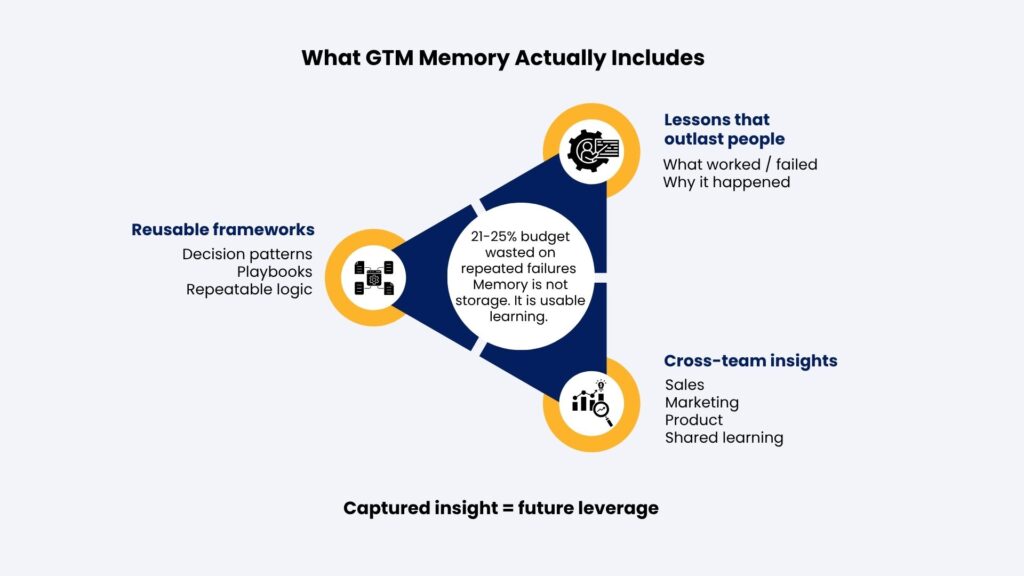
GTM institutional memory isn't simply logging everything. It's the process of collecting the right lessons in an effective manner to support future decision-making.
Real GTM memory must include the following three elements:
Lessons learned that outlast individuals
This goes beyond post-campaign reports. What needs to be captured systematically? The successful approaches, the failed ones, and the reasons behind each. One demand gen team at a Series B SaaS startup found that their most converting asset wasn't any case studies or demo videos but an ROI calculator. That lesson remained with the departing marketing manager and was lost when she moved to a competing firm. The new team took eight months to figure out that the same thing applies.
Lessons learned that cross silos
Sales enablement finds out that a certain pattern of objections occurs in all cases exceeding $100K. Product marketing realizes that there's a certain messaging that appeals to economic buyers. SDRs see that leads from a particular industry segment close three times faster. Insights like this don't cross functional lines. Without the integration of knowledge between departments, each team will work independently and duplicate errors that others have already fixed.
Re-usable decision-making frameworks that standardize decision-making processes
Apart from personal experience, memory systems must be able to recognize patterns. How do we know when to use agent-based modeling versus broad funneling methods? Who are the ICP groups that warrant personalized content journeys? What are the key drivers of an effective sales pipeline?
Why Memory Breaks Down
The failure of GTM institutional memory is not accidental. It is structural.
Poor documentation practices
This treats campaigns as transactions. While most organizations document their findings in terms of how many leads they generated, the price per MQL, and other metrics, they fail to document the strategic thinking behind these numbers. Why did they target this particular customer segment? What assumptions were made when crafting this marketing campaign? Which outside variables affected their success rate?
The manager of marketing operations for a midmarket firm shared her experience about the process of reviewing campaigns, saying, "I've got my metrics on my dashboards, but no documentation of the strategy behind it. Why did we target this customer segment? Why did we send them this messaging? Nobody knows!"
Team turnover creates knowledge extinction events
The average tenure for a demand generation manager is 18 months. When high performers leave, they take pattern recognition with them: understanding of what "good" looks like in your specific market, with your specific ICP, against your specific competitors. The new members get to learn the dashboards and playbooks but not the wisdom that shaped them.
It is for this reason that most teams suffer from performance decline once every year to one-and-a-half years despite an ever-increasing number of personnel and budgets. You are not scaling knowledge; you are re-scaling it.
Silos at the campaign level hinders learning
It is usual that most demand gen teams organize their activities into campaigns. For example, the third quarter webinar series, the drive for attending industry events, the product launch campaign. Each of these campaigns is self-contained, with its objectives, schedule, and playbook. Which message angle works consistently across channels? Do enterprise prospects engage differently than mid-market regardless of tactic? Is there a seasonal pattern in demo-to-close rates? Campaign-level silos make these patterns invisible.
The Performance Tax of Lost GTM Memory
Lost institutional memory does not just slow teams down. It fundamentally limits how effectively organizations can improve.
Iteration cycles lengthen unnecessarily
Without accessible learning, teams must re-validate basic assumptions each cycle. Does personalized outreach outperform generic at scale? Should you gate premium content or use it for awareness? What conversion rate indicates healthy list quality?
A demand generation team at a cybersecurity vendor spent two quarters testing email cadence strategies for cold outreach. Performance plateaued, prompting the director to dig through historical data. She discovered a sales development team had run comprehensive tests on the same question 18 months earlier, reaching clear conclusions that were never documented beyond an internal presentation. The team wasted six months and $80K on learning what they already knew.
Repeating inefficiencies compound invisibly
When the same inefficiencies arise again in another campaign, within another team, or even after another year, they become hard to spot as inefficiencies. Each new iteration looks unique to that individual campaign or team member. But the recurring theme goes unseen.
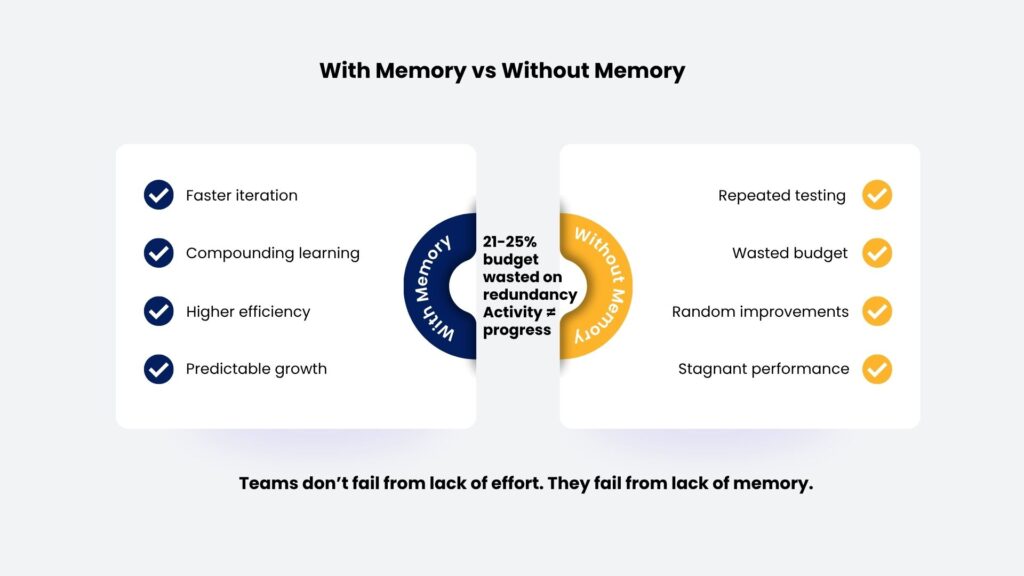
Research from SiriusDecisions indicates that B2B marketing teams waste 21 to 25% of budget on redundant activities or repeating known failures. This is not incompetence. It is systemic amnesia.
Improvement becomes random rather than accumulative
Teams that lack memory systems oscillate between tactics rather than building on validated approaches. They chase "what's working now" based on recent data points instead of recognizing longer-term patterns. This creates what looks like activity (constant testing, regular optimizations, new initiatives each quarter) but produces minimal compounding improvement.
Building GTM Institutional Memory That Compounds
Creating GTM institutional memory requires intentional infrastructure, not heroic individual effort.
Central knowledge repositories with enforced structure
This is not about creating another place to dump files. Effective knowledge systems require taxonomy, mandatory fields, and clear ownership. What question does this insight answer? What context is required to interpret it? How does it connect to other learnings?
Insight cards should be developed based on major insights gained from the process using a format. The insight cards include the context (e.g., audience, medium, timeline), key insight learned, evidence used to generate insights, and future actions. The insights are coded across several dimensions (i.e., ICP segmentation, funnel stage, medium, and message theme).
You can read more here.
Structured campaign debrief frameworks that extract patterns
Typical retrospectives generally consider performance: what went right or wrong, what we should do differently next time. Memory building debriefs go further in uncovering strategic learning opportunities.
Each campaign will require a formal debrief that addresses the following questions: What did this teach us about our target market? Were there any assumptions proven or debunked? What lessons would you pass along to a colleague launching a similar campaign in one year?
The trick is distinguishing between campaign-specific techniques and generalizable lessons learned. "Webinar attendance down 40%" is an indicator. "Target market responds better to live Q&A than recorded presentations when customer-generated questions have been seeded beforehand."
Insight activation mechanisms that surface learning at decision points
The knowledge held in a repository does not dictate action. The process needs to push the right insights to teams at the right times.
Prior to embarking on any new venture, teams need to ask themselves: Have we engaged with this demographic group before? What did we discover then? Any historical insights on messaging, preferred channels, or conversion trends? A simple checklist question of "Have historical insights been considered and utilized? Yes/No" will do just fine.
Making GTM Knowledge Actionable
Infrastructure alone will not change behavior. Three practices help translate captured knowledge into improved performance.
Embed learnings directly into execution workflows
The best place to apply prior knowledge is not a retrospective. It is during active planning and execution. Create campaign briefs that explicitly reference and build on previous learnings. When segmenting audiences, surface historical performance data by segment. When drafting messaging, show which value propositions have converted previously with similar audiences.
Standardize playbooks that encode proven patterns
Playbooks aren't recipes. Playbooks are collective wisdom on what’s proven to work in particular situations. Should you use multi-touch nurturing plays or single asset plays? Which content recipe is most effective for technical versus business audiences?
Good playbooks will capture the rationale behind why the approach worked and when it stopped working. The result is that the playbook evolves into something more valuable than a rigid set of steps.
Create continuous learning loops with systematic review cycles
Quarterly or bi-annual learning reviews force teams to step back from execution and look across campaigns for emerging patterns. What themes appear consistently? Where are we seeing diminishing returns? Which experimental approaches deserve broader testing?
These sessions should produce actionable outputs: updated playbooks, new insight cards for the knowledge repository, identified knowledge gaps that require further testing.
From Isolated Wins to Compounding Advantage
The highest-performing demand generation teams are not necessarily the most creative or best-resourced. They are the ones that learn faster than competitors because they build on accumulated knowledge rather than starting fresh each quarter.
Your organization has already run hundreds of experiments, invested millions in campaigns, and generated valuable signal about what moves your specific buyers in your specific market. The question is not whether you need new insights. It is whether you are using the ones you have already paid to generate.
At ProspectVine, we view the GTM institutional memory problem as the primary barrier to sustainable scale. Most companies focus so intently on reach that they forget to build recall, both in the minds of their buyers and within their own teams. Our philosophy is built on earned continuity. We understand that your best leads come from the compounding effect of your past work.
Institutional memory is not about preserving the past. It is about compounding the future. Every insight captured is leverage for the next campaign and every pattern documented accelerates the next decision. Furthermore, every framework refined increases the odds of repeatable success.
The teams winning in B2B are not the ones executing more campaigns. They are the ones ensuring each campaign makes every future campaign smarter. Growth is not a function of effort. It is a function of how much you have learned and how well you have applied it.