The B2B Outbound Trust Gap: Why Buyers Ignore You Even When Your Message Is Relevant

Your SDRs are hitting the right accounts. Intent signals are strong. Messaging references real pain points. And still, silence.
This is not a targeting problem. It is not a data problem. It is a trust problem; specifically, a B2B outbound trust gap that no amount of personalization or intent data can close on its own.
Today's buyers receive an average of 150-plus outbound touches per quarter from vendors claiming to solve their exact challenges. They delete emails referencing their recent job change, their company's funding round, and the webinar they attended last week.
According to a benchmark from 2025 involving 3,200 B2B decision-makers, 86% had been reached by vendors with highly relevant content yet without their trust that would compel them to respond. The average response rate of B2B email campaigns fell from 8.5% in 2018 to 1.3% in present times despite increasing personalization and intent-based outreach.
It is now no longer about "Are buyers getting your message?" but rather "Do they think replying is worth their effort?"
How Relevance Stopped Closing the B2B Outbound Trust Gap
Relevance was once the differentiation point. With intent data, AI augmentation, and sequence creation technology, it became a science. It has now become the base point for marketing rather than the differentiator.
Over 60% of in-market accounts now receive three to five well-targeted outreach sequences per month from vendors in the same category. In some enterprise tech segments, that number climbs to eight to ten sequences per account over a six-week window. Consumers are not receiving random spam emails. They are receiving targeted, data-driven, highly relevant messages from many companies all at once.
Relevance as a competitive edge disappears when every company is working with the exact same type of intent data, enrichment software, and plays. It becomes baseline noise. The threshold buyers now apply is no longer "is this about my business?" It is "am I going to be respected here, or just used?"
How the B2B Outbound Trust Gap Was Built
The B2B trust deficit was not an accident. It was engineered by the systems designed to scale growth.
Automation sans accountability resulted in the replacement of human intuition with automated triggers. According to a 2025 RevOps audit performed for seven fast-growing B2B brands, between 33% and 39% of their email outreach campaigns used triggers that did not necessarily imply purchase interest but seemed valid enough from a quantitative point of view. When automation outpaces trust, all engagements resemble transactions.
Over-personalization crossed a critical line. There is a meaningful difference between demonstrating context and demonstrating surveillance. Referencing a buyer's LinkedIn post signals attention. Referencing their non-public browsing history signals tracking. A 2024 LinkedIn study found that overly specific behavioral references without any prior relationship were the single largest driver of distrust in outbound outreach.
Message convergence eroded differentiation entirely. When multiple vendors all start with “reaching the right customer at the right time with the right message,” the claim loses its meaning entirely. In competitive categories, consumers cannot tell brands apart based on their messaging anymore. Consumers will judge brands based on how credible the brands’ messaging appears to be – through tone, restraint, and consistency.
What Closing the B2B Outbound Trust Gap Actually Requires
Buyers have not stopped engaging with vendors. They have raised the threshold for who earns their attention. That threshold is built from three compounding signals: familiarity, consistency, and restraint.
Familiarity beats novelty. A brand that maintains steady presence across key channels will consistently outperform an unknown vendor attempting to grab attention with a disruptive sequence. Trusted vendors convert high-signal intent moments into meetings at 2.5 to 3 times the rate of unknown vendors. Unfamiliar vendors need three to four times more touches to earn even a basic exploratory meeting. This is the mechanism behind every B2B outbound trust gap; not bad targeting, but broken relationship signals.
Consistency beats cleverness. Buyers are not comparing one campaign against another. They are comparing an entire year of signals against a brief evaluation window. A 2025 study of 120 enterprise buyers found that brand trust correlated most strongly with consistency in tone, messaging, and cadence across channels, not with creative "break-the-pattern" campaigns. A CMO at a 200-million-dollar SaaS company described her evaluation process: "If I only hear from you when you want something, I assume you're desperate."
Restraint has become a legitimacy signal. Trusted vendors reach out only after a clear behavioral or intent signal. They close sequences with informational value, not a "why won't you respond" follow-up. Calm, well-timed engagement signals confidence. Aggressive persistence signals desperation.
Rebuilding Trust Through GTM Design
Closing the trust deficit requires redesigning demand generation architecture, not just optimizing copy.
Intent Timing Over Message Brilliance
Forrester research shows that 68% of B2B purchases involve vendors the buyer had already heard of before entering active evaluation. The window for building trust is not the moment someone downloads a whitepaper. It is the six months before they know they need a solution.
Demand leaders are allocating more budget to long-cycle awareness tactics: niche sponsorship opportunities within podcasts, industry insights, practical tools such as calculators, benchmark studies, and problem-solving content that doesn’t ask for lead generation through form completion. The idea is to have the brand top-of-mind when the buying window opens up, not when it’s happening.
Multi-Touch Credibility Over One-Shot Persuasion
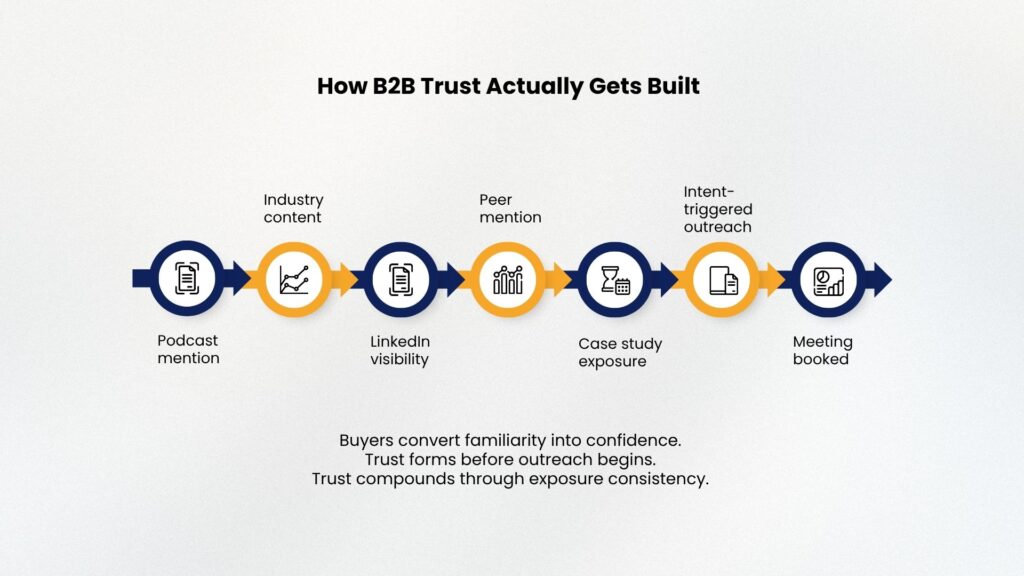
Consider two approaches to the same buyer. The first is to send a personalized email with three CTAs and four follow-ups within two weeks. The second guarantees that the buyer will see the brand while listening to a podcast, see another person's mention on Slack, see a collaborative analyst case study, and finally receive one email with context after visiting the pricing page.
The second approach converts at three to five times the rate because trust has been partially built through ambient exposure before direct outreach begins. Multi-touch credibility sequences designed around responses rather than rotations achieve 2.7 times higher meeting rates than full-pitch sequences, even against the same accounts.
Human Escalation at the Right Moment
Automation without accountability deepened the B2B outbound trust gap long before buyers could name it. Automation should build the foundation. Humans should capitalize on it. Accounts that first spoke with a signals-aware specialist who had already reviewed the account's context converted 29% higher than accounts routed into a standard SDR slot without that preparation. When buyers see that the human cares about their situation rather than just booking a meeting, trust increases.
You can read more here.
How ProspectVine Designs GTM Flows That Close the Outbound Trust Gap
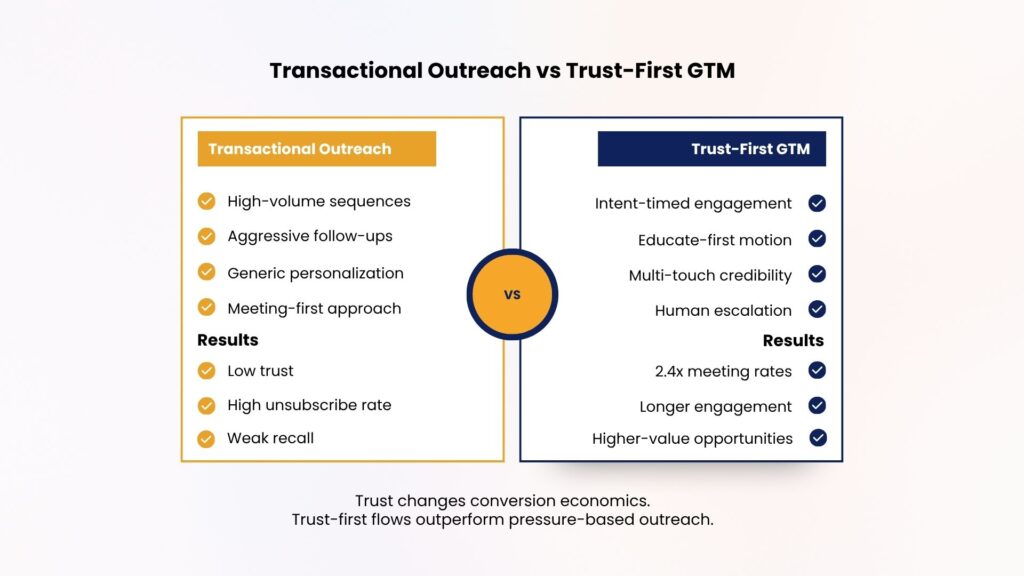
ProspectVine's GTM architecture is designed specifically to address the B2B outbound trust gap and filters intent into trust-safe tiers and routes accounts into distinct motion types: educate-first for early-stage curiosity, light-touch exploration for mid-stage interest, and capped high-intent sequences for accounts showing clear readiness signals.
In 2025 internal benchmarks, accounts that moved through trust-first flows engaged 41% longer per session, booked meetings at 2.4 times the rate of generic sequences, and produced 32% higher-value opportunities with 21% shorter sales cycles. The constraint was never the message. It was the design of the relationship.
New Metrics for Trust-Led GTM: Measuring the Right Buyer Trust Signals
If trust is the goal, traditional KPIs become misleading.
Response quality over response volume. A 5% response rate doesn’t matter when 80% of your answers say "remove me." Monitor engaged response rate, i.e., answers with a question, a request for more information, or an agreement to meet. Organizations focusing on quality have 2.9 times higher forecast coverage ratio compared to organizations focused on meetings.
Re-engagement rates reveal brand equity. Companies with strong trust infrastructure see 25 to 35% re-engagement rates from buyers who initially said "not now." Those relying on transactional outreach see below 5%.
Brand recall without form fills. When surveyed, closed-won customers report that anywhere from 40 to 60 percent of them had known about the company for at least six months, without ever completing a form or clicking on an ad. The trust-building process had been taking place quietly all along. Last touch attribution models completely ignore the contribution of those trust-building channels.
Sales conversations that start warm. When a discovery call begins with "I've been following you for a while" rather than "can you remind me what you do," the trust deficit has already been closed before the meeting starts. Those deals carry 50% higher close rates.
From Interruption to Infrastructure
B2B demand gen was designed for a time when buyers had limited access to information, and companies were competing for their attention. Nowadays, buyers are awash with unlimited information, and companies are competing for their trust. This is a completely different currency altogether – one which cannot be hacked or automated or engineered by great copy.
Those that succeed won’t necessarily be the noisiest or most optimized. They will be the brands that buyers revere even if they've never pressed the "book a demo" button on them before. You need to change your criteria of measuring success, rethink your flow and approach to communication, and regard each encounter with a buyer as an exchange of trust credits. The shift from interruption to infrastructure is how the B2B outbound trust gap finally closes.