The Execution Lag Problem: Why B2B Strategy Fails to Build Pipeline

Your Q3 strategy offsite was flawless. The market analysis was rigorous. The ICP was clearly defined. The messaging framework was sharp. The board approved the plan. Ninety days later, pipeline is flat. The B2B execution lag between approval and action has swallowed your growth and you're not alone.
A HBR study of 522 B2B professionals found a 45-point gap between strategy and execution: while 83% say their GTM strategy is very important, only 38% rate their execution as very effective.
The problem isn't your strategy. It's the delay between decision and deployment. And that delay is now a board-level concern.
What Execution Lag Actually Means in B2B context
B2B execution lag isn't just about slow teams. It's about system friction between strategy and action, manifesting in three distinct ways.
Delay between decision and deployment
A strategy approved in January should launch in February. But approvals multiply. Legal reviews add days. Compliance stretches timelines. By the time the campaign launches, the market has moved. According to Gartner research, the average enterprise marketing campaign takes 6-8 weeks from approval to launch. During that window, competitive landscapes shift and buyer priorities evolve.
Loss of context during handoffs
Strategy is set at the executive level. Execution happens at the operational level. Between them, context leaks. What started as "position against competitor X's new feature" becomes "update the comparison page", a tactical shadow of strategic intent. Research shows that around 80% of marketers report friction between sales and marketing teams concerning GTM execution, creating confusion over ownership.
Misinterpretation of strategy
When strategy is documented in dense slide decks rather than executable playbooks, interpretation varies. A "focus on enterprise" might mean different things to demand generation, product marketing, and sales development. The result is fragmented execution that never achieves strategic weight.
Why B2B Execution Lag Breaks Down GTM Strategy
Understanding the root causes of B2B execution lag requires examining structural barriers.
Multi-layer approvals
In enterprise organizations, a single campaign may require approval from marketing, legal, compliance, brand, regional leadership, and product. Each layer adds days or weeks. A typical demand campaign in a mid-market B2B company touches 7-9 approval stakeholders. Each approval cycle adds 3-5 days. By the time all sign-offs are secured, the original insight that inspired the campaign is stale.
Tool complexity
The average enterprise marketing stack includes dozens of tools. CRM, marketing automation platform, ABM platform, intent data, analytics, sales engagement, and more. Each tool adds integration complexity. When tools don't talk to each other, execution slows to the speed of manual data transfer. As one analysis noted, most B2B teams say they've automated when what they've really done is stitch together fragile hacks that break the second you scale.
Lack of clear ownership
Research found that 48% of marketers identify poorly integrated systems and data sources as the biggest challenge in designing GTM strategy. But the deeper issue is ownership. When no single team owns the end-to-end execution flow, delays cascade across departmental boundaries. There isn't a function within most organizations that owns the entire customer journey end-to-end.
Over-documented strategies
Strategy documents that exceed 50 pages are unreadable, not actionable. They become artifacts, not operating systems. The organizations that execute fastest have strategies that fit on a single page, translated into clear workflows that anyone can follow.
How Execution Lag Destroys B2B Pipeline Growth
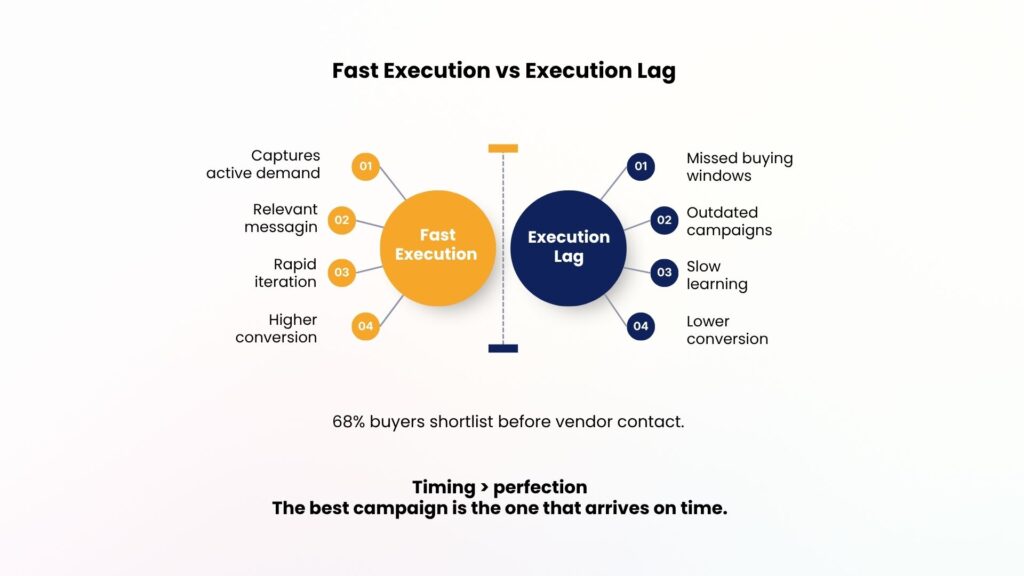
The consequences of B2B execution lag hit pipeline directly in ways that traditional demand metrics miss.
Missed timing windows
B2B buying windows are not infinite. Forrester found that 68% of buyers had already shaped their shortlist before engaging with vendors. If your execution lag means you're showing up two months late to a conversation that moved on, you're not in that consideration set. When follow-up to an intent signal takes weeks instead of days, the buyer has already moved on. Workhuman CMO Saima Rashid set a six-minute SLA for inbound follow-up, noting that not everyone can hit it, but AI can, because speed determines whether a raised hand becomes a meeting or a lost opportunity.
Reduced campaign relevance
A campaign built around a competitive response loses impact if it launches after the competitive narrative has evolved. Example from real world: A SaaS provider created a campaign targeting the change made by their competitor regarding their pricing strategy. But seven weeks after getting approval for their campaign execution, it came to notice that the competitor’s pricing plan changed again along with their communications. This campaign executed well with traffic, but the pipeline was 60% lower than estimated.
Slow iteration cycles
Modern demand generation requires rapid testing. If your campaign infrastructure takes six weeks to deploy initial campaigns and 2-3 weeks to implement changes, you can't iterate fast enough to optimize within a quarter. You're running annual experiments in a market that moves monthly. When each campaign takes months to launch, learning loops stretch across quarters. Teams cannot test, learn, and optimize rapidly.
Eliminating Execution Lag: Design for Speed and Deployment
To eliminate execution lag in B2B and accelerate pipeline velocity, systems must be designed for speed and clarity.
Simplify strategy translation
Strategy must be translated into execution-ready frameworks, not dense slide decks. Instead of comprehensive campaign briefs, create executable playbooks. One B2B company replaced their 35-page campaign documentation with a single-page execution brief containing: the strategic bet (one sentence), target behavior change (specific action), success metric (single number), and constraints (what we won't do). Execution teams reported 40% faster deployment because they spent less time interpreting and more time executing.
You can read more, here.
Reduce dependency chains
Every approval layer, every handoff, every integration point adds delay. Map your execution flow and identify where dependencies create bottlenecks. Build campaigns that can deploy in phases rather than requiring every component to be perfect before launch. Launch with core content and one channel, then layer in additional elements weekly. This allows you to capture timing windows while building campaign depth over time.
Establish clear ownership
Define who can make deployment decisions without approval cycles. Example framework: campaign owners have full authority to deploy if target audience, budget, and messaging stay within pre-approved parameters. Any deviation requires approval, but execution within bounds moves immediately. Every strategic initiative should have a single owner responsible for bridging the gap; someone who ensures that the original strategic intent remains intact from the boardroom to the browser.
Build real-time feedback loops
Execution cannot improve without visibility. Rather than quarterly strategy reviews, implement weekly signal sessions where execution teams share what's working in-market and strategy teams adjust direction accordingly. When campaigns launch late, understand why or when handoffs fail, redesign them. When tools break, fix them permanently.
The ProspectVine Perspective: Engineering Velocity
At ProspectVine, we believe that the gap between strategy and pipeline is where most B2B revenue goes to die. Our view on the execution lag problem is that it's fundamentally a failure of earned continuity. We help our clients build GTM systems where the strategic narrative is modular and ready for immediate deployment.
We don't just give you a strategy but also the signals and the frameworks to act on it before the market shifts. By respecting the buyer's time economy and prioritizing recall over reach, we help you turn decision drag into pipeline velocity. We believe the most successful brands won't be the ones with the most resources, but the ones with the shortest distance between a good idea and a customer conversation.
Practical Takeaways: Reduce Execution Lag in Your GTM Strategy
Audit your execution lag
Measure time between strategy decision and campaign launch. Map your last three strategies to actual launch dates. Calculate realization rate. Time your current strategy in flight. The numbers will likely confirm what you suspect.
Design for deployability
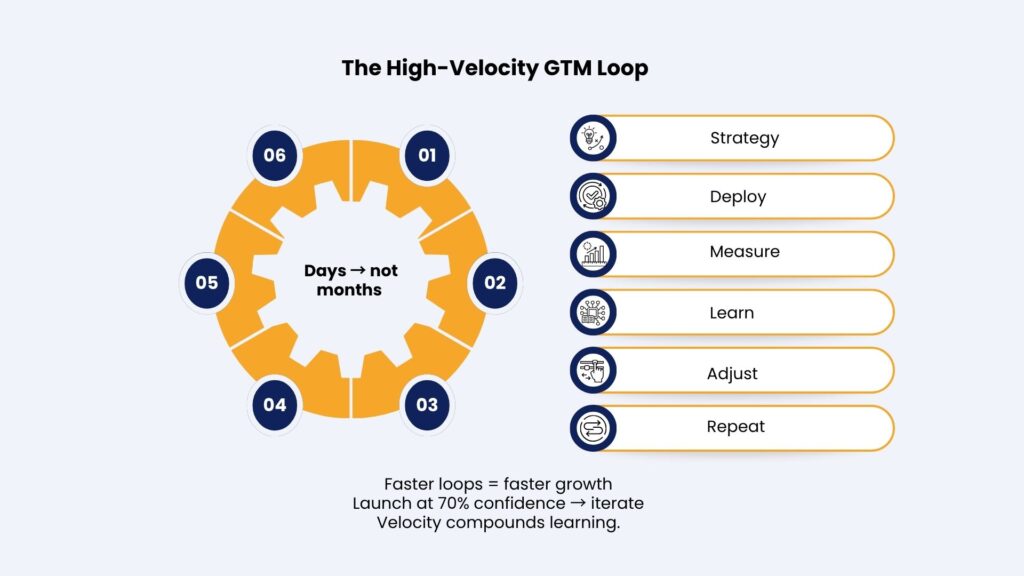
If strategy cannot be executed quickly, it's not effective. Perfect is the enemy of launched. Launch quickly, learn and evolve. The most effective business-to-business demand generation programs launch campaigns at 70% confidence, while iterating based on response instead of waiting for 95% confidence before launching.
Favor speed over perfection
Speed creates opportunity to learn.If you can launch in a week, you learn 52 times a year. If it takes you a quarter to launch an experiment, you can only learn four times a year. High execution lag ensures that your competitors are learning at a higher frequency than you are.
Focus on signal timing
Act on signals when they occur, not after. Buyer intent is time-sensitive. Signals such as website visits, content engagement, and research activity decay quickly. If execution lags, outreach happens too late, relevance drops, and conversion probability declines.
Eliminating Execution Lag as Competitive Advantage
B2B execution lag; the gap between strategy and execution, is not a minor inefficiency. It's the structural reason most B2B GTM strategies fail to deliver pipeline. With 83% of organizations rating their strategy as important but only 38% rating their execution as effective, the gap represents the single largest opportunity for competitive advantage in B2B go-to-market.
In markets where Gartner data indicates that B2B buying cycles are compressing (now averaging 83 days for deals under $50,000), timing precision matters more than campaign perfection. The campaign that reaches buyers during their active evaluation window with good messaging outperforms the perfect campaign that arrives after they've made their decision.
The fix is not better strategy. It's solving execution lag through faster deployment. The organizations that break through plateaus are not those with the most brilliant plans, but those that have redesigned their operating models to move from decision to deployment in days, not months. Because in B2B, where buying windows close and markets move, the speed of execution is not an operational detail. It is the strategy.
Your next strategy session should include one question that rarely gets asked: How fast can we deploy this? Because if the answer is measured in months, your brilliant strategy is already obsolete before it reaches market.