The B2B Attention Collapse: Why Buyers Tune You Out Faster Than Ever

Your open rates are holding. Your sequences are firing on schedule. Response rates keep dropping anyway and that gap has a name: the B2B buyer attention collapse. This isn't a messaging problem or a targeting problem. It's what happens when cognitive demand exceeds a buyer's available processing capacity. Your message reaches them, registers as relevant, and gets deleted regardless.
A RevOps benchmark for 2025 among 58 companies involved in B2B sales showed that 67% of highly intent-based leads did not engage with the outreach because the recipient had insufficient cognitive energy available to digest it, despite having no relevance concerns about the message. Benchmarks show that on average, businesses receive only 1% to 5% response rates to their B2B emails, and response rates declined by 28% to 39% within three years, despite improvements in personalization.
The challenge isn't about making buyers notice you anymore. It's about getting their attention.
B2B Buyer Attention Is The New Pipeline Bottleneck
This has quickly evolved. During the 2010s, the problem was visibility – potential customers didn’t even know that you existed. During the early part of the 2020s, it’s become relevancy. The problem today is that you can be seen, known, and have high intent signals; and despite all of that, you don’t get engaged. This is the mechanism behind B2B buyer attention collapse; a shift from visibility as the bottleneck to cognitive capacity.
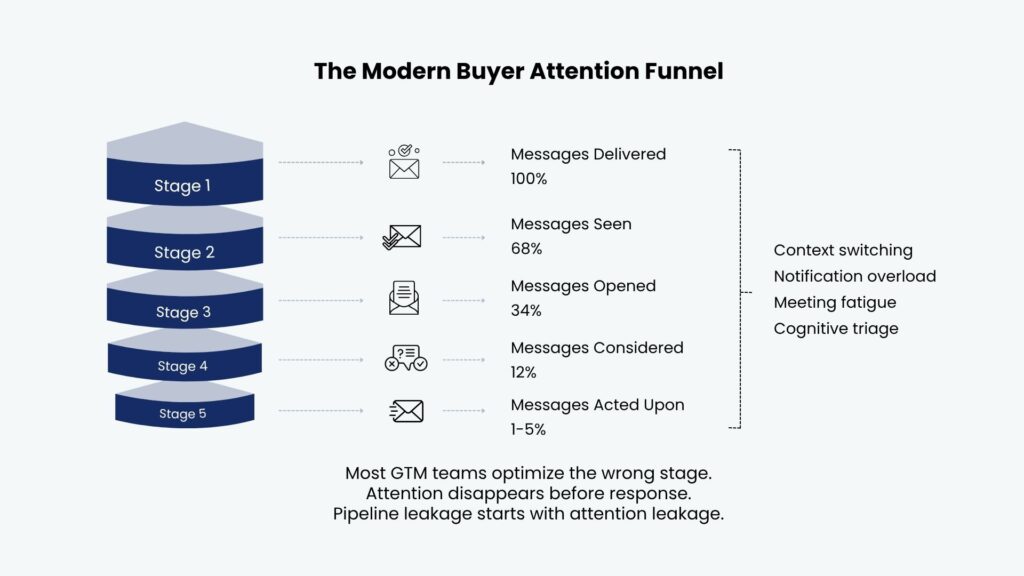
In a survey conducted in 2025 among 1,800 business decision-makers in 12 different verticals, on average, the buyer sees around 120 to 180 vendor messages per week via email, LinkedIn, Slack, advertising, and conferences. Only 8% to 12% actually pay attention to what those vendors send. Most importantly, 43% of those surveyed said that they deliberately ignore messages deemed relevant by filtering their own cognitive bandwidth towards more important stuff.
The pipeline impact is clear: visibility no longer equals pipeline. You can be in the inbox, in the feed, and at the event, and still be invisible to the buyer's active attention. When cognitive volume exceeds processing capacity, the default response becomes tuning out. That is the attention collapse.
What Caused the B2B Attention Collapse
The breakdown is systemic, not cyclical. The convergence of four major factors caused the breakdown.
Exponential growth in tools has fractured the focus of buyers irreparably. The average enterprise uses more than 200 software-as-a-service applications, which trigger notifications, updates, and alerts. Knowledge workers use 15 to 20 applications per day, get 80 to 120 notifications each day, and spend 35 to 40% of their day context-switching. You're not battling your competitors; you're battling the buyer's noise stack.
Always-on async culture eliminated the focused work block where buyers once evaluated solutions. Today, decisions are made in the interstices between meetings, during travel, and while juggling Slack threads. In a 2025 study of remote workers, 72% of knowledge workers said they felt “always on” but rarely “really here.”
AI-generated content flooding channels has created what researchers call content shock at scale. Over 60% of B2B outreach emails now contain AI-generated or AI-assisted copy. When every message is personalized, none feel personal. Buyers have become expert at pattern-matching and dismissing content that follows the generic AI cadence, even when the underlying message is genuinely relevant.
Declining executive bandwidth compounds everything. Senior decision-makers now spend only 12 to 18 minutes per day on external vendor research. Forty-one percent said they actively avoid new vendor conversations unless there is a clear and immediate need. You can read more about this here.
How B2B Buyer Attention Collapse Breaks Traditional GTM
Traditional demand generation was built on a simple assumption: reach qualified buyers frequently enough with a relevant message, and conversion follows. That logic is now actively counterproductive.
Relevant messages get ignored anyway
Under normal circumstances, the principle of relevance determines response. Under scarcity conditions, however, even a relevant message must still obey the rules of cognitive triage. The CMO who is dealing with an internal IT glitch, a board meeting, and a product launch is unlikely to return to the email sent at the wrong time. Once skipped during the initial triage window, it rarely gets a second look. A 2025 demand benchmark found that 63% of high-relevance messages were opened but not engaged with, and 41% of buyers read a message but did not respond because they lacked time to act on it.
Follow-ups backfire faster
The traditional logic of persistence has inverted. A 2024 outbound study found that after three to four follow-ups, the probability of positive engagement dropped 47%. After five or more follow-ups, negative engagement, including unsubscribes, blocks, and hostile replies, increased 32%. In a collapsed attention environment, repeated exposure without escalating value signals desperation. Buyers have learned that aggressive follow-up sequences correlate with low-quality solutions.
Frequency costs more than copy quality
The vast majority of GTM teams perform A/B testing on their email subject lines. Fewer still pay attention to the costs of attention when implementing their sequence cadences. GTM teams who have cut their touch rates from five-seven touches a week to two-three touches a week saw an 18% increase in response rate, a 23% increase in meeting conversion rate, and a 31% decrease in unsubscribes. The problem wasn’t the message. It was the attention architecture.
Designing GTM Around B2B Buyer Attention Limits
Adapting to B2B buyer attention collapse means redesigning architecture, not copy.
Fewer Interruptions, Higher Signal Per Contact
Each contact should offer some form of new information, a new point of view, or a contextual element that moves the buyer’s thought process forward even if they don’t schedule a phone call. Eliminate any unnecessary introduction or generic value statements. Start the conversation with an objective point of view in the first couple of sentences. Eliminate any tokens in the outreach that may refer to the buyer’s alma mater or weather patterns in their backyard.
Respect-Based Sequencing: Let Buyers Control the Pace
Every contact you make should be treated like a withdrawal from your customer’s attention bank. The idea is to deposit via the right timing, relevance, and moderation prior to withdrawing. These deposits take form through more time between contacts, allowing for opt-outs without barriers, and stopping your efforts when the prospect consumes your content, not increasing them. Buyers in a 2025 customer sentiment study showed a 2.3 greater engagement rate and 28% higher retention over 12 months when shown respect in their outreach.
Buyer Recognition Over Persuasion: The Attention-Era GTM Shift
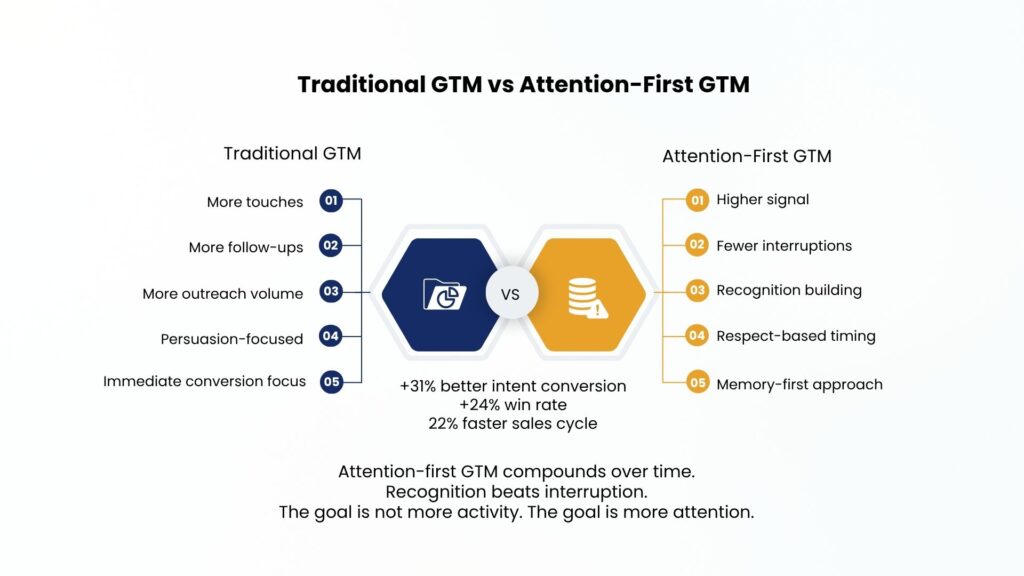
Conventional marketing relies on persuasion. Here’s the problem; here’s the solution; here’s the return on investment (ROI); here’s the call-to-action (CTA). Awareness-focused GTM strategy focuses on recognition. It is not about converting prospects immediately. It is about becoming familiar enough that when they are ready to buy, the brand comes into consideration. According to a study conducted in 2024, brands that concentrated on consistent and low-pressure marketing performed 31% better on intent conversions, 24% better on win rates, and their sales cycle was 22% faster.
Remove friction from your highest-value assets
Making a distracted executive fill out an eight-box form to access a trends report immediately generates friction. Share your best insights un-gated. Track engagement from your target enterprise domains through backend identity resolution, then let this drive your outreach strategy, not replace it.
At ProspectVine, this principle influences all the interaction models. The model considers not only the intention indicators but also recency, saturation, and attention debt. The final output is communication that takes into consideration the buyer’s capacity to listen and comes across as a conversation rather than an intrusion.
Metrics That Actually Measure B2B Buyer Attention
Traditional GTM dashboards measure the wrong things for an attention-scarce world.
Attention depth over attention reach
Reach tells you how many buyers saw your message. Attention depth tells you how many processed it. Proxies include scroll depth, time-on-page, video completion rates, and reply quality. A one-word reply and a three-paragraph reply are not equivalent signals, but most CRMs treat them identically. Teams that prioritized depth over reach had 2.7 times higher forecast-coverage ratios and 31% higher win rates.
Time-to-recognition
How fast does a new prospect realize what problem your company solves? Companies which shortened their recognition period by reducing it from six to eight months to three to four months have seen an increase in conversion of 28 percent and shorter sales cycles of 19 percent.
Engagement recovery after silence
What percentage of buyers who go dark re-engage after a strategically timed pause? Brands with strong recovery rates achieved 24% higher lifetime value over three years and 27% higher referral rates. Recovery rate exposes whether your silence is a deliberate tool or an accident.
The Forward View
The B2B buyer attention collapse is not a phase to wait out. Channels will not get less saturated. AI-generated content will not decrease. Buyers will not get less busy.
What makes for sustainable pipeline formation in such a climate, however, is a completely different approach to the question at hand. It is an approach based on the sensibility of an editor rather than a broadcaster. Instead of thinking about ways of reaching more people, they will think about earning the right to be listened to. It won't be enough to ensure that the message got through – it needs to stick around long enough to survive the next thousand times the buyer changes contexts.
Visibility isn't pipeline. Respect isn't visibility. Recognition is pipeline. And the quickest way to go from outreach to money flows through the buyer's memory, not just their inbox.