Your product fits the brief and pricing is competitive. Your demo goes well. And then the VP says: “Send references.” You get cut from the shortlist before you ever have a real shot.
This is the B2B trust gap, and credibility engineering is the only reliable way to close it. In today’s B2B markets, trust kills more qualified deals than price, features, or competition combined.
Research from LinkedIn and Ipsos, covering 1,500 senior marketers, found that 94% agree trust is the key to success in B2B. Yet most organizations treat credibility as something that accumulates naturally over time. It does not. Buyers complete 70% of their research before speaking to a salesperson. If your marketing has not built trust by then, you will not make the shortlist.
At ProspectVine, we call this the credibility gap and we’ve seen that closing it requires more than patience. It requires engineering trust in every signal a buyer receives. The organizations that win do not wait for trust to appear. They engineer it.
Why B2B Buyer Trust Is the Real Barrier to Closing Deals
Anxiety management is the root cause of B2B buying. A poor purchase will not only waste your budget but also stall operations, create internal reputation issues, and in some instances cost you your job. Decision-makers have the added burden of managing risks to themselves and their organization when they select a vendor.
77% of B2B buyers describe the complexity or difficulty of the purchasing process, according to Gartner due to needing to confirm the decision among many different levels of stakeholders. 13 is the average number of members on the buying committee today and each member brings a different level of concern with them to the committee. The dollar amount of a purchase can easily exceed hundreds of thousands.
In this environment, buyers filter vendors fast. A website that looks generic, messaging that feels vague, claims without proof: these are immediate disqualifiers. The buyer moves on, and you never know you were rejected.
Research shows 78% of buyers select products they had heard of before starting their research, rising to 86% among enterprise buyers. Recognition leads to consideration. Consideration leads to evaluation. Without credibility established early, you never enter the conversation.
B2B credibility engineering requires a systematic approach. Unlike brand awareness campaigns that prioritize reach, credibility engineering focuses on trust signals buyers actively seek during their research process.
The Four Pillars of B2B Credibility Engineering
Credibility isn’t a single trait. It’s made up of multiple signals buyers absorb, often subconsciously. When even one piece is missing, the entire foundation weakens.
Expertise Signals: Demonstrating B2B Authority
A buyer needs to see that you know their business, not just your offering, so you need to prove your capability (Evidence of Expertise). Show expertise using deep analysis and industry frameworks. Use original research on their operational friction.
77% of B2B marketers build trust by showing competence through content. This works better than just claiming “we’re experts.” The shift must now occur from “We are experts” to “We totally understand your issue.”
Social Proof: Building B2B Buyer Confidence
When making a purchase, research shows that 77% of B2B buyers look to their peers for advice (User Reviews), and 54% of B2B buyers contact existing customers for feedback before they buy. The value of validation from peers far outweighs the value of the vendor’s messaging.
Social proof has evolved since the days of showing a wall of logos to today. Build trust with case studies showing ROI, honest implementation challenges, and real customer comments. The higher number of verifiable data points and the higher degree of specificity in the description of those points, the more credibility will be given.
Transparent Communication: Earning B2B Trust Through Honesty
Studies have revealed that 69% of purchases are reported to have discrepancies between what the vendor websites communicate and what the salespersons actually speak. Such a gap results in a very strong disbelief. Being transparent refers to the fact of being very clear and honest about all the features, and also the limitations of a product.
It also means communicating the real amount of time needed for implementation, being clear about pricing when it is possible, and pointing out the limitations before the buyers come across them during their own research. Offering honesty proactively is one of the ways to show that you have the most confidence. It speaks to the buyers that you value the relationship more than the short-term sale.
Messaging Consistency: Reinforcing B2B Credibility Across Channels
You develop trust with customers by consistently telling coherent stories across multiple channels over time. If your LinkedIn ads say that you are focused on innovation, but your sales decks instead focus on cost savings, your potential customers are going to recognize a lack of alignment within your company and turn to an alternative vendor with a clear and coherent message.
Your website, content, sales conversations, and interactions with your customers need to all tell the same core message and build on each other for the sake of narrative continuity. The market will remember when you send out continued messages. When you make a tactical switch, this creates noise.
How B2B Companies Undermine Buyer Trust and Credibility
Although organizations see a need for trust, most continue to create distrustful conditions by repeatedly making the same mistakes of building and maintaining credibility. The most common mistake is a lack of balance in providing promotional information, which causes buyers to neglect all or a majority of the content provided by a vendor for fear of being sold.
According to research, 73% of consumers believe that, on average, the majority of all vendors do not provide them with honest information. By using promotional information as your first line of communication with buyers; you inadvertently create a perception that your goal is to sell versus assist.
Unsupported claims are the next problem. Phrases like “market-leading” without data trigger skepticism. Assertions require proof. Without it, you raise doubt rather than confidence.
Inconsistent brand narratives complete the problem. If a buyer encounters a different story at every touchpoint, they cannot form a clear impression. They move to a vendor who presents a stable, trustworthy identity.
How to Engineer B2B Credibility into Your Marketing Strategy
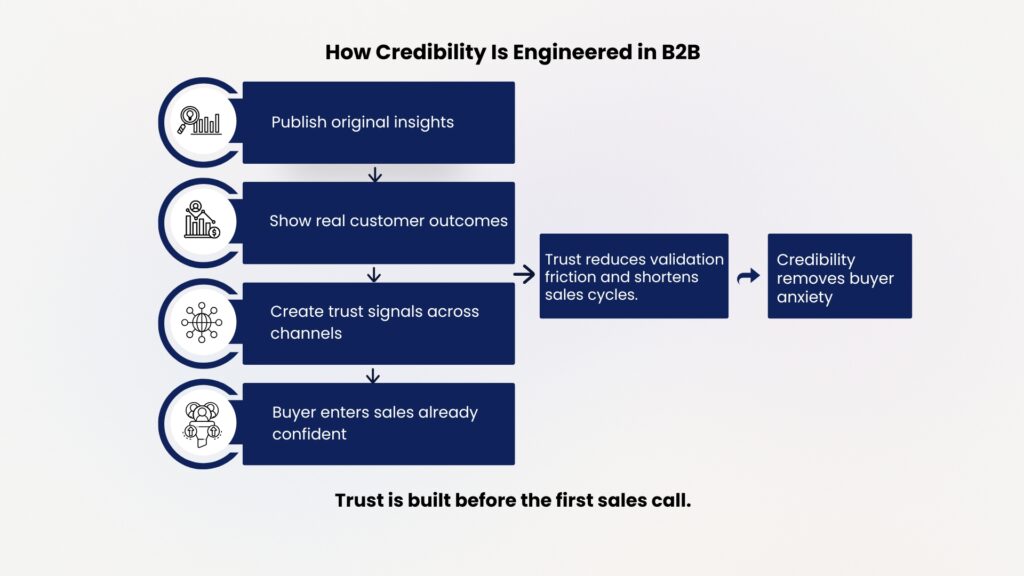
B2B credibility engineering is more than one tactic. It’s an ongoing process of building trust throughout the buying cycle. Start with “authority anchors”, specific points to demonstrate worth. Show value instead of just promising it.
Publish Original Research: Building B2B Authority with Data
Publishing unique, data-driven insights provides a marketing team with the opportunity to gain trustworthiness through authentic evidence. Once you have published original benchmarks, trends, surveys or any other type of previously undisclosed data, you become a reference point for trusted information. Others will cite you as a source, and customers will rely on your content. You’ll transform from retailer to recognized authority.
According to research, approximately 60% of people said they researched through software comparison sites and 52% also used business news sites when conducting research prior to making their purchasing decision. By providing data-based content you establish expertise therefore becoming an expert source of credible information and knowledge versus an interest serving vendor.
Make Customer Outcomes Central: Proving B2B ROI and Impact
Eventually, the buyer is interested only in the end result, not the technical details of the feature. In order to establish credibility with their marketing materials, a firm must present exact factual information on numerical statistics regarding growth of their pipeline, the amount of time saved in the sales cycle and numerous other measurable conversion improvements.
A case study needs to show the situation prior to implementation, the action taken and the resulting outcome following implementation. A case study can be used in conjunction with direct, client verifiable quotes to serve as a credibly making piece of evidence. Being so specific is the only way a firm can build trust in a prospective client; no one believes a ‘success story’ that someone continuously repeats. However, a client will absolutely trust a documented and quantifiable result.
Build B2B Authority Through Strategic Thought Leadership
Thought leadership is not product promotion. It is about advancing understanding of the domain your buyers operate in. This means publishing frameworks that help buyers think through their challenges, challenging conventional assumptions with evidence, and engaging in the conversations your audience is already having.
When buyers return to your content specifically to get your take on new developments, you have achieved earned continuity. Your brand becomes a peer to the executive, not just another vendor.
What B2B Credibility Engineering Delivers: Measurable Results
The business outcomes of systematic credibility are measurable and compounding. These outcomes aren’t accidental. They’re the direct result of B2B credibility engineering: the systematic design of trust signals across every buyer touchpoint.
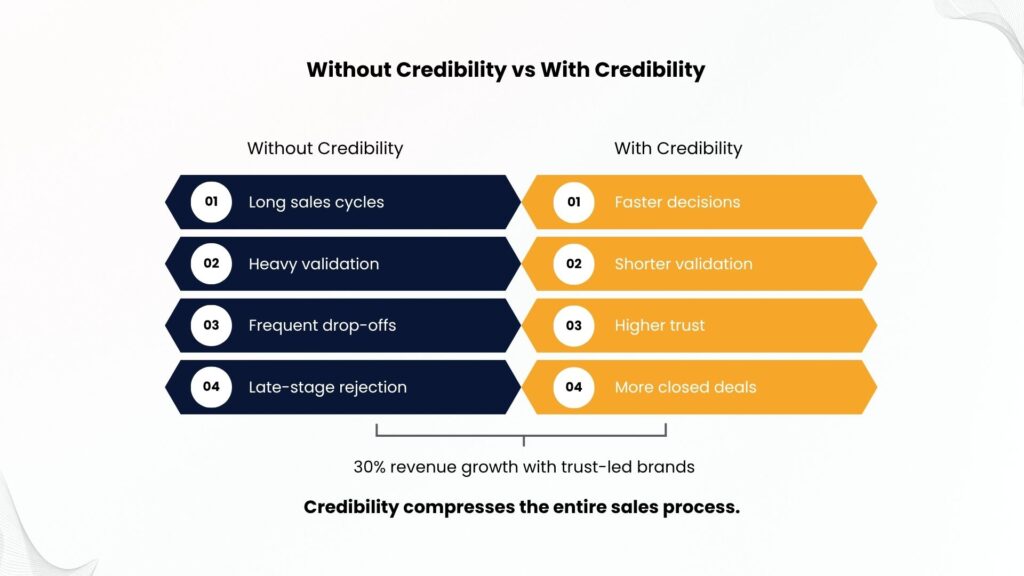
Buyers arrive at sales conversations already confident. Reference check requirements shrink. Legal reviews compress. Internal stakeholder alignment moves faster. The latest research proves that brands that get industry leaders to promote them experience up to 39% rise in their brand awareness and 30% growth in revenue.
The sales process gets faster because customers do not have to go through the validation stages they usually do. Explore more about credibility in the sales processes, here.
Educational materials explain things faster. Honest talk prevents any unexpected situations. Testimonials offer buyers the same validation that comes from references, but without the need for long checking periods.
Over time, credibility becomes a durable competitive advantage. Your organization becomes known as a trusted voice in your category. Satisfied customers advocate for you. Analysts take notice.
B2B Credibility Engineering: Trust Is a Design Problem
In B2B markets with costly errors, buyers research independently and use many channels. Longevity alone does not create trust. It is in fact a challenge to learn how you design things. It asks for deliberate decisions: what to put out there, what to emphasize, how to communicate, and how regularly to make an appearance.
Companies that follow trust-building procedures shorten sales cycles and close more deals. This builds lasting credibility, beyond any short-term campaign. The companies that will thrive in 2026 will not necessarily be those with the highest volume of advertising; but rather those with the highest credibility.
Implementing B2B credibility engineering transforms how buyers perceive your organization. At ProspectVine, we assist our customers in generating this credibility through the use of narrative continuity and earned recall, rather than through sheer volume alone.