Your lead or potential customer has engaged with your company’s marketing efforts in several ways: they have downloaded three white papers, attended two webinars, and watched five product demos. Also, they got pricing from seven different vendors. However, even after three months, they still have not decided on a product or service.
This is B2B buyer optionality- the hidden tax on B2B growth.
Research shows 86% of B2B purchases stall during the buying process. Over 40% of deals end with “no decision.” The average B2B buying cycle sits at 10.1 months. Buyers evaluate 17+ vendors pre-contact, up 40% year over year. Yet 38% end up with “no decision.”
When Buyer Optionality Hurts B2B Conversion
Understanding B2B buyer optionality starts with recognizing that more choice does not always lead to better decisions.
The well-known “jam study”, Columbia University’s groundbreaking research on choice overload, demonstrated that extensive choice sets can decrease motivation to purchase, increase decision difficulty, and reduce satisfaction with chosen options.
A 24-jam display drew a crowd, yet a 6-jam one led to 10 times as many purchases. When it comes to B2B, the implications are even more significant. A buyer who is considering an enterprise software is indeed making a very important job-related decision. The anxiety of selecting the “perfect” vendor teamed up with the plethora of options can be such a strong deterrent that one may even consider postponing.
Modern B2B buying committees have swelled to 6 to 10 stakeholders. Evaluation cycles have stretched by 25%. Buyers consider 62% more brands than five years ago, yet decision timelines are expanding. In high-stakes corporate environments, the cost of making a wrong choice is perceived as far higher than the cost of making no choice.
Optionality encourages postponement. When buyers believe a potentially better option might exist, committing now feels premature. In complex purchases, the cost of a wrong decision is high, while the cost of delay is often perceived as low.
How B2B Buyer Optionality Changes Decision Behavior
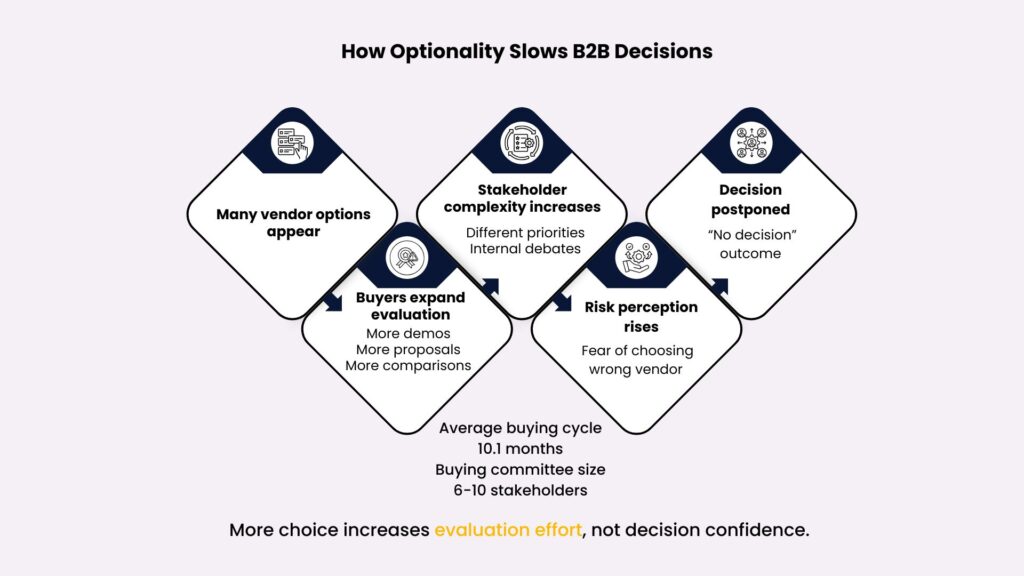
B2B buyer optionality creates three behavioral patterns that sabotage decision-making.
Delaying Commitment to Preserve Flexibility
When buyers face several credible options, the fear of making the wrong choice often outweighs the perceived benefit of selecting the right one. This fear manifests as endless evaluation. “We need one more demo.” “Let’s compare three additional vendors.” Each delay feels rational in isolation but compounds into indefinite postponement.
Evaluation becomes an activity in itself. Committees schedule additional demos, request more proposals, and consult more stakeholders. Not to gain new insight, but to justify the eventual decision.
Preference for “Keep Evaluating” Over “Decide”
Research examining choice overload demonstrates higher levels of regret, decision paralysis, and reduced satisfaction when facing abundant options. The typical B2B buying group now includes decision-makers at VP level or above (52%), requires CFO approval (79%), and involves people from two or more departments (89%).
Each stakeholder brings different priorities. Marketing wants features. Finance demands ROI proof. IT requires integration capabilities. No one gets fired for extending a vendor selection process. Someone does get fired for choosing the wrong vendor.
Internal Pressure to Avoid Premature Commitment
Decision-makers face scrutiny from peers and leadership. Committing too early exposes them to criticism if the choice proves suboptimal. Optionality provides cover.
By extending evaluation, stakeholders signal diligence and caution. The safe position is to demand more data, more comparisons, more validation. This dynamic explains why even enthusiastic champions sometimes slow down deals.
Why Vendors Accidentally Increase Optionality
Interestingly, many vendors unknowingly amplify B2B buyer optionality through their messaging and positioning choices.
Over-Broad Positioning
Companies position their solutions as relevant to not only one industry or only one-use case, but across industries, use cases and organization types in order to maximize the size of their addressable market. “We assist companies of all sizes and all industries to reach their objectives.” This may sound inclusive, but a buyer will hear this as unfocused.
If your statement is that you serve everyone, then the buyer will be the one to find out whether you actually serve them or not. Buyers have so much difficulty figuring out whether the solution is tailor, made for their setting that they decide to keep comparing other options.
If everything is possible, then nothing is certain. If buyers do not see themselves very well reflected in the story, then they will just assume that the solution is not completely aligned.
Presenting Too Many Use Cases at Once
The vast number of features presented in comprehensive product demonstrations confuse the buyers more. They don’t illustrate the value of the product; on the contrary, they add extra strings to the bow for comparison. Buyers start thinking: Which product features do really matter? Are we choosing the correct product package for evaluation? Are other competitors doing these things better?
At the end, product demonstrations turn into the walkaround of the features instead of being solution-oriented. Buyers may know exactly the product features but do not have an idea about the actions they should take after the demonstrations.
Appealing to Everyone in One Motion
Generic messaging that appeals to broad audiences generally does not generate strong convictions in any particular segment. Essentially, when marketing and sales teams do not decide who their best customers are, they effectively pass on the responsibility of making the choice to the buyers.
When vendors tailor their messages to the individual concerns of each stakeholder (CFO, return on investment, CMO, marketing capabilities, CTO, technical infrastructure), they end up with differing stories. This results in a disunited buying group as each member has received a different value proposition.
Organizations like ProspectVine emphasize precision over breadth in demand systems, focusing on alignment with defined buyer contexts rather than attempting universal appeal. This approach reduces optionality by reinforcing relevance.
Designing GTM to Reduce B2B Buyer Optionality
Reducing B2B buyer optionality means guiding buyers toward confident decisions, not overwhelming them with possibilities.
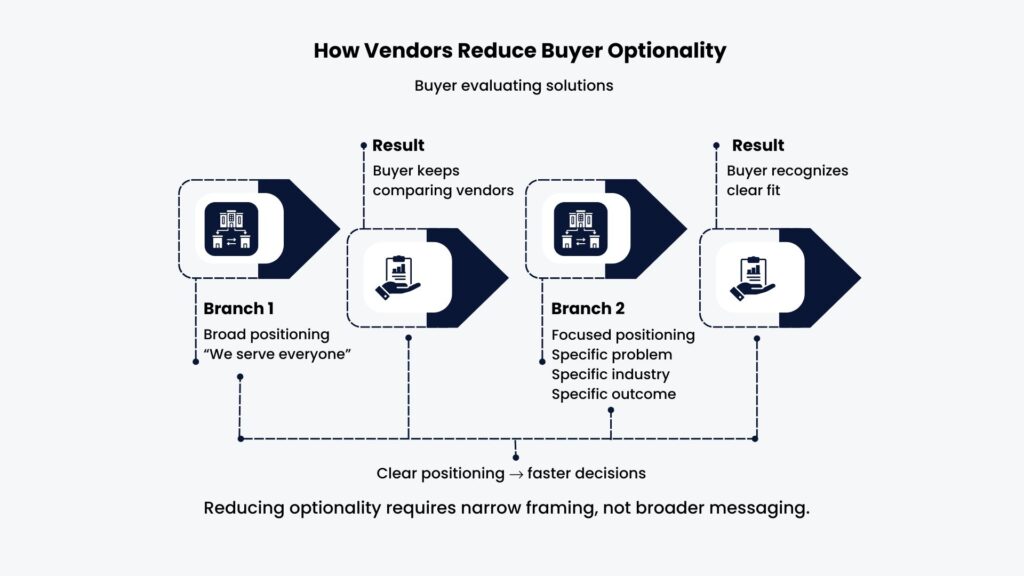
Narrow Framing vs Broad Persuasion
Effective positioning narrows the field of perceived relevance. Instead of saying, “We support any organization,” vendors should articulate who benefits most, in what scenarios, under which conditions.
Frame narrowly: “We are the best choice for this specific type of company facing this specific challenge.” “HubSpot for SMB RevOps” beats “Marketing platform.” Single outcome positioning (“Cut CAC 35%”) beats broad capability claims.
Creating “Safe Paths” to Decision
One of the reasons why buyers tend to put off a purchase is because decision, making sometimes feels like taking a risk. One of the ways to make it less risky and more safe for them is to offer a solid plan finish and the clearly defined road to success set of steps for progressing in the program. Risk reduction through trial opportunities, satisfaction guarantees, and straightforward exit terms will effectively lessen the perception of risk comprehensively.
Structuring Clarity Instead of Abundance
Organizations that win consistently simplify decision-making by highlighting primary use cases, demonstrating proven success patterns, and providing comparative context proactively. This philosophy views every buyer interaction through a lens of cognitive load. Does this website clarify or overwhelm?
ProspectVine’s approach to demand orchestration prioritizes focused messaging and aligned engagement to reduce decision friction rather than maximizing exposure alone. The core of their approach is establishing a memorable brand presence long before sales discussions take place. By leveraging data intelligence, AI-driven targeting, and a narrative that resonates, the campaigns ensure that brands stick in people’s minds.
So, by the time potential customers are ready to evaluate, they are very familiar with the company, what it stands for, and why they are important. Such a level of pre-awareness greatly diminishes the desire to consider other options.
Measuring Optionality Reduction
Optionality is observable through specific indicators.
Fewer Comparison-Stage Objections
When buyers no longer inquire “how do you compare to Vendor X?” and instead ask “how do we go about implementing this?” you have reduced the optionality. When buyers cease to say, “We’re also looking at…” and proceed to say, “We think you’re the right fit, ” it means that you have successfully navigated the optionality haze.
Faster Internal Alignment
Reduced time spent reconciling stakeholder perspectives indicates the solution is perceived as a clear fit. Track time from first demo to internal decision.
Shorter Evaluation Loops
If your sales cycles are shrinking while others’ are expanding, you are winning the battle against optionality. Organizations implementing focused go-to-market strategies report cycle compression of 20% to 40%.
Winning by Reducing Choices
In the economics of buyer behavior, optionality is both an asset and a burden. While buyers value choice, excessive choice delays action.
The companies that accelerate growth are those that help buyers move from exploration to commitment confidently. In a world of infinite choice, the most valuable service a vendor provides is helping buyers choose.
In short, it is a matter of having the bravery to cut down your own positioning, to reject some audiences, and to clarify your value proposition to such an extent that the choice becomes evident.
Cutting back on the number of options means perfecting your positioning, providing decision routes, validating with the context, and being consistent in your messaging. Ultimately, buyers are not seeking the maximum number of options. They are seeking the minimum level of risk.
The vendor that makes commitment feel safer than continued evaluation will win. Not because it offered more, but because it made choosing easier.
Optionality is a tax on growth, but it is not inevitable. It is created by vague messaging, broad positioning, and a refusal to make choices. And it gets reduced by clarity, narrow framing, and a relentless focus on making the buyer’s path to decision safe and simple.
The vendors who win will not be those with the most features or the broadest appeal. They will be those who help buyers escape the paralysis of choice and find the confidence to decide.