Your SDR finally books a discovery call. The VP Marketing invests 15 minutes filling your form. They arrive excited. Then you spend the hour pitching features they’ve already researched. “Send me pricing,” they say, calendar freed. You’ve consumed 45 minutes of their scarcest resource. Meanwhile, competitors deliver self-serve value in 90 seconds.
Welcome to the buyer time economy. According to 2025 research analyzing nearly 4,000 B2B buyers, purchasing cycles compressed from 11.3 months to 10.1 months; not because buyers have more time, but because they’re ruthlessly protecting what little time they have. In the buyer time economy, buyers spend only 17% of their purchasing time meeting with suppliers. The remaining 83% goes to independent research and wrestling with competing priorities.
The Buyer Time Economy: Why Time Beats Budget
For decades, B2B sales strategies revolved around budget qualification. If a prospect had money allocated, the opportunity was viable.
That logic no longer holds.
Today, the scarcest commodity in enterprise buying is not dollars but rather attention, as measured by how much time you can put on your calendar, and this can be justified with a return on investment model along with the approval of your CEO. Once you spend time, you cannot get it back.
Every meeting displaces another priority. Modern decision-makers are not asking, “Do we have budget?” They are asking, “Do we have time for this right now?”
This shift has created a new competitive battlefield: the buyer’s time economy. Vendors compete against internal initiatives, operational crises, strategic projects, and overloaded schedules.
A typical B2B purchase involves buying committees averaging 10 to 13 members. Research shows 72% of B2B purchases involve high-complexity buying groups requiring coordination across multiple functions. Every additional stakeholder multiplies scheduling complexity exponentially.
How Buyers Allocate Time in the New Economy
Understanding the time economy requires understanding how buyers ration attention.
Meetings as Risk Signals
In complex organizations, agreeing to a meeting signals commitment. Accepting a vendor conversation triggers internal expectations, follow-up obligations, and potential project momentum.
Research shows 73% of B2B buyers actively avoid suppliers sending irrelevant outreach, and 61% prefer a rep-free buying experience. A crowded calendar is not a scheduling issue. It is a prioritization filter.
For modern stakeholders, a meeting request is a risk. It’s an hour with potential for zero value. Buyers look for signals whether a meeting will be high yield before accepting.
Async Over Live Interaction
In the modern buyer world, people are gravitating toward a preference for asynchronous learning, like watching demos on their own time, reading through documents and exploring case studies. A study by Gartner shows that 84% of B2B buyers feel as though self-service tools are important to them and only 75% want to deal with a sales rep when they can avoid it.
This means that buyers prefer to control how quickly they go through the buying process (especially so they don’t have to be tied to a verbal agreement with a vendor) while engaging asynchronously.
Internal Prioritization Filters
Buyers also have several filters that they use to determine whether they want to engage with a vendor. These filters include evaluating the strategic fit, urgency of the problem, and readiness to act on behalf of the organization. Buyers maintain ruthless mental filtering: Does this immediately solve a crisis? Does this impact my quarterly objectives? Does my boss care about this initiative?
If a vendor evaluation doesn’t satisfy at least two criteria, it drops below the time allocation threshold. The vendor’s challenge is not proving value alone. It is proving that engaging now is worth the time investment.
Why Traditional GTM Fails the Buyer Time Economy
Traditional go-to-market processes were designed for vendor efficiency, not buyer efficiency.
Long Forms
Multi-field forms ask buyers to invest time before receiving value. Forcing executives to fill out 12 fields to download a PDF is a high-friction tax. Research reveals form friction directly correlates with abandonment. Buyers facing 8 to 10 field forms routinely abandon midway.
Not because they lack interest, but because completing forms feels like work rather than value delivery.
Unnecessary Calls
Many discovery meetings repeat information buyers already provided through forms. The “quick intro call” that runs 45 minutes. The discovery call that repeats questions answered on the website. The demo that covers features the buyer doesn’t care about.
Each unnecessary call consumes calendar space while delivering diminishing returns, training buyers that engaging with your organization means wasted time.
Repetitive Discovery
In multi-stakeholder deals, buyers often repeat the same explanations across sales, solution, and executive conversations. Buyers describe the same problems to SDRs, account executives, solution engineers, and implementation specialists.
Each repetition increases cognitive fatigue. Nothing kills a deal faster than a buyer repeating pain points to an AE they already explained to the SDR. Over time, the evaluation process feels like work. Buyers disengage.
Designing GTM for the Buyer Time Economy
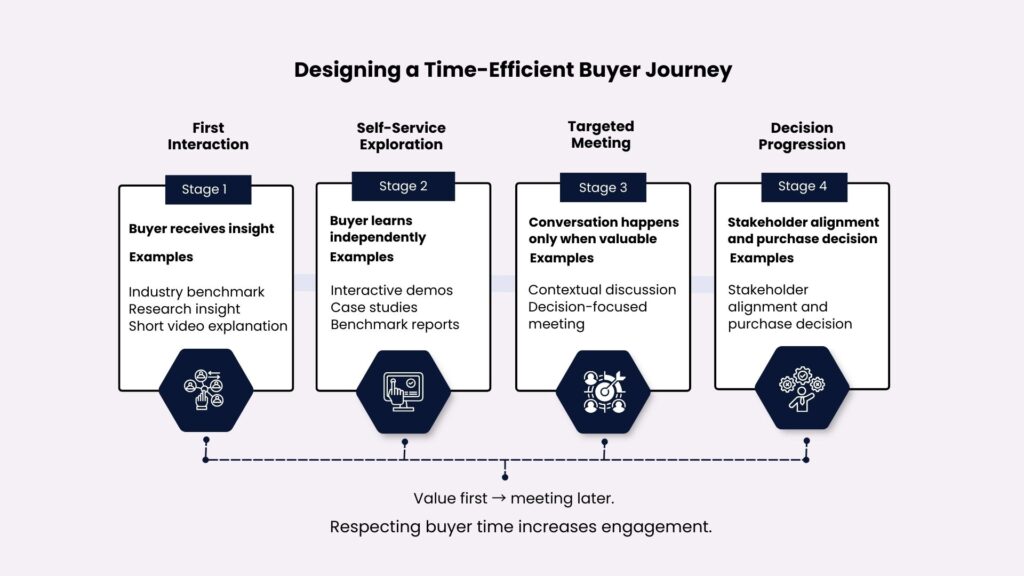
Winning in the buyer time economy means redesigning engagement around efficiency, not just effectiveness.
Progressive Disclosure
Instead of demanding full commitment upfront, information and interactions are staged. Buyers receive relevant insights first, deeper engagement later.
At initial touch point, do not provide the entire technical manual to the customer. Follow the principle of progressive disclosure by giving the customer only what he/she needs in his/her current situation. Provide high level results first, then provide async video to demonstrate process and only provide the deepest technical specifications to those customers that need it (i.e., the stakeholders).
This approach lowers the initial time barrier while maintaining momentum.
Value Before Meetings
By offering relevant insight prior to scheduling a conversation you enhance the quality of meetings and lessen the perceived risk to buyers when they agree to have a meeting; they should have a good understanding of your value proposition prior to agreeing to meet, have viewed examples of organizations similar to their own who have successfully worked with you, and will be prepared to discuss their own situation.
Some examples of this type of content that organizations that successfully implement this approach will offer include customized research; industry benchmarks; customized recommendations; asynchronous calculators; and interactive demos. Organizations that implement this approach provide extensive self-service content which answers at least 80% of buyer questions prior to the buyer ever interacting with a vendor.
When buyers receive value from you before meeting, they will view the meeting as a progress meeting instead of something that is required of them.
ProspectVine’s philosophy regarding demand is to offer actionable insight before asking for engagement, so that your outreach appears to be useful to prospective buyers and does not have an extractive nature.
Time-Respecting Journeys
The GTM is streamlined to save time with no excess processes, pre-filled forms, context-based conversations and one unified message from each group. All efforts are focused on removing duplicate touch points so that each contact pushes the buyer’s decision forward.
Education is done primarily using self-service. Buyers can do 80% of their research on the internet and not have to speak with a person prior to contacting a company, all information they do get is relevant to the buyer and has been independently sourced to verify its accuracy. Once the buyer contacts the company, they have enough information that will allow for an organized educational discussion.
Targeting is done with the help of artificial intelligence and confirms that targets are credible (received via previous company interactions) and uses true buyer interest as the determining factor, rather than using a single marketing calendar to time outreach.
Measuring Success in the Buyer Time Economy
The buyer time economy demands new metrics beyond traditional pipeline measures. New indicators reveal whether GTM processes respect buyer schedules.
Time-to-First-Value
How quickly does a buyer experience meaningful insight after initial interaction? Effective time-respecting GTM delivers useful insights, tools, or content within minutes of first contact. Traditional approaches require days or weeks before value delivery.
Shorter times correlate with higher engagement. Target under two minutes from landing to insight.
Meeting-to-Decision Ratio
How much time does it take for your prospects to move through your sales cycle? Too many meetings can suggest there’s something wrong with your sales process.
The best organizations are most often able to obtain purchase agreements with 3-4 stakeholder meetings. The least successful organizations will take 8-12 meetings over many months.
Drop-Off Before First Call
High drop-off rates suggest early-stage friction. What percentage of engaged prospects disappear before scheduling their first meeting?
If prospects visit your landing page but don’t book a call, your “time tax” is too high. Reducing form complexity and offering alternative engagement options improve conversion.
Winning the Buyer Time Economy: The Future of B2B
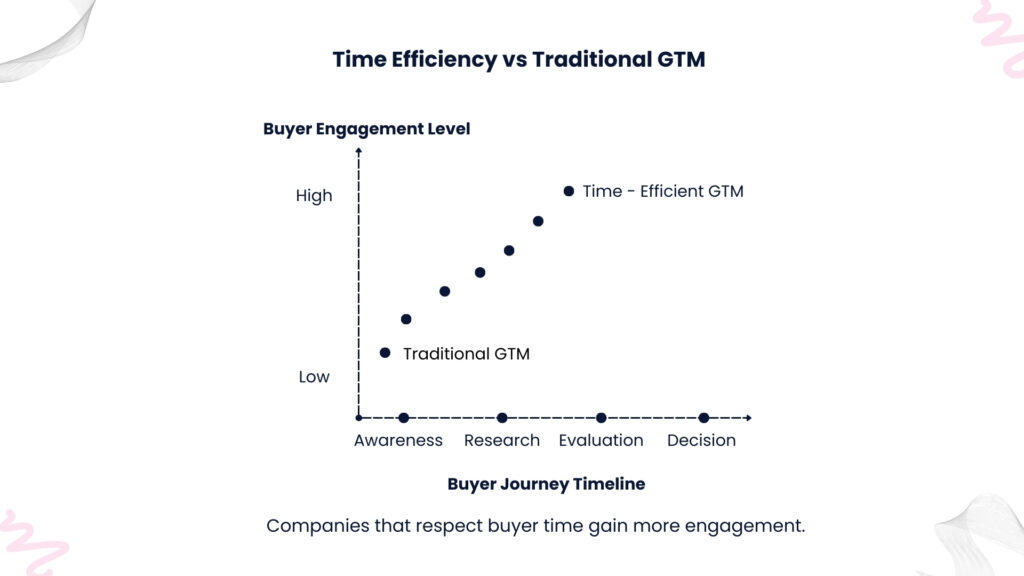
Attention economics will define the future of B2B go-to-market strategy. Budget is important, but time is the ultimate factor that decides if the assessment even happens.
As B2B markets become more sophisticated and products become very similar in their characteristics, the main source of competitive edge comes from recognizing the one resource that buyers value the most: their time. Companies that in a systematic way reduce the time required by buyers while at the same time delivering the highest value get a much bigger share of the market.
Those who create buyer-focused journey experiences will see themselves as partners and not as disruptions, thus giving priority to relevance and timing rather than quantity.
Organizations respecting buyer time will accelerate decisions, reduce friction, and build stronger relationships. Time efficiency compounds. Buyers who experience respectful, efficient engagement become champions who actively help rather than passively participate.
In the future of B2B competitive advantage, it won’t be about having better features than your competition nor offering lower prices than your competition. It will come down to time. Buyers value suppliers who recognize that their most limited resource is time and treat it accordingly.
Every single touchpoint must be redesigned: forms must only collect the data needed to complete a transaction; content should educate without requiring a meeting; and conversations must begin with valuable insights.
Budget gets found. Time cannot. Win the calendar, and the budget will follow.
In the buyer time economy, the winning question is no longer “Why should they buy from us?” It is “Why should they spend time with us now?”