B2B omnichannel orchestration is what separates brands that convert from brands that confuse. You’ve got campaigns running in parallel: email outreach to CFOs, LinkedIn Sponsored Content, programmatic ads in industry publications. Individually, each performs reasonably well. But when your prospects receive conflicting messages across different channels within the same week, you’re creating confusion instead of conviction.
This is the reality facing B2B marketers today. 52% of B2B marketers say omnichannel execution is their second biggest challenge, while siloed campaigns waste budget through redundant messaging and missed coordination opportunities. Companies with omnichannel customer engagement strategies retain 89% of their customers, while omnichannel marketing delivers nearly six times more sales than single-channel approaches.
ProspectVine’s philosophy reflects this shift clearly: buyers don’t convert through channels. They convert through coordinated journeys.
Why B2B Omnichannel Orchestration Beats Siloed Campaigns
The traditional B2B marketing organizational structure creates natural silos. Email marketing team manages nurture campaigns. Social media team runs LinkedIn ads. Demand generation team coordinates programmatic display. Each team optimizes within their channel, measuring opens, clicks, and conversions independently.
The Cost of Independent Channel Optimization
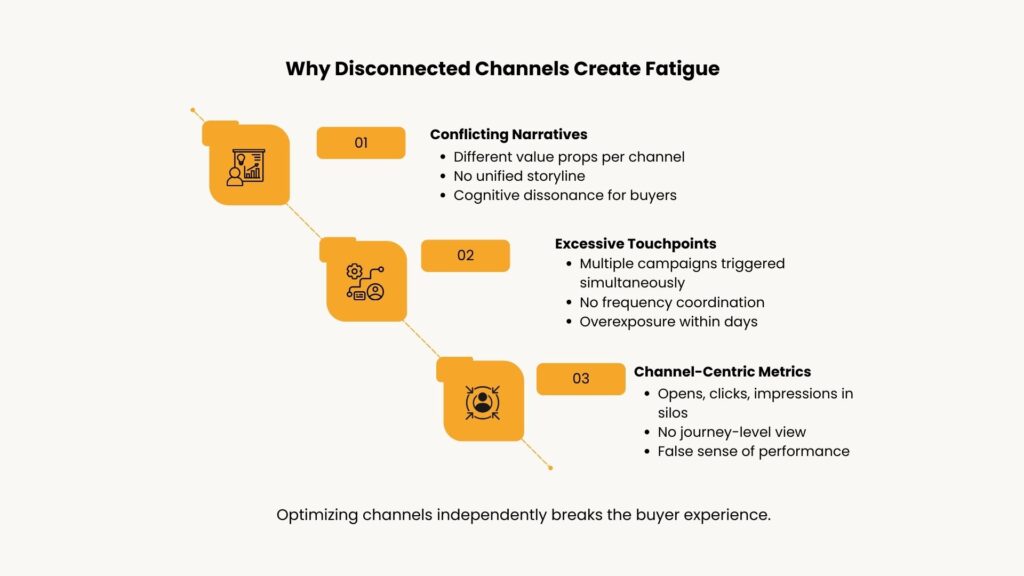
When these channels operate independently, messaging conflicts emerge. Email campaign promotes webinar focusing on ROI and cost reduction. LinkedIn ad positions your solution as innovation enabler driving competitive advantage. Programmatic display emphasizes ease of implementation and rapid time-to-value. A CFO encountering all three messages within 48 hours experiences cognitive dissonance.
Messaging fatigue accelerates when uncoordinated channels create excessive touchpoint frequency. Prospect downloads whitepaper triggering email nurture sequence. Same prospect engages with LinkedIn post, entering separate retargeting sequence. Programmatic cookies identify prospect visiting your website, activating third display campaign. Within one week, prospect receives 12 touchpoints across three channels, each operating independently. The prospect feels bombarded rather than engaged.
A Harvard Business Review study showed that 73% of shoppers are using multiple channels throughout their shopping journey, using at least six different points of contact prior to making a purchase. B2B buying committees further complicate the process since the various stakeholders in the buying committee have used different channels to engage with your business. CFOs engage primarily via email and LinkedIn. CTOs consume technical content through industry publications and programmatic placements.
Omnichannel Orchestration: The Synchronization Imperative
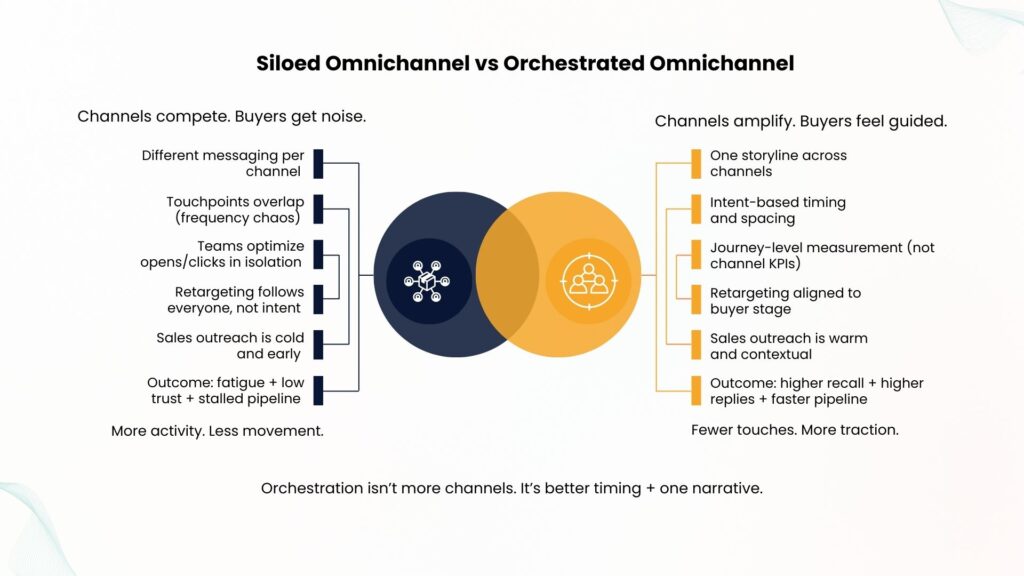
Omnichannel orchestration requires shared strategy, unified messaging, and coordinated timing. ProspectVine’s approach to marketing is that channels are complementary rather than competitors. Rather than launch separate campaigns, the company designs customer journeys that merge data intelligence, AI, powered targeting, and storytelling via a blend of email, LinkedIn, and programmatic touchpoints. Every channel amplifies the others; thus, a storyline is formed that leads the prospects in a seamless way through the awareness, consideration, and evaluation stages.
Synchronized orchestration operates on several principles. Message consistency ensures core value propositions remain stable across channels while format adapts to platform. Progressive revelation sequences information strategically: LinkedIn generates awareness, email provides deeper education, programmatic reinforces key insights. Frequency coordination caps total touchpoints preventing fatigue.
Warming Up Prospects Through Programmatic Display
Cold touches convert at 1-3% because they arrive without context. SDR email arrives referencing prospect’s company and role but feels generic because no prior relationship exists. LinkedIn connection request from sales rep lacks credibility because prospect never encountered the brand previously. These cold touches convert at 1 to 3% precisely because they’re cold, arriving without preparation or context.
Programmatic display transforms this dynamic by creating brand familiarity before direct outreach. When prospects encounter your brand through targeted display ads weeks before sales contact, subsequent email or LinkedIn messages feel warm rather than cold. The prospect thinks “I’ve seen this company” rather than “Who is this random vendor?”
Targeting and Strategic Sequencing
The mechanics leverage account-based advertising targeting specific companies and decision-makers through programmatic platforms. Using firmographic data (company size, industry, revenue) and technographic signals (current technology stack, recent platform adoptions), campaigns serve display ads exclusively to prospects matching ideal customer profile.
Message sequencing follows strategic progression. Initial awareness ads mostly focus on introducing the brand and its category positioning without going into any specific product pitches. Consideration ads, on the other hand, highlight particular use cases and customer outcomes. Evaluation ads offer social proof by means of customer logos and testimonials. This sequence of stages develops credibility gradually instead of asking for immediate action.
The Impact on Sales Conversion
The warm-up effect manifests in dramatically improved email and LinkedIn performance. After exposure to brand display messages, prospects recognize sender names in email inboxes. They accept LinkedIn connection requests because the company feels familiar. They engage with outreach because prior display ads established legitimacy and relevance.
Research validates this approach. Marketers report that exposure to brand messages increases LinkedIn form completion likelihood 13 times and InMail response rates 6 times. The brand building investment through programmatic display pays dividends across all subsequent touchpoints by transforming cold prospects into warm contacts.
As ProspectVine emphasizes, the goal is to warm the account before you warm the conversation. This layered strategy ensures that sales teams engage prospects who already recognize the brand and have a clear grasp of its value.
How Intelligent Chatbots Elevate Engagement
The moment prospect clicks programmatic display ad represents peak engagement opportunity. They demonstrated sufficient interest in interrupting current activity and investigating your solution. Most organizations waste this momentum by directing clicks to static landing pages requiring form completion before providing value. Prospects bounce, returning to interrupted tasks.
Intelligent chatbots transform landing page experience from static information collection to dynamic conversation. When prospect arrives from programmatic ad, chatbot greets them contextually: “I noticed you clicked our ad about reducing customer acquisition costs. What’s your biggest lead gen challenge right now?”
Natural Qualification and Real-Time Assistance
This approach does several things at once. Qualification happens naturally through dialogue rather than forced form fields. Chatbot asks progressive questions understanding prospect’s situation, budget timeline, and decision-making authority. Personalization adapts responses based on firmographic data and technographic signals.
The real-time assistance overcomes common conversion barriers. Prospects ask specific questions receiving immediate answers rather than waiting for sales follow-up. Chatbot addresses objections and concerns on the spot. For high-intent prospects, bot facilitates immediate meeting scheduling with relevant sales reps. For earlier-stage researchers, bot offers valuable content downloads and educational resources.
Conversion Impact and Seamless Transitions
The effect on conversion rates is quite significant. Intelligent chatbots can increase conversion rates by 20, 40% on landing pages just by removing friction and giving instant value. Additionally, as they gather comprehensive details via conversation, they can quite notably qualify leads even better than traditional forms.
ProspectVine’s approach to B2B omnichannel orchestration emphasizes seamless transitions between channels. Rather than treating channels as endpoints, the organization engineers’ journeys where every touchpoint naturally progresses to next logical step.
How B2B Orchestration Creates Surround Sound Presence
This is omnichannel orchestration in action: your brand showing up wherever your buyer looks. The surround sound concept means prospects encounter your brand wherever they look, creating perception of category leadership and market dominance. The psychological impact compounds through repeated exposure: when CFO sees your brand in LinkedIn feed Monday morning, receives relevant email Tuesday afternoon, and encounters programmatic ad on industry publication Wednesday evening, familiarity and trust build progressively.
Research validates coordinated multi-channel presence. Companies employing surround sound marketing report sales cycle reductions of 25 to 40 percent because prospects arrive at sales conversations pre-educated and pre-convinced. The qualification and education that traditionally consumed early sales cycle stages happen through coordinated marketing touchpoints instead.
Strategic Orchestration and Success Metrics
Coordinated campaigns deploy complementary messages across channels within compressed timeframes.
- Week 1: LinkedIn Sponsored Content introduces new research findings.
- Week 2: Email delivers comprehensive report with detailed analysis.
- Week 3: Programmatic display reinforces key insights across industry sites.
- Week 4: Sales outreach references prospect’s engagement with previous touchpoints.
This orchestration creates progressive relationship rather than disconnected tactics.
Success metrics extend beyond traditional funnel metrics. Pipeline velocity measures how quickly prospects progress from awareness to closed deals. Engagement depth tracks interaction quality and content consumption across channels. Win rate improvements demonstrate whether surround sound prospects convert at higher rates.
How B2B Omnichannel Orchestration Drives Revenue Results
Organizations implementing surround sound report transformational results. Initially, a B2B software company was able to significantly shorten its sales cycle by integrating its LinkedIn, email, and programmatic advertising campaigns to provide a lovely, fluid experience for its prospects. The prospects in question have already been exposed to educational materials, have found out about the features of the product that is going to be sold to them, and have come up with favorable opinions of the brand, by the time they have a sales conversation.
The transition from utilizing isolated strategies to conducting marketing through coordinated customer journeys is a decision that should be reflected in five areas: technology, data, content, team structure, and measurement. This, therefore, signifies that CMOs and Demand Generation Leaders must understand that their buyers wish to engage with them via a variety of channels, and they also expect to be offered consistent and pertinent experience through all those channels. Deliver coordinated journeys creating surround sound effect, or watch competitors capture mindshare while your siloed campaigns create confusion.
In order to create seamless experiences, ProspectVine’s B2B omnichannel orchestration integrates LinkedIn, email, and programmatic display. The company gets sales prospect ready by creating unforgettable brand experiences through data intelligence, storytelling, and AI-powered targeting.
Marketing no longer serves solely as a tool for generating leads but a strategic source of revenue through this collaboration, sales cycles getting shortened and conversion rates going up.