The B2B industry faces a critical challenge: how to achieve AI-driven marketing authenticity while balancing efficiency with relationship-building. The question keeping many CMOs up at night isn’t whether to use AI, but how to use it without sacrificing the human connection that builds trust. The answer lies not in choosing between authenticity and technology, but in understanding how they can amplify each other’s impact.
Today, 73% of B2B buyers want personalized experiences. But here’s the catch: personalization without human insight feels empty. The Association of National Advertisers picked both ‘Agentic AI’ and ‘Authenticity’ as the 2025 Marketing Words of the Year. Why? Because both must work together.
AI-Driven Marketing Authenticity: Amplifier, Not Architect
Think of AI as a telescope. It extends your vision rather than replacing it. AI processes data that you can’t handle manually. It spots patterns in seconds that would take weeks to find by hand. AI takes on a set of data that cannot be manually worked through. It will spot a pattern in a matter of seconds that would take weeks to detect manually.
What it cannot do is comprehend the purpose of brands. It cannot deal with nuances in ethics. It cannot weave stories to resonate with challenges pertaining to its client.
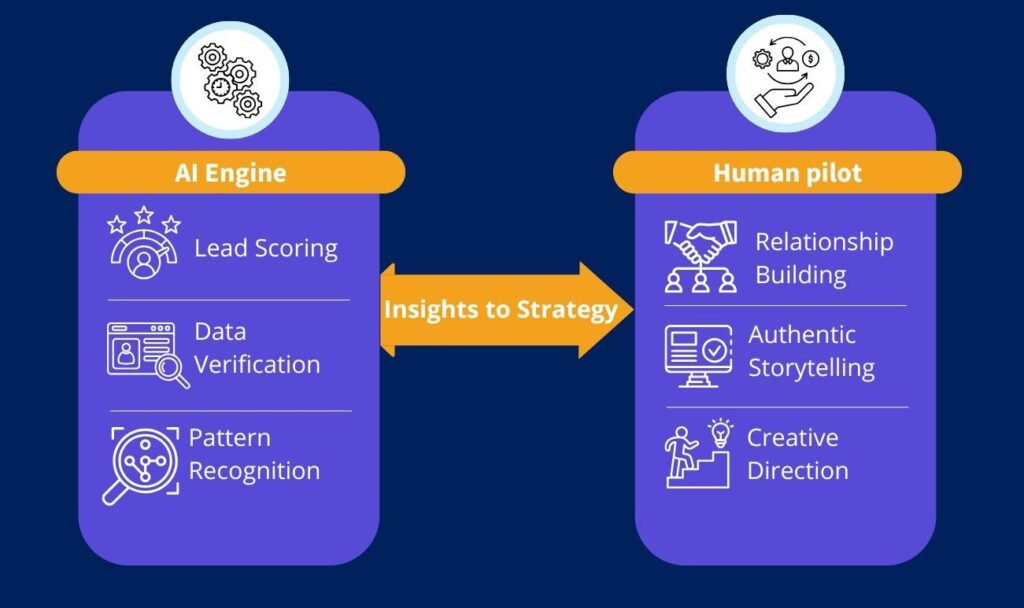
McKinsey research shows AI-driven personalization delivers 5-8x better ROI on marketing spend. But this only works when AI serves as the engine, not the pilot.. This is true when AI is used the right way, as the engine and not as the pilot.
Defining Clear Roles
A defining element of effective marketing through AI is to have complete perspective about the roles played by AI and Humans. AI can do the repetitive, boring work of handling vast amounts of information: enriching, verifying, and segmenting leads, predictive scoring, and timing optimization of outreach. These activities require a great deal of scale, speed, and precision that is best served through automation.
At ProspectVine, differentiation between human and machine is a conscious design decision. AI is meant to enable quick tasks, but it doesn’t make decisions based on data analysis. The goal of AI is to increase human productivity. AI offers technology that will make things easier, while people offer insight that will advance the discussion.
Human teams create the story, decide how to best use the context to make an interesting conversation, and then have a conversation about outreach, rather than just pure data. And when there is some balance between AI and humans in doing these activities, it creates an outcome where the outreach will feel organically relevant rather than synthetic.
Therefore, whereas AI provides consistency, humans bring in the aspect of purposefulness and also the capacity to build trust between the outreach and the target receivers of the outreach campaign. When humans and AI work together, marketing becomes scalable and authentic.
AI-Driven Personalization Meets Human Empathy
Artificial insights will become useful when they form the basis of personalized and empathy-laden sales discussions. The telemarketing team will understand that a certain prospect has just participated in a webinar concerning supply chain optimization; hence, they will initiate their discussion with questions.
60% C-level buyers prefer phone calls for first touches. The humanity component is thus imperative. AI does away with uncertainty. Trust is established by humans.
The salesperson, with the help of the AI-composed snapshot, can view the content interacted with by the prospect, the industry challenges he is likely facing as inferred from the behavioral data, as well as the probable point in the sales cycle he is in. This is when the cold calling process warms up.
The rep says, “I noticed they were interested in our case study on increasing efficiency in the supply chain. It made me think about what’s happening in the industry at the time.” This is relevance driven by AI, with a side of caring about humans.
Real Results from the Hybrid Approach
Companies that implement hybrid strategies have measurable outcomes. One mid-market SaaS provider was struggling to get above a 1% connect rate on cold outreach. After implementing a hybrid model, results shifted dramatically.
It used predictive modeling to identify the top 5% of “Ready-to-Buy” accounts within the AI layer. The human layer then deployed telemarketing to these select leads, guiding calls with AI-generated talking points.
Connect rates increased by 3.5x. Lead acceptance from the sales team was up 40%+.
Another B2B company mixed AI-verified leads with human telemarketers trained up on those insights. Connect rates surged as reps used AI flags to initiate nuanced calls, address specific needs, and close deals faster. The hybrid approach sliced acquisition costs while hefting engagement.
Same pattern, different play. AI does volume. Humans are valued. And together, they are better than alone.
Building Trust Through Ethical Implementation
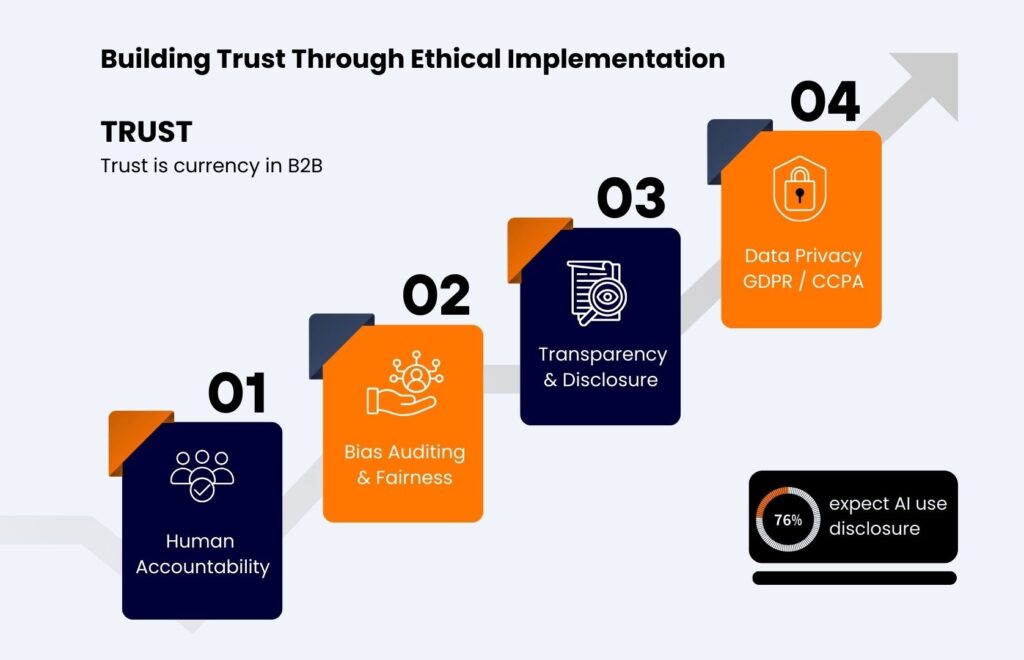
76% of Americans feel that it is a requirement for businesses to reveal the use of AI in marketing. Transparency has now become a non-negotiable element. The following are some of the ethics to employ while building
- Clear policies regarding disclosure of AI usage
- Audit trail for all AI-based reports
- Strong data privacy rights according to GDPR and CCPA
- Audit processes for bias and fairness
- Accountability where the brand is responsible, not a machine
People are not afraid of AI. But people are afraid of manipulation. If you are transparent and let people know that AI can improve human judgment, not replace it, you will build your credibility.
“Trust is currency in the world of B2B business. And the ethical use of AI protects the currency of trust while fortifying authenticity.”
The Future of AI-Driven Marketing Authenticity
The future of B2B marketing is not a choice between artificial intelligence and human authenticity. It is about using automation to eliminate busy work and then investing the time that you have reclaimed in building real relationships.
Competitors are adopting AI. That’s a given. The distinguishing advantage lies in the unmistakable humanness while doing so.
Use technology to scale your message. Let humanness make it meaningful.
The goal isn’t to be the most automated company in the room. The goal is to be the most memorable. By using AI to handle data and targeting, you free human marketers to focus on strategy, narrative, and emotional resonance. Elements that machines still struggle with.
This division creates brands that feel both efficient and deeply personal. The combination wins deals, while the combination builds loyalty in the noisy digital world.
Start with an audit of where your time is going. Find areas of human performance that computers can handle better. Shift human activity to relationship-building and strategy. Success metrics need to relate to relationship strength, not just the numbers.
The technology is at your service. Not the other way around.
Human-centric AI is not a trend word. It is what puts companies into the category of those growing versus those existing.