Your database contains 10,000 leads. The marketing team praises you for 25% open rate. However, most prospects ask, ‘Sorry, who are you again?’ when your sales team answers the phone. This is the gap that no one discusses; the stark contrast between contact collection and genuine purchase readiness through recall-ready leads. We’ve been trained to worship volume, clicks, and cost per lead in B2B marketing. The uncomfortable fact is that a click does not equate to a customer, and an open does not equate to an opportunity.
In 2026, attention won’t be the most valuable currency. It’s recollection. Welcome to the “Recall-Ready” lead: a potential customer who actively remembers your brand name when the time comes to make a purchase, rather than merely acknowledging your existence.
Why 50 Recall-Ready Leads Beat 1,000 Generic Contacts
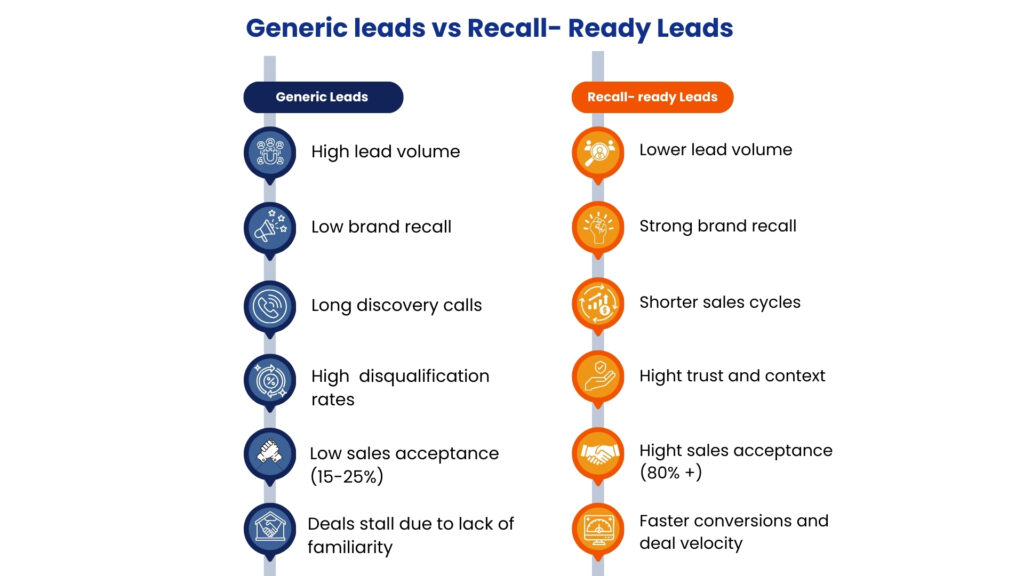
The traditional playbook promises volume, “Generate more leads, and conversion rates will follow.” However, according to Forrester research, less than 1% of leads that are generated in large quantities usually result in sales. Why? Both brand recall and contextual awareness are lacking. Your sales team is well aware of this.
On a dashboard, a pipeline full of 1,000 leads may seem impressive, but you will soon discover that prospects don’t remember who you are or why they signed up. Longer discovery calls, greater disqualification rates, and deals that stall because recognition never came before the sales conversation are among the many examples of the rough statistics. Now think about 50 decision-makers who can vividly recall how your brand addressed their particular issue. They have a higher lifetime value, require shorter sales cycles, and convert more quickly.
According to LinkedIn’s B2B Institute, 95% of buyers aren’t actively in-market at any given time. Staying at the forefront of their minds until they’re ready is more important than pressuring them to buy. Dashboards are filled with volume. Recall fills pipelines.
Multi-Channel Nudges: The Science of Staying Top-of-Mind
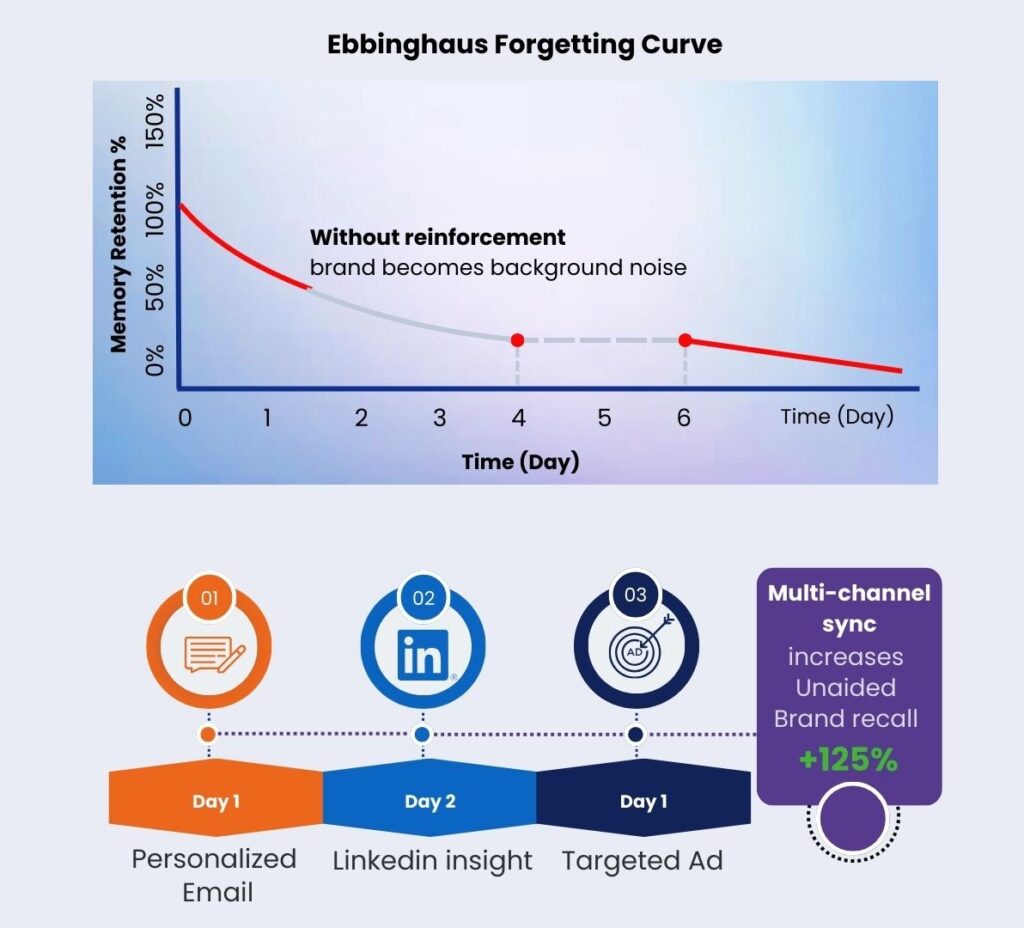
Within 48 hours, corporate minds forget 90% of information. It’s neuroscience, not a failure of your messaging. The Ebbinghaus Forgetting Curve shows that strategic repetition of your brand in a variety of contexts prevents it from becoming background noise. Brand resonance is not a coincidence. In high-consideration B2B purchases, where companies shortlist vendors long before they start sales conversations, the Ehrenberg-Bass Institute demonstrates that brand recall significantly impacts purchasing decisions. While most B2B marketing initiatives generate leads with almost no brand recall, established brands achieve unaided recall rates of 30–50%. This is where the science of touchpoints alters everything.
ProspectVine creates recall-ready leads through AI-timed reminders and multi-channel synchronization. A personalized email follows a thought-provoking insight on LinkedIn at the exact right moment. The insight is backed up by placing a targeted online ad. Each element provides a unified message. A study has proved that multi-channel campaigns pay off and increase unaided brand recall by 125% as compared to single-channel communications. There is one significant difference in our approach. We don’t spam prospective customers. A human will finally contact relevant customers when a brand has made a psychological foundation.
The Leap From “I’ve Seen Them” to “I Trust Their Solution”
Awareness is viewing a display ad while browsing. Engagement is spending three minutes on a targeted microsite developed specifically for your industry pain points. According to a study by Google and Bain, a whopping 90% of all B2B buyers select a vendor from their “Day One list”—the shortlist of suppliers that prospects know from Day One that they’d like to consider. Putting someone on this shortlist is a lot harder than gaining awareness. It takes active engagement.
ProspectVine turns passive ad viewers into active participants through a series of engaging journeys that propel prospects through the intent ladder. Beginning with a blog article, progressing through use of an ROI calculator, to learning about solutions specific to their profession and problems, each step is a thoughtful act that builds affinity and purchase intent. These aren’t your generic landing pages. These are curated experiences that prospects “book” and “favour” and revisit at purchase time. Ad impression is a transitory moment that fades away in days. An engaging microsite experience builds long-term recall and positions your company as the natural next purchase decision.
The KPI Revolution: Why Smart Teams Have Stopped Measuring Cost Per Lead
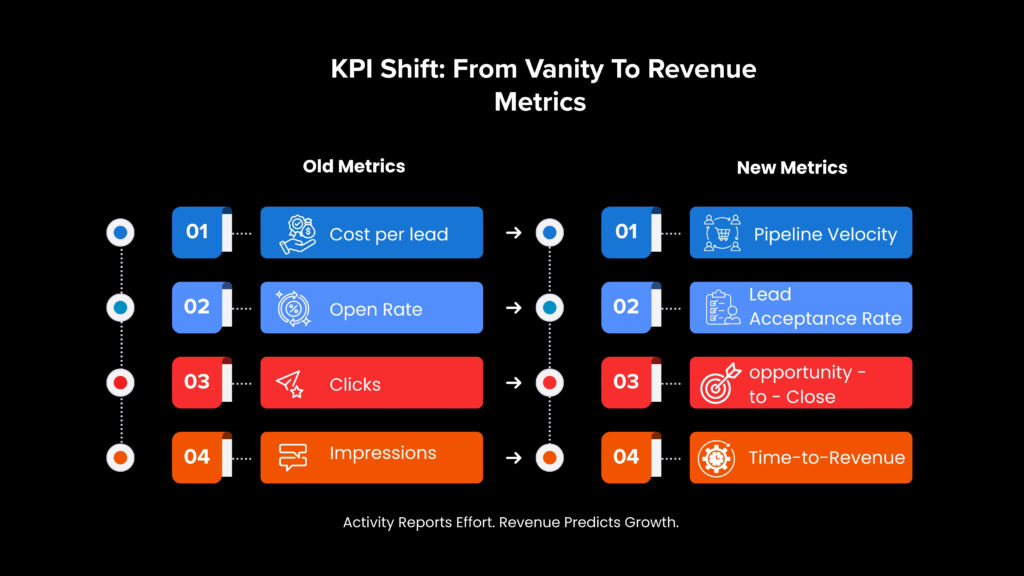
The old metrics reported activity, not impact. Cost per lead is a cost that you can track, and it’ll drive you to deliver low-cost leads. Low-cost leads clog your pipeline and frustrate your salesforce. Serious businesses making money are focusing on metrics that have a real correlation to growth:
Pipeline Velocity– quantifies how quickly qualified leads convert to revenue. Once your leads are recall-ready, you’ll see a dramatic decrease in first-touch to close WON sales cycles.
Lead Acceptance Rate– This measures the percentage of marketing-qualified leads, which the sales team accepts and qualifies. Companies with well-structured and organized qualification processes have a sale acceptance rate of 90%. Leads that are recall-ready activate a sale acceptance rate above 80%, and generic leads have an average of 15-25%.
Opportunity-to-Close Ratio– reinforces resiliency. Businesses maximizing lead velocity speed and the number of quality leads monthly have real-time revenue potential visibility for 12-18 months. This all connects because recall-ready leads are those most likely to convert, reside in deals longer, and need no convincing.
How Recall-Ready Leads Transform Your Pipeline
In a crowded market, being known is good, but being remembered is better. When you focus on the kind of leads who are recall-ready leads rather than volume, the whole funnel changes. Talking to decision-makers who remember why they first reached out will increase your win rates. As soon as you hit them, the friction vanishes because you are already known, so pipeline velocity will increase. The cost of acquiring new customers will decrease because you won’t be investing in non-converting individuals.
The question isn’t whether your leads can pick out your logo from a lineup. It’s whether they think of your brand name organically whenever they have a problem to solve. That’s the strength of recall-ready lead generation. It’s the future of B2B marketing. And it’s already how businesses are succeeding while their competition still obsesses with vanity metrics and wonders where their leads are.
Ready to build recall-ready leads? Discover how ProspectVine helps B2B companies transform their lead generation strategy.