Your sales team finally books the discovery call they’ve been pursuing for weeks. The prospect arrives on Zoom, arms crossed, opening with: “So, walk me through what you do again.” Despite months of marketing touches, your B2B credibility building work has made no impression. Every claim requires proof. Every capability demands validation.
Now contrast this with another scenario: The same discovery call, but this time the prospect opens with: “We’ve been following your work for months. Your piece on intent-based targeting resonated. We’re ready to discuss implementation.” Credibility pre-loaded. Trust has already been established.
Research from 2025 shows that the majority of a B2B buyer’s journey occurs before the vendor is even aware of the prospect’s existence. Buyers use anywhere between 60% and 90% of the content available to them before they reach out to the sales team. Buyers typically look at 15 or more different content pieces across multiple sources as well. Of note, 97% of all buyers begin their inquiry at the vendor’s website, thereby completing the majority (69%) of their research before they engage with sales.
In this environment, credibility isn’t earned during sales conversations. It’s either already established or you never get the meeting.
B2B Credibility Is Built Before You Ever Speak
When a buyer agrees to a sales call, they have already made one of the most important decisions; a decision not about whether to buy, but to believe you as a trustworthy source of information.
In many B2B organizations, the first sales conversation is where they perceive the first step of establishing trust with the buyer. Sales teams spend time and effort preparing discovery questions, product demonstrations and proof points that persuade buyers to act upon during the first meeting. However, by the time that the initial sales conversation occurs with a buyer, the buyer often has already formed an opinion on your level of credibility.
Modern buyers rarely encounter vendors for the first time during a sales call. They have already seen LinkedIn posts, articles, peer discussions, or brand mentions. They may have browsed the website, read industry commentary, or encountered the company through digital channels.
The B2B Credibility Curve
Gartner’s research on B2B buying shows that buyers spend a majority of their evaluation journey independently researching solutions before speaking to vendors. At such a time, buyers form perceptions about the competence, reliability, and expertise of a sales representative long before they break the air for a first face-to-face interaction.
The first moment of making an impression in B2B doesn’t happen anymore in a reception or on a Zoom screen It is during the unsuspecting, unknown research phase that a buyer comes across a LinkedIn post, reads an ungated case study, and checks your ‘About’ page. During this dark social and independent research, the buyer is trying to find signs of stability, expertise, and relevance. Without these signs, or if they contradict each other, the salesperson loses the sales talk even before it starts. If those signals are strong, the sales call becomes an exercise in activation rather than persuasion.
This is where B2B credibility building begins; the gradual accumulation of trust signals before any direct interaction. The gradual accumulation of trust signals occurs before direct interaction. Companies that understand this curve enter sales conversations with credibility already established. Those that ignore it begin every conversation trying to overcome skepticism.
How Buyers Evaluate B2B Trust Signals
B2B credibility building rarely hinges on a single data point. Instead, buyers infer trustworthiness through patterns they observe across multiple touchpoints.
In the absence of direct interaction, buyers use heuristics, mental shortcuts, to judge credibility.
Brand Consistency
A company demonstrates consistency by delivering the same message, positioning, and thought leadership in their communication across multiple channels, including their website, thought leadership, marketing, and sales messaging. This creates an impression of organizational alignment for buyers. A buyer who visits a company’s website will see consistency if they go from the website to LinkedIn, from LinkedIn to a third-party review site and encounter the same company, same messaging, same tone and same visual identity. Inconsistency signals chaos. Consistency signals reliability. Reliability is a proxy for trust.
Researchers on brand trust-building show that AI generates over 50% of long-form posts, and 50% of buyers stop reading when they feel the content is machine-generated. For businesses with complex sales cycles involving legal, finance, and IT, genuine trust becomes the ultimate competitive advantage.
On the other hand, inconsistency breeds doubt. If the vendor calls itself something different on LinkedIn compared to its website and other communications, the potential buyer will begin to wonder about the vendor’s clarity of purpose. If your brand looks professional on your website but sounds like a desperate business on LinkedIn, you’re creating cognitive dissonance.
Narrative Coherence
Another aspect that buyers assess is if the messaging is creating a coherent story. Humans are storytelling creatures. Buyers want to hear a coherent story. What is your story? What problems are you solving? Why is this important?
A coherent story is one that ties together the problem you are solving, the market context in which you are solving this problem, the way you are solving this problem, and the outcomes that your customers are experiencing. When these things are working well together, you look like a credible organization.
When your story is coherent, your strategic narrative is perfectly aligned with your tactical evidence. If you are an AI-first enterprise solution and your blog posts are all about how to do manual workflows, your story is not coherent.
When messaging is changing constantly and is shifting from one theme to another that is completely unrelated, buyers are not sure what your true area of expertise is. Clarity is key to building trust. When you are clear about your area of expertise, you are showing that you understand.
Visibility Without Aggressiveness
Visibility is an aspect that helps in building credibility, but this is true only if there is an equilibrium. Companies often build credibility by being mentioned in industry talks, research findings, and professional discourse. Gradually, this creates the “mere exposure effect,” which researchers define as “exposure to a stimulus increases the tendency to respond favorably to that stimulus.”
Buyers notice companies that are present but not pushy. A well-crafted LinkedIn post, an informative blog, or an unobtrusive display ad are signs of confidence. Being pushy and aggressive is not good. Desperation is not good for building credibility. Confidence is good.
In-depth research into buyers has shown that 61% prefer rep-free buying experiences and that 73% avoid suppliers sending them irrelevant outreaches. There is a thin line between being present and becoming a nuisance. Being helpful and not expecting anything in return is an aspect that builds true authority.
Where Vendors Lose Credibility Early
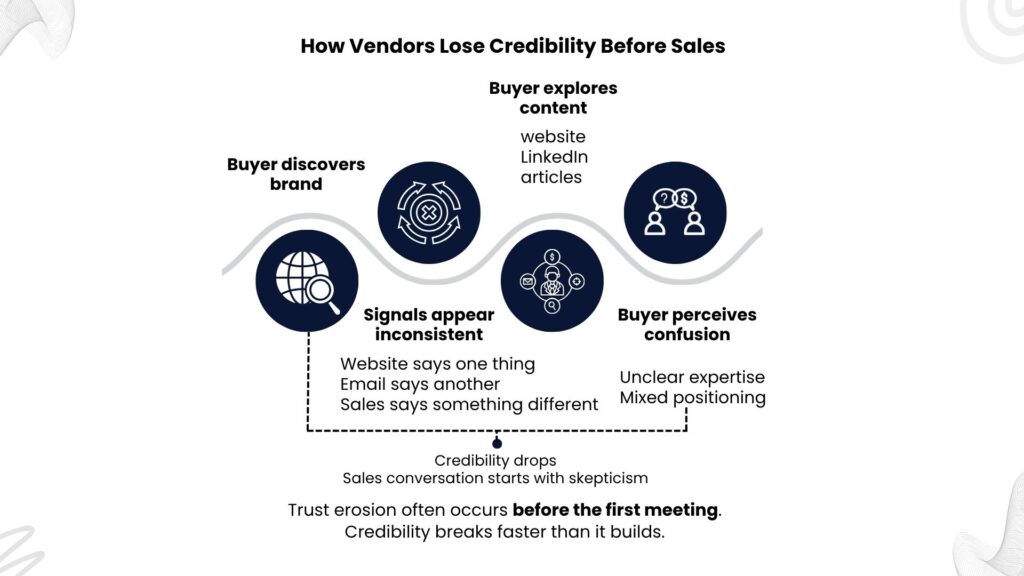
Given how buyers judge, certain common GTM practices are credibility killers, often before a single sales conversation. While buyers naturally approach vendors skeptically, most organizations systematically accelerate credibility erosion through avoidable mistakes.
Inconsistent Positioning
Your website indicates one thing while your SDR email indicates something else as does the banner you’ll have at a trade show.
The disconnect here creates an inconsistency in how the buyer views themselves and how you as a company view yourself (at least, in their minds). No company (including yours) can earn trust unless it demonstrates internal alignment in its use of messaging through as many channels as you can manage (external as well as internal).
Overly Tactical Messaging
Messages like “Download now!”, “Schedule a demo!” and “Limited time offer demo!” lead to the perception of a brand being more like a robot than an expert when all they do is give you a call-to-action (CTA).
If you’re only providing “how-to” guides as your content and don’t communicate any sort of perspective or strategy about your company/industry, you will come across as simply being utility or service vs. product partner. Buyers are more interested in seeing your strategic business philosophy than they are in seeing the features of your product.
Urgency creates tactical ability and weakens or diminishes your overall strategic credibility.
Sudden Sales Escalation
A potential buyer finds a blog article that provides value to them. They find an embedded link and then click on it. Now they encounter a “Book a Meeting” popup. In one click, the experience has gone from being helpful to being confrontational. The message the buyer receives after clicking on the link is that you don’t actually want to help them and only care about selling them something.
There is no faster way to destroy pre-sale trust than by using bait and switch techniques. For example, when a buyer downloads a useful PDF, a salesperson immediately calls them with a high-pressure sales call, telling the buyer that what they thought was going to be helpful was actually just a trap. This will instantly kill your credibility.
Designing Your GTM for B2B Credibility Building
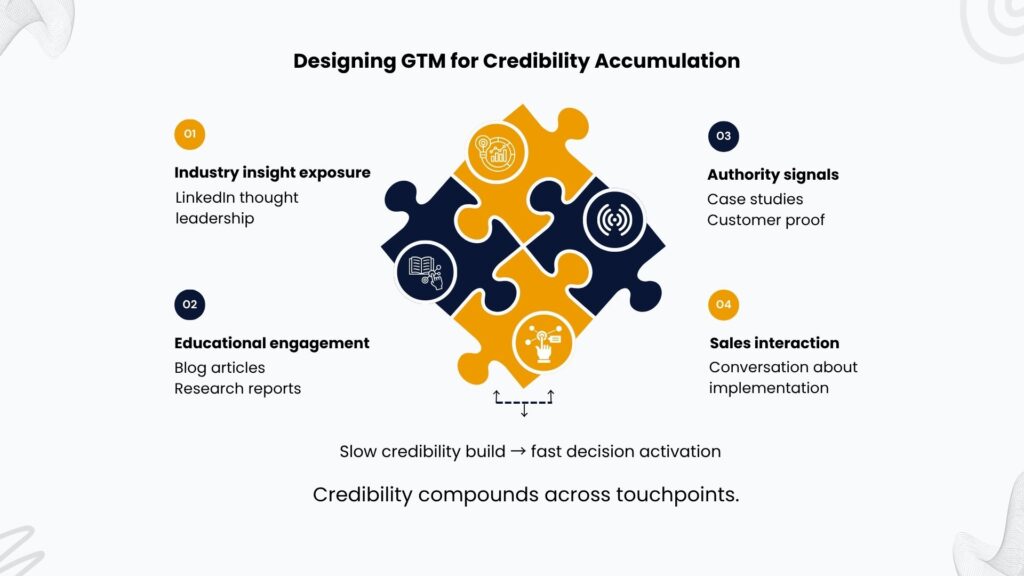
Establishing credibility takes time through a series of campaigns; it builds cumulatively over time through various interactions. The goal is to design a GTM motion built for B2B credibility building, one that feeds this accumulation rather than interrupting it.
Slow Credibility, Fast Activation
Trust builds slowly but activates quickly. A buyer who has accumulated months of positive signals moves to a decision in weeks. The opposite is also true: a buyer with weak credibility signals will stall, regardless of how good your sales team is.
At Prospectvine, our philosophy is rooted in the idea of slow credibility, fast activation. We believe that designing the GTM engine should accumulate trust equity over time, creating a reservoir of goodwill that makes the eventual sales process frictionless.
Design for the slow build that enables fast closing.
Repetition of Core Value Signals
Credibility is reinforced when buyers encounter the same core ideas repeatedly. Not the same message, but the same value signals: reliability, expertise, customer focus. Every contact with a brand, as viewed from a customer’s perspective, is an opportunity to reinforce important messages and create a cohesive overall message over time.
At Prospectvine, we help companies develop their unique value propositions and communicate them across all levels of their GTM activities; from the first time a visitor sees a company name on a LinkedIn post, through to when the CEO provides an executive briefing. By repeating core mental anchors across multiple channels but varying the context, you create a sense of established truth.
A Credibility-First Philosophy
A credibility-first philosophy treats B2B credibility building as a strategic function, not a byproduct of sales activity. We evaluate every form of communication by asking the following question: “Will this help establish credibility or undermine it?” The focus is on consistency rather than uniqueness, coherence versus quantity, and patience compared to urgency.
We shift from a lead generation mentality where we collect emails to a brand-oriented demand generation model. This means focusing on earned continuity, the idea that every piece of content must earn the reader’s attention for the next piece.
As one perspective frames it, the goal is to be “an engine of demand, not leads,” to create a presence that earns trust before it ever asks for a meeting. Once you preload your credibility, a sales call transforms from a cold pitch to a conversation.
The frequent delivery of high-quality insights without barriers verifies that you have the actual expertise and can provide value.
Measuring Your B2B Credibility Building Progress
If credibility is a strategic asset, it must be measured. If we build credibility before the sale, we cannot wait for closed-won data to measure it. Look for these signals that your pre-sales credibility is working.
Reduced Skepticism in First Calls
A buyer with high pre-loaded credibility asks different questions. They ask about implementation, not validation. They ask about partnership, not proof.
Track when buyers move from asking “Why should I trust you?” to asking “What would working with you look like?”
Faster Trust Establishment
Trust that normally takes three calls to build is established in one. The buyer is not starting from zero. They start with a positive balance. Track the speed of relationship development.
Lower Defensive Questioning
When credibility is low, buyers spend time probing weaknesses. When it is high, they spend time exploring possibilities. A reduction in defensive questioning is a direct signal of credibility lift.
The Pre-Work of B2B Credibility Building
Companies that win understand that B2B credibility building happens long before the handshake. Sales conversations do not begin at neutral. They begin at a point on a curve, a curve shaped by every signal you’ve emitted, every interaction you’ve enabled, every message you’ve sent.
Successful companies do not have the fanciest sales pitch; instead, they understand that they build credibility before any conversation and create every part of their process to contribute to this B2B credibility building.
Your job is to ensure that curve is rising before the first handshake.