Your demo was super successful, the champion was nodding their head approvingly, asking you a variety of excellent questions, and they promised to schedule the stakeholder meeting “next week.” Fast forward three weeks, and your follow-up email hasn’t received a response. Once you finally connect, they express confusion: “Can you remind me again why your solution is different?”
This isn’t ghosting. This is the B2B brand recall problem, what we call the GTM memory gap.
The GTM memory gap is the distance between how memorable you think your messaging is and how quickly buyers actually forget it. Research shows that B2B brand recall decreases by 50% after 3-4 months without reinforcement, and campaigns lose 80% of effectiveness within 3-6 months. According to the Ebbinghaus Forgetting Curve, people lose 70% of new information within 24 hours without reinforcement. In complex B2B sales cycles lasting 6-10 months, your perfect pitch from last week is already a distant memory.
The B2B Brand Recall Illusion
Understanding B2B brand recall starts with recognizing that engagement doesn’t equal memory. Most B2B marketers assume that once a prospect has had an interaction/engagement with their brand, the relationship begins; however, this is often not true. After attending a webinar, receiving a report or participating in a positive sales conversation, if the sales team follows up several weeks after the engagement, the buyer likely won’t remember them at all.
This scenario shouldn’t come as a surprise. This is a predictable outcome of the way human memory functions. There is a false sense of security around the way marketers interpret engagement metrics data and develop assumptions regarding how likely a purchase from the company will take place. You may have had a 42% open rate on your email or had 200 attendees at your webinar, but when the buyer finally gets into the market for your solution weeks/months later, they will not remember you are out there.
Research confirms that there are some stark realities around how buyers operate within the general ecosystem of B2B marketplaces. When it comes to buying, 80% of buyers have a list of potential vendors that they already have on their radar screen before they start doing research for a new purchase, and 90% of their final decisions about which vendors to purchase from come from that initial shortlist of vendors that they have already identified. Yet many brands fail to achieve the level of mental availability required for them to appear on these lists.
For B2B markets where the purchase cycle takes months or years to complete and where there are between 10 and 13 different people in the stakeholder buying committee, being top of mind is not just a matter of branding; it is a matter of survival from a competitive perspective.
How B2B Brand Recall Works: The Science of Memory
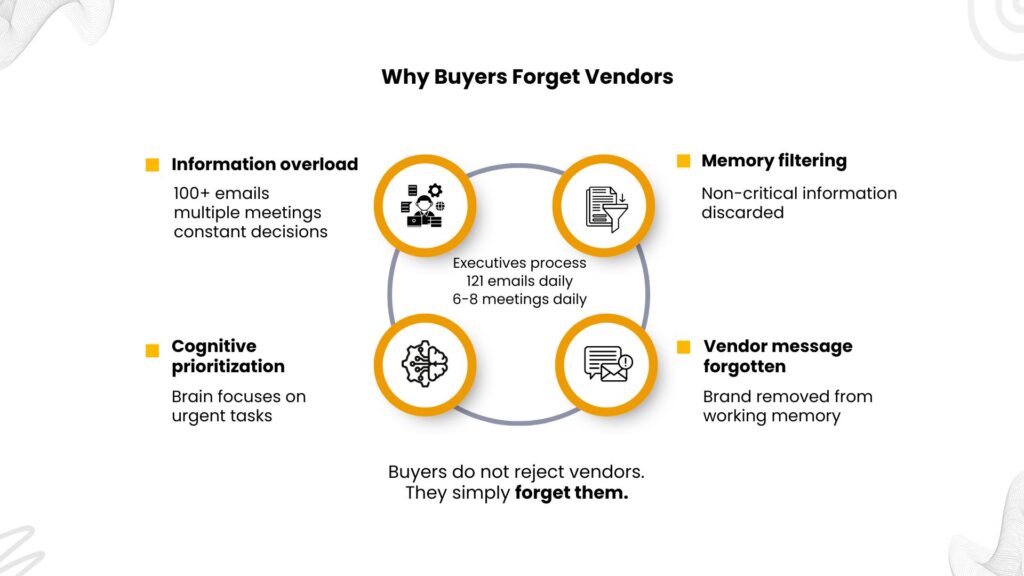
Improving B2B brand recall requires understanding how business professionals process and retain information under cognitive pressure. Meetings, shifting priorities, daily operational fires, and a crowded vendor landscape are all fighting for the same sliver of attention.
Cognitive Load in B2B Roles
Executives process enormous volumes of information every day. Studies demonstrate the constraint of working memory’s capacity probably to a tiny number of currently functioning objects in an individual’s mind.
A decision-maker can process approximately 121 separate email messages per day plus 6 to 8 meetings. Vendors will be competing with operational emergencies, broad company objectives and the mental overhead involved with managing complex organizations for decision-makers time and attention when he or she interacts with vendors.
Cognitive overload is a struggle for today’s executives. Every day, they receive over 100,000 words in the form of Slack messages, emails, and meetings. When their minds are filled with overflowing information, they will place priority on working memory so that they can take care of what needs to be done at the moment but will forget other memories stored in their minds for future reference.
According to research on decision fatigue, making choices exhausts willpower and impairs judgment over time. When buyers evaluate your solution after already processing hundreds of information inputs, they’re cognitively spent.
Why Episodic Memory Fades Without Reinforcement
Reinforcement and association form the basis of how we remember, and Ebbinghaus’ Forgetting Curve tracks how much we forget soon after we receive new information (50 to 70% of new information will be lost within days) unless we reinforce what we learned.
This means that B2B buyers will also have the same experience as B2B prospect after hearing an important message about your brand value proposition / offering but will not hold onto the specific detail of that message unless they are regularly reminded.
The loss of short-term episodic memory is not an arbitrary phenomenon, as such loss follows a particular pattern & development stage. In B2B, these are vulnerable because they lack personal stakes. Unless your solution is tied to a buyer’s immediate survival, the brain categorizes your demo as “non-essential data.”
For episodic memories to convert into semantic memories, systematic reinforcement is required. Single impressive demos create brief episodic memories that evaporate within weeks.
Familiarity vs Understanding
Buyers may feel familiar with a brand without clearly remembering what it does or why it matters. Familiarity is passive. Understanding is active. If a buyer cannot explain what you do to their own CEO in one sentence, you haven’t moved into their long-term memory.
This occurs when messaging creates recognition but fails to anchor meaning. When the buying moment arrives, the brand does not automatically surface as the relevant solution.
GTM Mistakes That Destroy B2B Brand Recall
Many GTM strategies accidentally destroy B2B brand recall through predictable mistakes.
One-Off “Big” Messages
Organizations often focus on large, singular marketing moments: major campaign launches, product announcements, conference presentations. While these events generate temporary attention, they rarely sustain memory.
We launch a massive whitepaper or a flashy keynote and then go silent for three weeks. This “Big Bang” approach fails because it doesn’t account for the steep drop in the forgetting curve. Memory requires repetition, not spikes.
Context Switching Across Channels
There are many channels available today in modern marketing: LinkedIn, email, webinars/online courses / paid ads, outreach to potential customers through a sales force. When the message being conveyed through those various channels is so different from each other, creating a single mental image of your brand in the mind of the buyer becomes almost impossible.
If your LinkedIn ads are about efficiency, if your emails are about return on investment (ROI), and if your salespeople are talking about product features, you will force the buyer to relearn your brand every time they encounter it. These different messages create a fragmented experience for the buyer and inhibit them from developing a common and robust mental framework of your brand.
Long Gaps Without Narrative Continuity
Three months between touches is not a pause. It is a reset. The buyer’s cognitive slate is wiped clean. You are not picking up where you left off. You are starting over.
The space between the discovery call and the proposal is the “Valley of Death” for memory. If there is no narrative thread connecting these touchpoints, the buyer has to do the mental work of re-starting every time you call.
Designing GTM to Improve B2B Brand Recall
Building strong B2B brand recall means designing GTM around how memory actually works, not how we wish it worked.
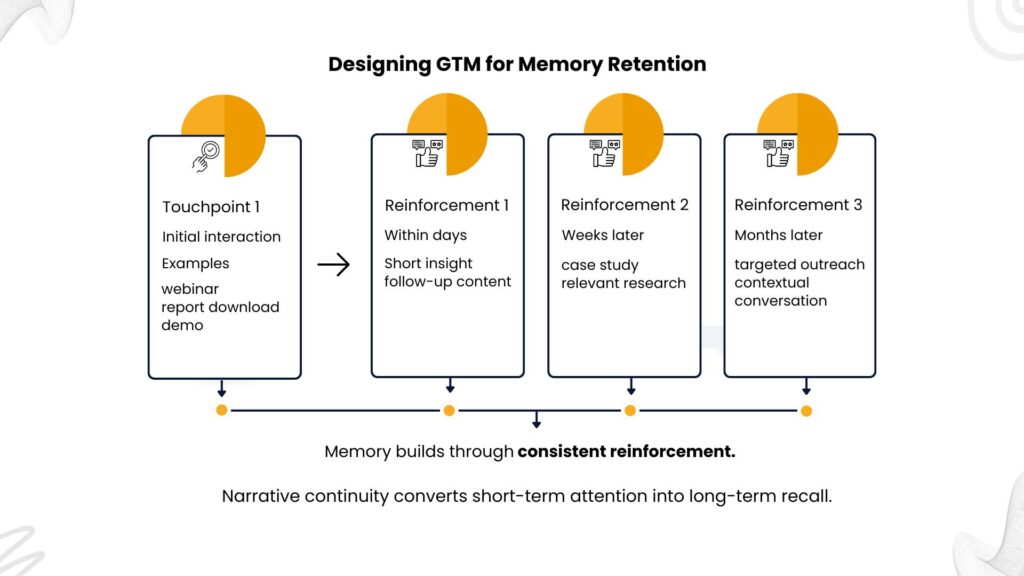
Narrative Continuity Across Touchpoints
Rather than disconnected messages, buyers should encounter a consistent narrative that builds cumulatively. Each touchpoint reinforces the previous one while adding context.
Organizations like Prospectvine emphasize narrative continuity in their demand orchestration approach. Instead of developing one-off marketing promotions, they build supportive environments that maintain key messages throughout the purchasing experience and provide consistent reinforcement touches throughout the buying cycle.
ProspectVine develops its philosophy with affinity-building, AI-enhanced, offline marketing components (anchors). Through Data Intelligence and AI assistance, we design actionable campaigns that ultimately create powerful emotional connections with consumers. Each of our campaigns utilizes continuous narratives across each channel; this ensures your consumers will receive a true and reliable marketing experience, adding greater value to your customers and that their brand/identity remains intact throughout their marketing experience.
This approach to earned continuity builds semantic understanding that persists across time. Buyers move from episodic recall (“I saw their webinar”) to semantic knowledge (“Prospectvine helps generate qualified pipeline through intent-based targeting”).
Reinforcement Timing Based on Decay Curves
The frequency of messaging should coincide with memory decay trends. The first reinforcement of the message should happen within several days, not weeks, to avoid rapid forgetting of the message during early retrieval. If structured follow-ups to a message occur, then the initial message will remain intact in your memory longer.
Anchoring to Existing Mental Models
New information sticks better when connected to knowledge buyers already possess. Rather than introducing entirely novel concepts, effective messaging links to familiar frameworks. When messaging anchors to existing mental models, buyers integrate new information into established knowledge structures.
Measuring Memory Retention
Traditional marketing metrics measure engagement but ignore retention. Organizations serious about the memory gap track different indicators.
Unaided Brand Recall
Survey buyers who engaged months earlier. Without prompting, do they remember your company name and value proposition? This metric reveals whether engagement translated into lasting memory.
Message Consistency Across the Buyer Journey
Review every customer touchpoint to make sure the story stays consistent. Do buyers encounter the same core messages across channels? Inconsistency fragments memory and accelerates forgetting.
Time Decay in Follow-Up Conversations
When sales teams reconnect with previously engaged prospects, how much context needs re-establishing? If every conversation starts from zero, the memory gap is winning.
Winning Through B2B Brand Recall: The Future of GTM
In B2B markets, brand recall isn’t an advantage, it’s the entire competitive battlefield. McKinsey research shows that B2B buyers complete 70-90% of their decision journey independently before engaging vendors, making early brand awareness critical to consideration set inclusion.
The brands that consistently appear establish familiarity, trust, and authority; thus, they are already in the minds of buyers when the time comes to buy. Companies that create journeys focused on the buyer position themselves as partners rather than interruptions to the buyer’s journey. Prospectvine prioritizes relevant, consistent engagement over raw volume.
Organizations that master memory retention accelerate decisions, reduce friction, and build stronger relationships. The future of B2B go-to-market strategy will be defined by memory economics.
The vendors who win will not be those with the biggest campaigns or the broadest reach. They will be those who understand how business memory works and design GTM strategies that combat predictable forgetting through systematic narrative reinforcement. Buyers don’t lack interest. They lack memory capacity. The vendor that stays remembered wins.