The energy in the conference room is electric. The leadership team assembled around a polished deck showcasing the new go-to-market strategy, which appeared to be unbeatable: crisp positioning, clearly identified target market profile (ICP), and aggressive revenue goals. Everyone agreed to this new strategy, and everyone was aligned in their expectations. Flash forward six months… the same campaigns are being run by Marketing, and the same sales pitch is being used by Sales, resulting in a stagnant pipeline.
This is the GTM Translation Problem, where GTM strategy execution breaks down between boardroom and frontline.
According to Gartner research, organizations waste up to 40% of their marketing budgets on poorly executed go-to-market initiatives. Another research states that, 90% of businesses struggle to implement their GTM strategies effectively, while 67% of well-formulated strategies fail due to poor execution, not poor planning.
Your strategy isn’t the problem. The translation from strategic intent to daily decisions is.
The GTM Strategy Execution Gap: Good Plans, Poor Outcomes
Business organizations spend many weeks creating detailed go-to-market strategies, confirming ideal customer profiles, establishing value propositions and summarizing distribution channels. The PowerPoint presentation looks spectacular. There is alignment among the entire leadership team.
However, once the organization moves to executing the strategy, the SDR uses out-of-date talk tracks; marketing emails are contrary to sales discussions; account executives pursue accounts outside the defined ICP, and product launches occur without delivering significant training on how to use the product.
Research reveals that most strategies fail not because of poor planning, but because of poor coordination between teams. Marketing optimizes for lead volume while Sales pursue a different ideal customer profile. Each team interprets the strategy differently, creating confused buyer experiences.
Product marketers put out 10 to 16 products a year. For each one, they spend around 50 hours, and they must go back and forth with 10+ stakeholders. At the same time, the failure rate of these launches is 50%. So, hundreds of hours are wasted per person. Thus, the translation problem even becomes a major threat to growth efficiency.
While 85% of enterprises believe their GTM strategies are effective, only 27% of organizations say their teams are fully integrated across strategy, KPIs, and execution.
Where GTM Strategy Execution Breaks Down
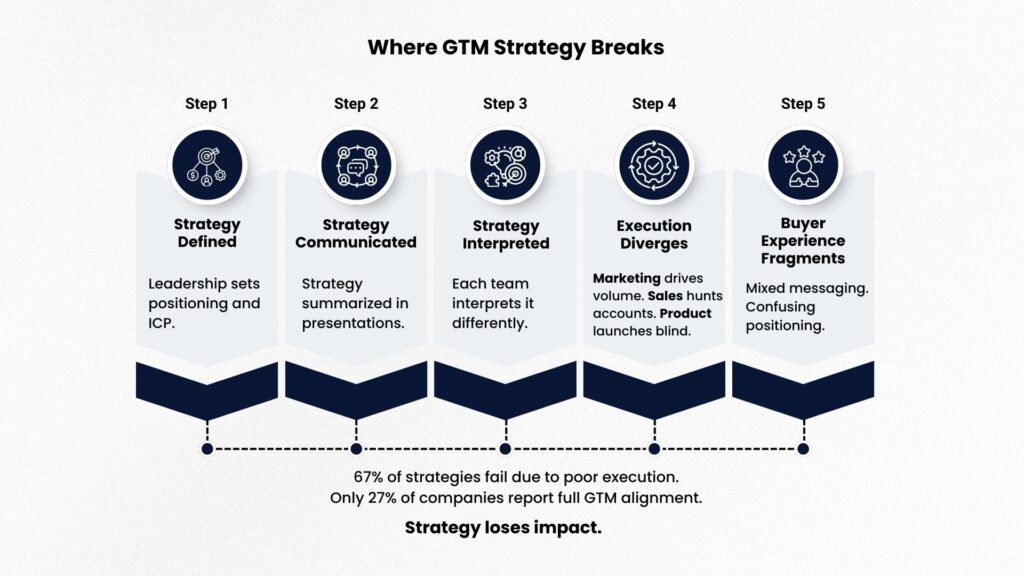
GTM strategy execution breaks at predictable junctures where strategy encounters operational reality.
Strategy Too Abstract
The most common translation failure: strategies articulated at altitudes execution teams cannot operationalize. Leadership defines “focus on mid-market technology companies experiencing rapid growth” as the ICP. But what does that mean for an SDR qualifying an inbound lead?
Research shows vague or unworkable ICP definitions fill funnels with low-fit leads, inflating customer acquisition costs and lowering conversion efficiency. Abstract strategies like “lead with trust” or “value-based selling” sound beautiful. But what does that mean for an SDR writing a cold email?
The abstraction problem compounds across organizational layers. Executives think in market segments. Marketers need campaign targeting criteria. Sales requires qualification frameworks. When strategy doesn’t translate across these functional languages, each team invents its own interpretation.
Execution Teams Lacking Context
Front-line teams are often told things like “focus your efforts on clients in the banking sector” without being given any background on why these orders are important. According to studies, only 40% of workers have a complete understanding of their company’s plans or objectives.
When team members don’t grasp strategic intent, they follow scripts mechanically and miss opportunities for adaptation. Without context, teams optimize locally. Sales prioritizes quick wins. Marketing prioritizes lead volume. Customer success prioritizes retention metrics. These optimizations conflict with long-term strategy.
Misaligned Incentives
The most insidious translation failure: organizational incentive structures rewarding behaviors that contradict strategic priorities. The GTM strategy emphasizes long-term customer value and careful ICP qualification. But sales compensation rewards monthly deal closures regardless of customer fit.
According to analysis of cross-functional GTM failures, 30% cite failure to coordinate across units as the single greatest challenge to executing strategy. When functional goals conflict with strategic objectives, functional goals win because they directly determine individual success and compensation.
Incentives silently override strategy. If the strategy says “deep relationships with key accounts” but sales incentives reward new logo count, the strategy will lose.
Symptoms of Failed GTM Strategy Execution
Organizations experiencing translation failure display predictable patterns.
Inconsistent Messaging Across Channels
Different teams describe the company in different ways. Your website says one thing. A sales deck says another. Website positioning differs from sales presentations. Campaign messaging diverges from executive narratives.
Prospects experience your brand as fragmented and confusing. This creates “brand schizophrenia” and makes it impossible to scale what works.
Sales Improvising at Scale
Without clear guidance, sales teams adapt messaging based on individual conversations. When reps feel the official deck isn’t working, they build their own. Suddenly, you have 50 different versions of your value proposition being pitched.
Improvisation might close deals short term but erodes brand coherence. Over time, the company becomes difficult to categorize in the market.
Marketing Reverting to Tactics
When a strategy is missing operational clarity, marketing tends to revert to what they know: general campaigns, large, scale targeting, programs focused on volume. They keep repeating the same programs, targeting the same customer lists, and measuring the same metrics. The level of activity goes up but alignment with the strategy goes down. Eventually, strategy becomes just a paper document, and tactics are what actually gets done.
Designing Executable GTM Systems
Improving GTM strategy execution requires moving from strategy as document to strategy as system.
Turning Strategy into Decision Rules
Effective GTM systems convert high-level intent into practical guidelines. Instead of “focus on enterprise,” define target account criteria, minimum deal size thresholds, required stakeholder engagement levels, and messaging priorities.
An executable GTM system takes the abstract and makes it tactical. Instead of saying “target high-growth startups,” the system defines it: “target Series B companies with 50+ employees using Salesforce and experiencing 20% headcount growth in Engineering.”
Every strategy implies choices. The job of translation is to make those choices explicit. If the strategy is “lead with trust,” define which proof points will be used where, which words are on-brand, and how trust is demonstrated at each buyer journey stage.
Establishing Constraints and Guardrails
Strategy becomes practical and implementable when teams are clear not only about the actions to take but also about the actions to avoid. Guardrails can be restrictions such as not engaging with certain accounts, avoiding specific marketing messages, or keeping away from the activities that are outside the scope of the strategy.
Good communication of strategy includes giving teams their boundaries: “We are not price competitors. We do not pursue unqualified leads. We do not resort to heavy discounting.” These limitations empower teams to work confidently within set limits. Constraints act as safeguards against deviation.
Operationalizing Strategy Across Channels
Following the execution thread is to require synchronized systems across marketing, sales, and customer success. And the organizations that effectively perform their strategies are making sure that the targeting of the campaigns is in line with the strategic segments, the sales materials are intrinsic to the positioning, and the customer success is sustaining the delivered outcomes.
ProspectVine focuses on structured demand systems capable of leading the strategy to the operationalization actions coordinated horizontally across various channels. To them, the strategy deck is not a one, time deliverable. Rather, they assist the teams in constructing the reassurance architecture through shared operating forums where Sales, Marketing, and Success work together to resolve execution bottlenecks; modular messaging that living reps easily adapt without losing the core strategic intent; and real, time feedback loops.
The way they do it is partly to allow for personalization at scale using firmographic intelligence, technographic data, and behavioral signals. The moment every interaction shows sincere recognition of the other party, the recipient will be engaged by way of response. The AI-verified targeting builds trust through personalized recall, pacing outreach based on genuine buyer intent rather than marketing calendars.
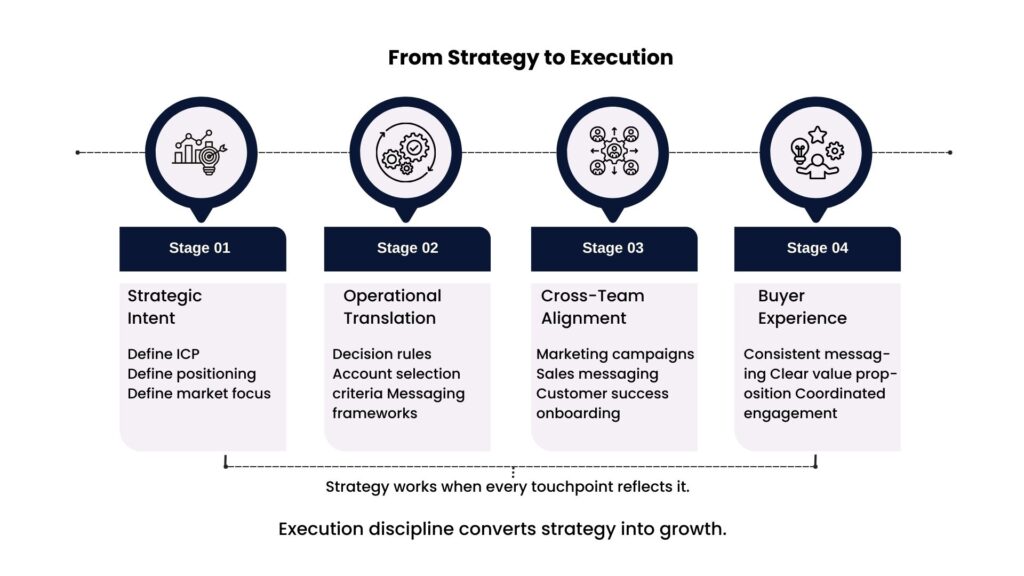
Measuring GTM Strategy Execution Integrity
Strategy success should not be measured only by outcomes but by execution quality. Execution integrity leaves observable traces.
Consistency Across Channels
Aligned organizations tell a consistent story through their advertising outreach content, and even sales talk. You should also check all your customer touchpoints. Are message, tone, and positioning aligned? Disjointed brand exposures may be the last thing your prospects remember. Consistency with buyers reflects a thoughtful and integrated strategy.
Sales Confidence in Messaging
When sales teams clearly understand positioning, conversations become more focused and persuasive. Ask your sales team: “Do you believe in our positioning? Does it help you win deals?”
If they hesitate or admit to using their own modified versions, you have a translation failure. Low confidence often indicates translation gaps rather than capability issues.
Reduction in Ad-Hoc Improvisation
Improvisation decreases when teams have clear guidance. Measure the variance in sales calls, emails, and presentations. Is there a recognizable company style, or does every rep sound different?
Tracking reliance on custom messaging versus standardized frameworks reveals execution discipline. Lower variance indicates successful translation. High variance indicates incomplete translation.
GTM Strategy Execution: From Slides to Systems
In modern B2B markets, GTM strategy execution separates winners from losers. Organizations that outperform competitors translate intent into coordinated action.
A strategy that stays on slides is not a strategy. That is a desire, not a reality. If a plan is made and then the entire team carries it out, for instance discussion, decision, and actions, it is a definite edge in the competition. Addressing the issue of translating go-to-market (GTM) strategy entails decision, making rules, execution teams’ situational awareness, motivators in agreement, and systems that are supporting for in the same manner. Strategy must move from slides to systems.
When execution reflects strategy consistently across every touchpoint, buyers experience clarity rather than confusion. Clarity accelerates trust.
Stop asking if your strategy is right. Start by asking if your team is doing it. When you align your incentives, simplify your messaging, and empower your teams with context, the translation problem disappears. The purpose of strategy is not to sound right. It is to work.