The B2B buyer confidence gap is killing deals at an alarming rate. You’ve checked every box, and your product truly addresses a real need. The pricing aligns with their budget. Your demo addressed their specific use case. Yet three months later, the deal sits stalled in “legal review” with no clear path forward.
This confidence gap affects 86% of B2B purchases; deals stall not from lack of fit, but from lack of buyer confidence. Even more striking, these 86% of purchases stall despite buyers using AI tools that theoretically accelerate decision-making. The problem isn’t product-market fit or pricing. Buyers lack the confidence to commit even when every logical indicator points to “buy.”
In a world where 9% of organizations feel confident about growth targets (just 3% in mid-market), this hesitation becomes the defining challenge of modern B2B sales.
When Fit Doesn’t Guarantee Forward Motion
Understanding the B2B buyer confidence gap starts with recognizing that fit doesn’t guarantee forward motion. In the high-velocity B2B landscape of 2026, many go-to-market leaders face what’s becoming the “Perfect Fit” stalemate. Your marketing team has identified a prospect matching your Ideal Customer Profile to a tee. Sales reps have demonstrated clear product-market fit. The ROI calculations are undeniable. Yet the deal stalls.
Traditional sales frameworks assume a linear path: identify need, demonstrate fit, address objections, close deal. But Gartner research consistently shows that B2B buying groups (now averaging 11 to 20 stakeholders) are increasingly plagued by “decision regret” and “omission bias,” the tendency to stay with the status quo to avoid potential negative outcomes.
In many cases, the deal doesn’t go to a competitor. It goes to “No Decision.”
Research from 6sense reveals that 95% of the time, the winning vendor appears on the buyer’s Day One shortlist. Yet buyers spend 10.1 months evaluating before selecting that predetermined winner. This isn’t careful due diligence. It’s organizational paralysis masquerading as process.
The core of the problem: confidence in how well the solution fits does not equal confidence in executing the transaction. Buyers are able to identify what they should purchase but have difficulty getting past the psychological and organizational roadblocks that keep from making a commitment.
What Creates the B2B Buyer Confidence Gap
The B2B buyer confidence gap emerges from several psychological and organizational factors. Studies into how companies buy reveals something odd. A deal freezing up rarely happens when there is no problem to fix, no money, or no person who can say yes. What actually freezes things? Leaders worry too much about picking poorly. Their dread of a mistake outweighs their hope for a win.
The Paradox Of Choice
Now there are way more tech sellers than before, almost everywhere you look. Most business shoppers already know what they want by the time they reach out, sixty, one percent done, usually. With fifty, plus tools that seem to work just fine in each type, it gets messy. Features match up closely between brands, prices feel much like one another, promises blend together after a while. Too many choices lead to cognitive load, making the safest choice “doing nothing.” Even within a niche, buyers are inundated with alternatives. The more similar the options, the harder the decision.
Unclear Success Paths
A buyer might love the software but fear the implementation. If the roadmap from “Signed Contract” to “First Value” feels foggy, the risk feels too high. Buyers need to visualize their journey from current state to desired outcome.
Questions that stall deals:
- How long until value is realized?
- Who inside the organization must be involved?
- What happens if adoption fails?
As Philomath Research found in their 2025 report on 150+ B2B projects: 64% of buyers said unclear pricing was a reason for delayed decisions, and 49% said overly complex procurement processes reduced their trust. Without operational clarity on what happens on Day 1, Day 30, or Day 90, stakeholders are unlikely to proceed, even if they are eager to help.
Fear of Internal Blame
In a tightening economy, a failed software implementation isn’t just a budget line item. It’s a career risk. B2B purchases carry reputational risk. If a decision fails, the sponsor’s credibility suffers.
Research shows that 43% of buyers make defensive purchases more than 70% of the time. No one gets promoted for a failed software implementation. Buyers are acutely aware of the political capital at stake. This creates a bias toward inaction.
No one gets fired for delaying a decision. People do get blamed for backing the wrong one.
Lack of External Validation
Only 74% of buyers distrust vendor proof according to recent research. Success stories matter because people wonder if someone just like them made it work. When examples match their world, same field, size, and tools, they see themselves fitting in. Missing those real, life parallels, the whole thing feels untested. Instead of belonging, they sense isolation. Familiar footsteps ease the step forward.
Start by matching case studies to the specific field, then adjust for how big or small a business is. One thing matters just as much, the situation where it gets used. Implementation settings shape outcomes more than people expect. Think about real examples that fit closely, not broad ones. Otherwise, buyers struggle to translate success stories into their own context.
How Marketing Widens the Buyer Confidence Gap
Ironically, the moves brands make to get noticed tend to increase customer worry instead.
Over-Promising Outcomes
Promises like “10x Growth” tend to trigger doubt in experienced buyers. Such overblown statements inflate both hopes and suspicion at once. If it feels unrealistically perfect, the mind jumps straight to fine print.
Grand claims of “3x pipeline” create skepticism when the reality delivers 2.5x. Hyperbole creates a credibility gap. When every competitor promises similar transformational results, buyers discount all claims as marketing hyperbole.
Complex Positioning
We often try to sound “innovative” by creating new categories or using dense jargon. For a buyer looking for stability, “complex” translates to “difficult to learn.” Multi-dimensional value propositions and elaborate capability frameworks overwhelm buyers already struggling with decision complexity.
Sophisticated narratives obscure practical understanding. If the buyers cannot effectively communicate the value of the solution, including what the solution does and why it’s valuable, reaching a consensus within the organization becomes challenging. Complexity leads to confusion, and confused buyers do not buy.
Feature-Heavy Narratives
While adding too many features might equate to adding value to the solution, to the buyer, it equates to adding more things to potentially break or become complex. It equates to the comparison factor, where the solution becomes a laundry list of features, with the competition potentially offering one more feature.
Feature lists answer “what,” not “what happens next.” Buyers care less about capabilities and more about outcomes. A product demo proves functionality but still leaves decision anxiety unresolved.
Designing GTM that Reduces Decision Anxiety
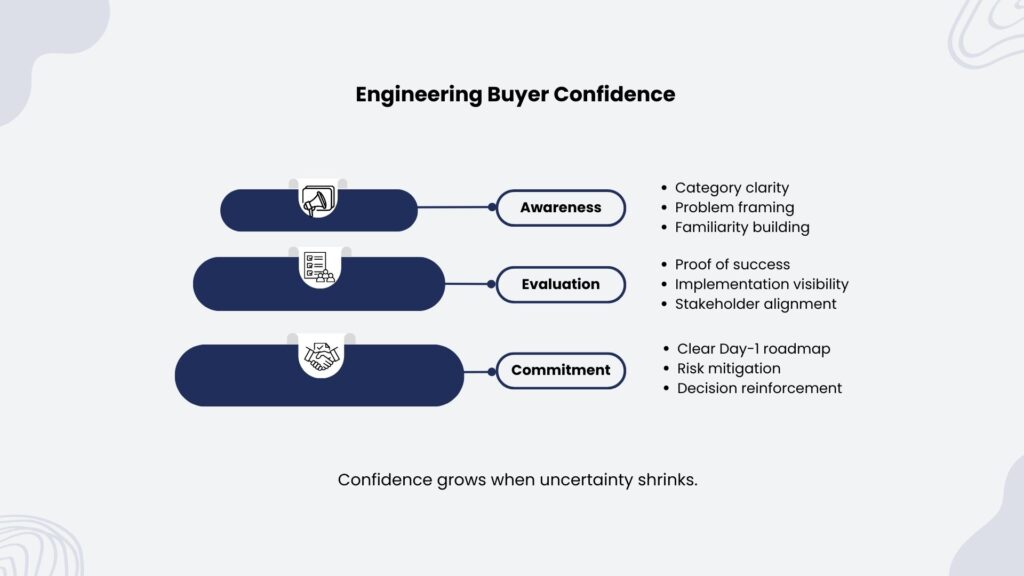
Closing the B2B buyer confidence gap requires shifting from persuasion to reassurance. You don’t need to prove to people that you are the best; you need to make them feel comfortable choosing you. At Prospectvine, the guiding philosophy is that consistency is the ultimate form of reassurance.
Simplicity Over Sophistication
A single glance should tell someone what you’re about, even if they missed everything else. Remove anything extra. What matters is the task people hire your product to do.
A single idea, sharp and straight, wins more trust than something clever but messy. When words make sense fast, minds stay open. Picture someone seeing exactly which problem fades, how the fix fits, then spotting their win without guessing. What matters sits up front, never buried.
Confidence grows when the idea is simple enough to share without stumbling. That clarity gives your supporter the edge they need to win others over. Simplicity accelerates internal alignment.
Predictability Over Novelty
Buyers in 2026 don’t want “surprises,” even “innovative” ones. They want to know exactly what happens on Day 1, Day 30, and Day 90. According to research examining buyer preferences, 78% expect ROI within six months of implementation.
One thing ProspectVine highlights is how clear steps matter. Showing a method that works every time shifts attention away from features alone. Instead of asking what it offers, people start wondering how it fits their needs. A pattern people can follow makes understanding easier. When the path forward feels predictable, questions change naturally. Seeing the flow helps teams imagine using it themselves
Success feels more real when it happens again and again. A single win means less than a pattern that sticks. Clear guides help buyers see what comes next. Timelines turn confusion into something step by step. Milestone maps show progress without guesswork. Structure builds trust where chaos loses it.
The Reassurance Architecture
Consistency in your GTM motion acts as a psychological safety net. Prospectvine’s approach centers on AI-verified targeting that builds early trust through personalized recall. Every touchpoint needs to provide the buyer with a consistent, coherent narrative that serves to reinforce their confidence in your company through the use of a clear set of messaging, tone, and proof points.
When all three areas of content creation are consistent throughout each touchpoint, this provides the buyer with a sense of trust and reinforces the degree of reliability they perceive in your company. Therefore, when you present yourself or your company in the way you do through your other touchpoints, your prospective buyers will begin to subconsciously trust that you are a stable company. In their mind, you will not only be a vendor, but also an organization that provides a strong presence in an unstable marketplace.
Prospectvine maintains continuously validated, enriched prospect databases (what some call “data that breathes”) ensuring every buyer interaction leverages current, accurate intelligence. This eliminates scenarios where outdated information undermines trust.
Measuring the Confidence Gap: Key Buyer Signals
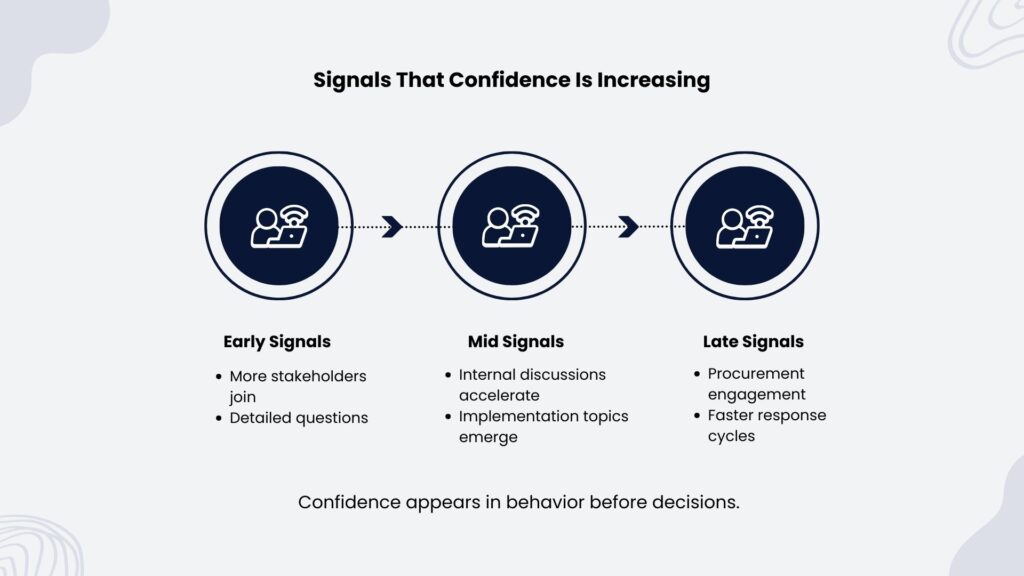
How do you know if you’re closing the confidence gap? Look beyond pipeline volume to behavioral signals.
Shorter Internal Cycles
When buyers feel confident, internal approvals move faster. High-confidence buying processes compress internal deliberation time. Rather than four to six month evaluation cycles, confident buyers complete due diligence in six to eight weeks.
One study from 6sense shows buying timelines shrinking, down to 10.1 months in 2025 from 11.3 the year before. That shift? Buyers making up their minds quicker, hitting points where they feel sure. When evaluations drag on, it’s usually hesitation lingering, not just slow processes getting in the way.
Stakeholder Alignment Speed
Confident purchases exhibit rapid stakeholder convergence. Confident buyers bring others into the conversation willingly. When a prospect quickly introduces you to the economic buyer or implementation team, they’re advocating for you internally.
Reduced friction when the “Technical Buy-in” meets the “Executive Buy-in” signals growing confidence. If stakeholder expansion stalls despite apparent interest, it suggests initial contacts lack confidence to champion internally.
Reduced “Need More Time” Objections
This is the clearest confidence signal. If your deals stop stalling, you’ve built confidence. Requests for additional time rarely reflect scheduling issues. They indicate decision discomfort.
When buyers request more time, additional references, extended trials, or incremental validation, they’re signaling insufficient confidence to commit. The buyer feels they have enough information to mitigate the risk of moving forward when these objections disappear.
Advanced tracking includes NPS intent and engagement (Prospectvine recall metrics) to measure confidence building effectiveness before deals reach critical stages.
The Buyer Confidence Gap as Your Competitive Edge
As products commoditize and feature parity increases across categories, buyer confidence becomes the decisive competitive factor. Organizations that systematically reduce decision anxiety while competitors amplify it gain disproportionate market share regardless of product superiority.
The transformation requires rethinking GTM through the confidence lens. Every marketing message, sales interaction, and customer proof point should explicitly address confidence deficits.
Modern GTM increasingly relies on intelligence rather than persuasion. Data reduces perceived risk by demonstrating peer success, showing relevant use cases, and mapping stakeholder concerns. Account intelligence and buyer context allow messaging to shift from generic claims to specific reassurance.
Instead of saying “Companies improve pipeline by 30%,” vendors say, “Organizations similar to yours achieved specific outcomes in defined timeframes under known conditions.” Specificity builds credibility.
When companies get trust right, they rely on accurate information about prospects shaped by real intentions so each interaction shows clear awareness of what buyers actually care about. Instead of blasting messages blindly, focused efforts create credibility fast because they fit the situation perfectly.
Something strange keeps happening. When more people join the purchase talk, when money feels shaky, when choices multiply like weeds, trust doesn’t grow. It shrinks instead. Silence grows louder each time. Organizations that actively engineer confidence through deliberate GTM design will win.
The GTM confidence gap is not a marketing problem or a sales problem. It’s a trust design challenge. The companies that close deals fastest are not those with the boldest claims but those that remove the most uncertainty.
In modern B2B, trust is the ultimate accelerator of revenue.