Your marketing team spent three weeks creating the perfect whitepaper. Design looks professional. Research is original and offers real value. You publish it on your website, promote it via email, and wait for downloads. After two weeks, you’ve had 47 leads fill out your form, gotten 12 qualified leads, and haven’t booked a single meeting. The content was excellent. The problem? Nobody saw it. You need B2B content syndication strategies.
For CMOs and demand generation heads managing B2B lead generation, this scenario repeats monthly. According to research, 46% of all B2B content is gated. Most of this gated content resides behind forms on firms’ websites where prospects never find it. Meanwhile, 48% of B2B marketers are prioritizing enhancement of their content distribution strategies, specifically syndication, to better utilize resources. Effective B2B content syndication strategies solve this visibility problem.
While B2B buyers continue to consume content, they will no longer simply accept substandard content distribution or poor channel distribution methods. As email box filtering technology improves, reaching high-level decision makers becomes increasingly challenging; not due to a lack of engagement, but rather due to an overload of content on platforms such as LinkedIn. Intent-driven syndicators enable businesses to improve lead quality by eliminating unqualified prospects from entering the funnel, as evidenced by 80% of B2B marketers reporting improvements in their lead quality.
Gated Content: Foundation of B2B Content Syndication Strategies
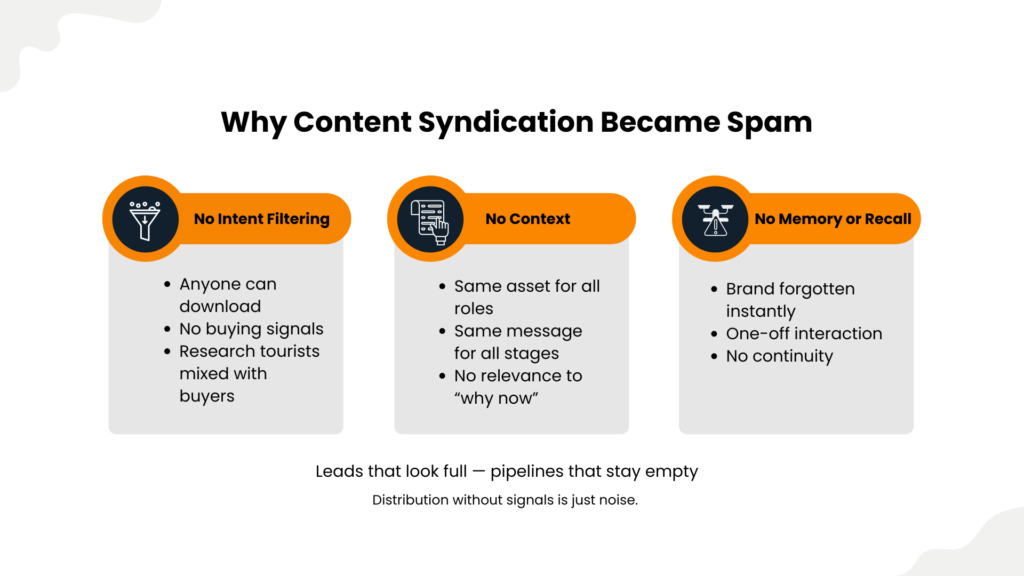
The exchange seems fair. Valuable content for contact information. You spent resources creating insights. Prospects provide email addresses to access them. But in 2025, leads are cautious. They’ve had negative experiences. Aggressive follow-up after downloads. Expected value must exceed expected risk. B2B content syndication strategies must respect this.
The fundamental question every gated asset must answer: Is this whitepaper, ebook, or research report genuinely worth a prospect’s email address, knowing that email will trigger sales outreach? Most content fails this test. Generic insights, repackaged industry statistics, and thinly veiled product pitches don’t justify the inevitable barrage of follow-up emails prospects anticipate.
Lead acceptance rates, the percentage of syndicated leads sales teams pursue, reveal this quality problem. When marketers gate low-value content, they generate high download volumes but low sales engagement. SDRs recognize generic content downloads don’t indicate buying intent.
The Value-First Approach to B2B Content Syndication Strategies
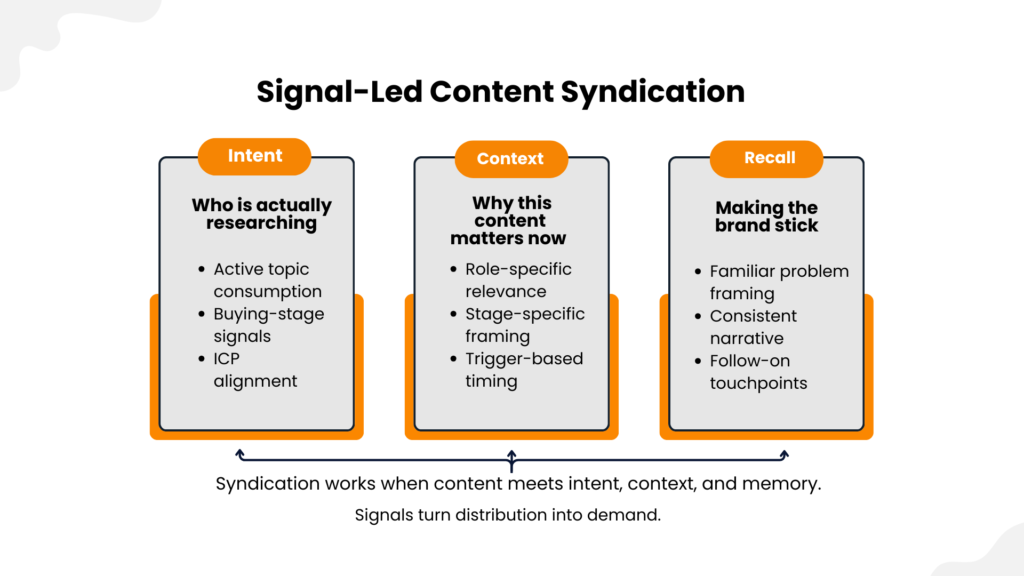
At Prospectvine, the philosophy centers on value-first gating. Content should earn attention before it earns data. Gated high-performance content targets specific problems related to an audience member’s job. These gated high-performance assets will provide tactical insights or data-driven insights as opposed to simply providing high-level thought leadership. They will also correspond with the potential buyer’s level of awareness (to ensure success) and will feel like something that potential buyers would like to save rather than just skim.
Original research delivering data prospects can’t find elsewhere justifies the exchange. Proprietary frameworks providing actionable methodology offer genuine utility. Comprehensive guides saving prospects research time demonstrate respect for their attention. Prospectvine engineers campaigns blending data intelligence, AI-powered targeting, and storytelling making brands memorable before sales outreach begins.
The gating decision itself requires strategy. Educational blog posts, introductory videos, and thought leadership pieces work better ungated, building authority and establishing expertise. Gate only content delivering sufficient value: comprehensive research reports, detailed implementation guides, proprietary benchmark data, exclusive frameworks, and ROI calculators providing personalized analysis.
Omni-Channel B2B Content Syndication Strategies: Creating Surround Sound
The reach of your content can be restricted if it is only available in one location or medium, regardless of how effective the content is. B2B buyers today will research various types of content across many mediums (LinkedIn while they are commuting; email during the workday; industry publications as they are learning; and peer recommendations in their business networks). If you syndicate effectively, your content will be present when prospects are looking for it, creating a “surround sound” effect.
Primary Distribution Channels
LinkedIn Sponsored Content is critical for B2B content syndication strategies and enables native distribution within professional feeds. Through the use of this platform’s targeting capabilities, you can deliver content to specific personas; therefore, making sure it gets in front of the right audience. Sponsored content tends to look less “advertisement-like” compared to direct advertising; it blends into the editorial feed while still successfully driving engagement. Some helpful tips for using this type of media effectively are: focusing on the outcome rather than the feature; using native video will create a higher level of engagement; and tracking beyond just clicks will give you the opportunity to measure true asset downloads.
Email distribution through syndication partners provides direct inbox access. Unlike your own email lists limited to existing contacts, syndication vendors maintain databases of opted-in prospects matching target profiles. The quality of vendor offerings is highly variable, so it is important to evaluate vendors based upon their audience relevancy, lead qualification processes, delivery mechanisms, and post-download nurture capabilities.
Niche networks and industry publications offer concentrated access to an audience, e.g., TechTarget reaches technology buyers, Healthcare Dive reaches executives in the healthcare industry, and CFO.com reaches financial leaders. These vertical platforms provide an environment where highly relevant audiences are already reading content related to their industry. Syndicating assets through these channels positions your brand alongside trusted editorial sources.
The Compound Effect and Coordination
The surround sound effect compounds when prospects encounter your content across multiple channels within compressed timeframes. Marketing attribution studies show multi-touch exposure dramatically increases conversion probability. A prospect seeing your research report promoted on LinkedIn, mentioned in an industry publication, and recommended via email within the same week perceives your brand as a category leader rather than random vendor.
Prospectvine uses omni-channel execution as a means to coordinate all communication. Campaigns use AI powered targeting, so that messages are received by potential clients when they are most likely to take action. This means that each engagement is purposeful, thus creating a sense of recall through strategic repetition.
The Lead-to-Meeting Bridge
The moment after content download represents the highest-value opportunity and biggest failure point in most syndication programs. Prospect demonstrated interest by exchanging contact information for your asset. They’re considering your category, evaluating solutions, seeking information. This is perfect timing for meaningful engagement. Yet most organizations squander this window through generic, delayed, or absent follow-up.
The typical failure pattern: Lead downloads whitepaper Tuesday morning. Marketing automation sends generic “thank you” email with asset link. Lead enters nurture sequence receiving weekly emails for eight weeks. By week four, SDR attempts first outreach with templated message unrelated to downloaded content. Lead ignores email, having moved forward with a competitor who engaged immediately.
Segmented Nurturing and Brand Recall
At Prospectvine, this bridge from content to conversation receives systematic attention. The organization doesn’t simply hand over lists. They engineer recall by ensuring every campaign creates memorable brand experiences before sales contact occurs. This means post-download engagement designed to deepen relationship rather than immediately pushing meetings.
Prospectvine recognizes prospects downloading content aren’t universally sales-ready. Some research early-stage, seeking education. Others evaluate mid-funnel, comparing options. A few sit ready to buy, requiring only vendor selection. Effective bridge strategies segment based on buying stage signals and tailor engagement accordingly.
For early-stage researchers, post-download nurture provides additional educational content reinforcing expertise without sales pressure. Follow-up emails have many things such as links, helpful resources, invitations to educational webinars, frameworks and templates. Building trust helps to keep your brand in front of the prospects while they continue working towards becoming an active evaluator.
High-Intent Engagement and Timeliness
For mid-funnel evaluators showing higher intent, engagement accelerates. Personalized emails from SDRs reference specific content consumed, offer relevant case studies, suggest peer conversations with existing customers. When outreach is driven by demonstrated intent, the experience becomes relational, not just another transactional touchpoint.
Research demonstrates that leads that were contacted in less than 1 hour have been proven to convert 7x more frequently than those contacted after 2 hours. This does not mean aggressive pitching immediately upon contact. It means timely, relevant follow-up acknowledging download and offering next logical step based on content consumed and prospect profile.
Predictive Modeling: AI-Powered B2B Content Syndication Strategies
Traditional syndication distributes identical content to large groups of potential customers, with the expectation that some percentage of recipients will eventually convert. The modern approach uses Artificial Intelligence (AI) to identify which pieces of content resonate with specific persona types, thereby reducing wasted advertising dollars and improving overall customer engagement.
Analyzing Patterns and Persona Relevance
Predictive modeling analyzes historical performance data identifying patterns. How do job titles, industries, and company sizes influence the preference for technical whitepapers versus executive summaries, case studies versus research reports, and lengthy guides versus brief frameworks? These patterns guide content matching.
AI processes inputs predicting content relevance scores. A CFO at a mid-market manufacturing company shows high predicted engagement with ROI-focused case studies and cost-reduction frameworks. A CTO at an enterprise SaaS company predicts engagement with technical architecture guides and integration documentation. Marketing director at a Series B startup predicts response to growth playbooks and demand generation frameworks.
Precision Distribution and Future Outlook
These predictions enable precision distribution. Rather than syndicating a whitepaper to all “marketing directors,” target specifically those whose profiles predict high engagement. This focus improves metrics: higher download rates from better targeting, improved lead quality from genuine interest, increased sales acceptance from relevant fit, better ROI from reduced wasted distribution.
Content syndication does not fail because buyers stop caring. It fails because too many teams optimized for volume over value. In a post-spam world, effective syndication is selective, contextual, integrated, and intent-led. When the content is seen as relevant and receives attention, and the distribution honors the buyer’s environment, then syndication becomes one of the most powerful channels to reach buyers that traditional advertising and direct outreach miss. The “unreachable” aren’t “unreachable”, they are just waiting for something worth engaging with.”