Your SDR sends out a batch of 200 cold emails over the course of a week. Three potential clients respond. One is an out-of-office reply. The second asks to be removed from your list. The third says ‘not interested.’ This is the reality of generic cold outreach. Hyper-personalized cold outreach changes everything.
According to 2025 statistics, average cold email response rates for B2B correspondence range from 1 to 3 percent. However, top 10 percent of campaigns; those using hyper-personalized cold outreach, record 8 to 12 percent response rates consistently. The difference isn’t luck. The difference is precision personalization transforming cold outreach from ignored spam into conversations prospects answer.
For demand generation heads and SDRs managing outbound programs, this performance gap represents millions in lost pipeline. Generic cold emails see approximately 9 percent response rates, while those with advanced personalization see about 18 percent, double the generic rate.
Why Generic Cold Outreach Fails: The Case for Hyper-Personalization
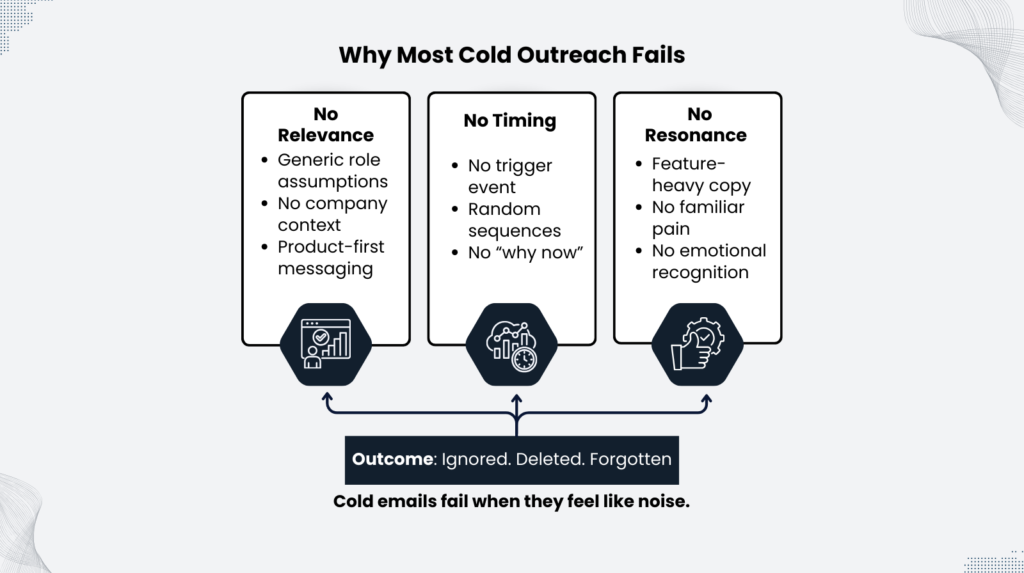
Decision makers receive an average of 15 cold emails every week. Research from McKinsey shows that 71% of emails that are overlooked are those that are not relevant. However, 43% are those that are impersonalized and 36% lack trust signals.
There are three main reasons why cold emails often fail: They target a wide-ranging audience, making it sound as if no one in their database is interested in their product. Instead, they tend to focus more on product, rather than on what their customers want or need. The way their message is sent out lacks proper timing and purpose; therefore, the recipient has absolutely no reason to want to respond.
ProspectVine’s philosophy is based on this reality. Outreach should be triggered by signals, rather than sequences; otherwise, they will be seen as nothing more than noise in the marketplace. Clear messages anchored in what is going on in the buyer’s world create perceived value for the receiver of the message, regardless of how well-written the cold email is. This is the foundation of hyper-personalized cold outreach.
The Flaws in Your Outreach
Take a look at this actual outreach email received by a CMO:
“Hey (First Name), I see your business is growing fast. Our platform assists businesses like yours in growing their marketing operations. Do you have time for a quick 15, minute call this week?”
This method is not only misguided, but it is also against the basic principles of communicating with prospects.
The personalization extends no further than a first-name mail merge. The “noticed your company is growing fast” offers zero specificity. What evidence of growth? Which growth indicators matter to this prospect? The value proposition remains vague. The ask provides no compelling reason why the prospect should invest time.
Generic templates plague B2B outreach. Reps facing activity quotas requiring 50-plus emails daily copy-paste templates, changing only names and company references. Prospects recognize templates immediately and delete them.
The 3R Framework for Hyper-Personalized Cold Outreach
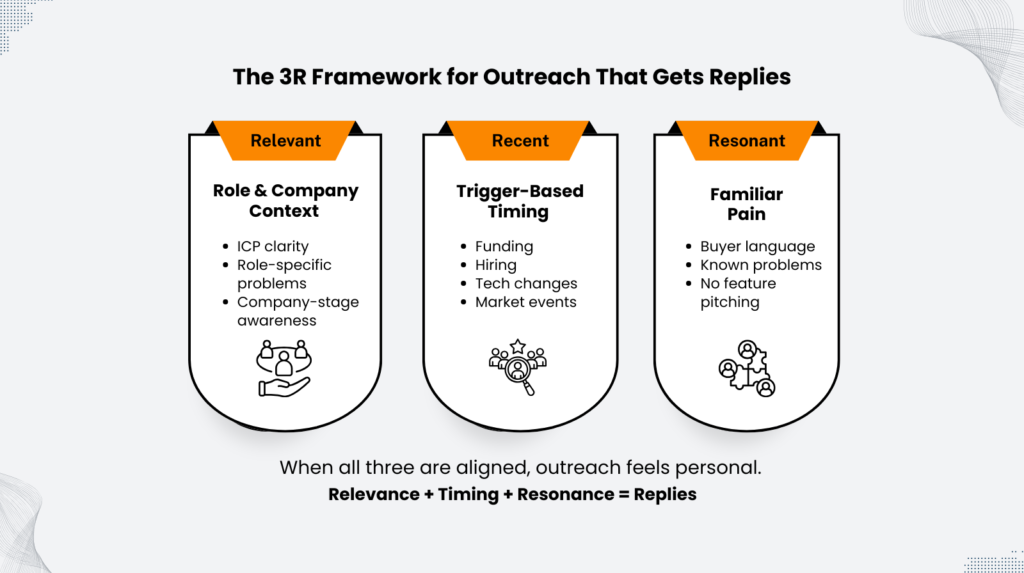
The basic framework used by high-performing teams is Relevant, Recent, and Resonant. This framework guarantees that each correspondence seems like one-on-one interaction.
Relevant: Role and Company Context
Relevance is the extent to which the buyer finds the product or service suitable for themselves and their needs. A good relevance message clearly communicates who the product is for, what kind of company it suits (size and stage), as well as the typical problems or challenges of the role.
For example, a CMO at a startup of 50 people is very differently challenged compared to a CMO at a 5, 000, person enterprise. The startup CMO has a small budget, needs to perform various roles, and looks for the systems that can scale with fast growth.
The enterprise CMO manages large teams, prioritizes integration with existing tech stack, and requires board-level ROI justification.
Example: “As a demand gen leader at a B2B company with an outbound motion, you’re likely measured on pipeline quality, not lead volume.”
This signals precision immediately.
Recent: Trigger Events That Justify Timing
Recent signals explain why now. ProspectVine emphasizes this strongly: outreach without a trigger is interruption.
Triggers often come from milestones such as funding rounds, leadership movements, team growth, changes in the tech stack, or new product and market launches. Timeline-based hooks outperform problem-based hooks by 2.3 times in reply rates and 3.4 times in meetings booked across all industries.
Example: “Your SDR organization appears to have expanded recently. Setting priorities usually gets harder rather than easier.”
Now the outreach feels timely, not random.
Resonant: A Pain That Feels Familiar
Resonance is where replies happen. Instead of selling features, reflect problems the buyer already experiences.
Research industry-specific challenges affecting this vertical at this moment. Identify role-specific challenges this persona faces daily. Use language prospects use when discussing these problems. Marketing leaders talk about “MQL-to-SQL conversion rates” and “lead quality issues.” Sales leaders reference “pipeline coverage” and “win rates.”
Example: “Teams at this stage often have plenty of leads but little confidence in which ones deserve immediate attention.”
If the reader thinks “that’s us,” you’ve earned the reply.
Using Data Enrichment to Find Conversation Starters
The 3R Framework needs additional information than just basic contact information. ProspectVine views its data as a “living ecosystem; continuously enriched, validated and refined with real-time market signals.” This philosophy is vital in going from general mass email blasts, to intelligent, targeted communication.
Modern data enrichment platforms provide intelligence enabling personalization at scale. Company-level enrichment reveals firmographic and technographic attributes essential for relevance. Leadership enrichment tracks decision-maker movements and role changes creating trigger events. Engagement enrichment captures behavioral signals indicating active interest.
This method ensures that your outreach is relevant and smart by converting data from a static resource into a dynamic source of conversation starters. You uncover triggers like “I noticed your team recently migrated to AWS. Are you seeing the expected improvements in latency?” or “I saw you’re hiring five new SDRs. Are you looking for ways to get them up to speed on your tech stack faster?”
News and event monitoring surfaces trigger events as they happen. Real-time alerts allow you to reach out a couple of days after the events when people still remember those events very well: “Congratulations on your Best Place to Work award that was announced yesterday. High, growth companies like yours usually face the challenge of scaling culture while doubling headcount.”
How to A/B Test Hyper-Personalized Cold Outreach by Buyer Profile
Identifying which messages appeal to each customer profile is key to achieving personalization on a scale. Calls to action, value propositions, and communications tend to differ for varying job roles.
Subject line testing impacts whether prospects open messages. Email subject lines with prospects’ company names increase email open rates by 22 percent. Cold email subject lines including numbers get approximately 113 percent more email opens. About 5.8% of people who were surveyed, said they mainly respond on Wednesdays between 7 and 11 a.m.
Use A/B testing of different variations of email titles that mention company names, specific numbers, and personal details to get better results from cold outreach.
Here are some ways you can make your outreach more personal:
Generic Outreaches: ” I wanted to ask you a quick question regarding (Company)
versus Personalized Outreach would be: “How are you seeing the automation of (Company)’s expansion into healthcare?”
Numbered Outreaches: “3 ways the CMOs of Series B SaaS Companies have reduced their CAC by 40%.”
versus Triggered Outreach: “Congratulations on your Series C (First Name)!”
By testing your value proposition based on the desired outcomes of different roles. CFOs care about ROI and reducing costs; CMOs want to grow the pipeline and understand how to attribute to it; and VPs of Sales want a clear forecast with velocity through their deals.
Strategic outcomes and peer endorsements are the most effective ways to get C-suite executives to respond. They want information regarding the ROI that is brief, precise, and to the point. Subject lines that mention competitors or industry issues perform better than generic ones by more than 30%.
VPs and Directors engage with tactical solutions to specific operational problems. They appreciate data, case studies, and implementation details. Messages that use specific metrics like “reduce cycle time 47 days,” and name-related businesses convert more likely.
The Complete Picture
Before (Generic Cold Email):
Subject: Increase efficiency at Company
Hello, (First Name) We assist businesses like yours in increasing sales effectiveness and driving growth. I would be delighted to demonstrate the operation of our platform. Set up a call?
After (Signal-Led, Warm Outreach):
Subject: Quick question on outbound focus
Hi (First Name), Noticed Company has been hiring aggressively in sales. Often when teams start feeling the strain between lead volume and rep focus.
Many teams I speak with at this stage struggle to identify which accounts deserve immediate outreach versus long-term nurturing.
Curious: how are you prioritizing accounts for outbound today?
No pitch. No demo ask. Relevance, timing, and resonance.
The Future of Hyper-Personalized Cold Outreach
The teams winning today don’t send more messages. They send better-timed, better-informed messages showing they understand the buyer’s world. ProspectVine’s core belief captures this well: Buyers don’t respond to volume. They respond to meaning.
One client implemented hyper-personalized cold outreach and increased response rates from 2% to 11% by narrowing their ICP from “all SaaS companies” to “Series B SaaS companies using Salesforce with 50 to 200 employees.” Specificity in targeting enables specificity in messaging.
Before launching a cold email campaign, it is advisable to perform an A/B test on your emails to increase your chance of receiving replies by 15%. Following the 3-7-7 follow-up cadence will yield 93% of total responses within 10 days; however, any further follow-ups after that usually result in little to no additional responses.
Build research infrastructure providing intelligence supporting relevance. Establish frameworks ensuring consistency while encouraging customization. Test rigorously to identify what resonates with different personas. Follow up strategically to capture delayed responses.
When you master hyper-personalized cold outreach, it stops being cold. It feels warm.