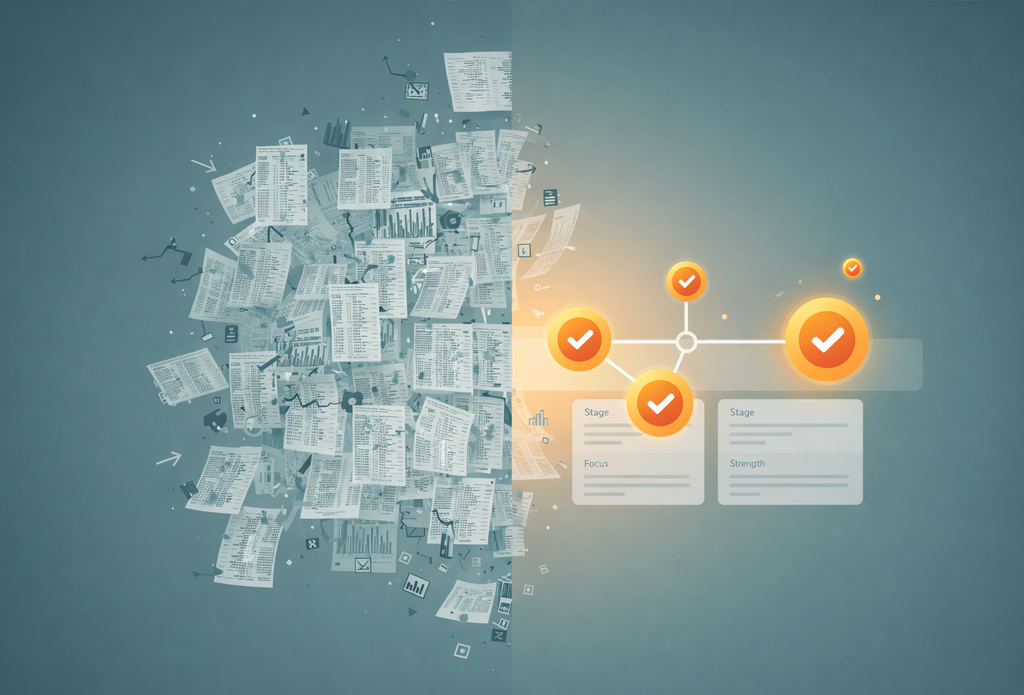
Your marketing dashboard glows with activity. Website traffic is up by 40%. You collected 10,000 new contacts this quarter. Email open rates hover around industry benchmarks. Yet when you walk into the executive meeting, the question remains uncomfortably unanswered: Where’s the pipeline? The problem isn’t your data. It’s your data-driven marketing decisions.
In many B2B marketing organizations, there is a similar problem: too much data, not enough results. This is not a problem with the data, but with how that data is leveraged. The issue is data-driven marketing decisions or more accurately, the lack of them. Teams collect endless data but fail to convert it into actionable strategy. They measure everything but improve nothing. They drown in metrics while starving for pipeline.
Why B2B teams drown in data but still underperform
The modern marketing stack has become a surveillance apparatus, counting clicks, scrolls, downloads, and email opens, and it extols the benefits of its main proponent: marketing automation platforms that provide unparalleled visibility.
Here’s the data: 87% of marketers have access to data. Only 26% can use it to make decisions. The problem isn’t technological. It’s strategic. Too much data creates ‘analysis paralysis.’ Teams struggle with data-driven marketing decisions.
This means teams confuse data collection with insight and track many metrics but lack true prioritization. In demand generation scenarios, for instance, while the systems might track interactions such as downloading whitepapers or attending webinars, it fails to provide the essential context about the prospect’s true intentions, roles, and budget.
Data, when left uninterpreted with contextual consideration, starts making a lot of noise rather than a revenue-building effect.
Collection vs. Application: Understanding the Gap
Researchers consider data collection a passive task and include the use of tracking pixels, platform integration, and sync systems. Although this is basic infrastructure and necessary for data collection success, it does not represent a strategy and simply shows what is taking place without illuminating what is happening or what needs to be done.
Data application is considered a strategic process and involves taking data and turning it into something meaningful through critical inquiries regarding purchase intentions and predictions and patterns associated with high-value customers.
The challenge? B2B marketers overinvest in MarTech platforms. These platforms excel at data acquisition. They fail at data application. Marketers accumulate data warehouses. But they lack decision engines. They collect endless data but can’t make data-driven marketing decisions.
At Prospectvine, we believe that data acts as a dynamic tool, representing an ecosystem that market signals continually validate.
It is essential to recognize the value of having a compass in place of a destination. This is because successful corporations do not necessarily possess superior data but a superior approach to decision-making. They concentrate more on developing clear evidence of the revenue consequences associated with certain patterns. They look beyond the surface.
For example, they understand the significance of downloads, such as the CFO downloading the pricing calculator compared to the marketing intern downloading an eBook, even with the same scores for the lead, since the former is of more importance compared to the latter.
Where Marketers Fail at Data-Driven Marketing Decisions
Many marketers often mistake intent data, a budding source that uncovers third-party signals of which accounts are researching relevant topics, for active buying intent. But someone who’s researching “account-based marketing platforms” might only want to write about it in their blog or get ready for an interview, not necessarily be in purchase mode. When marketers misjudge this, it leads to poor outreach, which can harm credibility and waste resources.
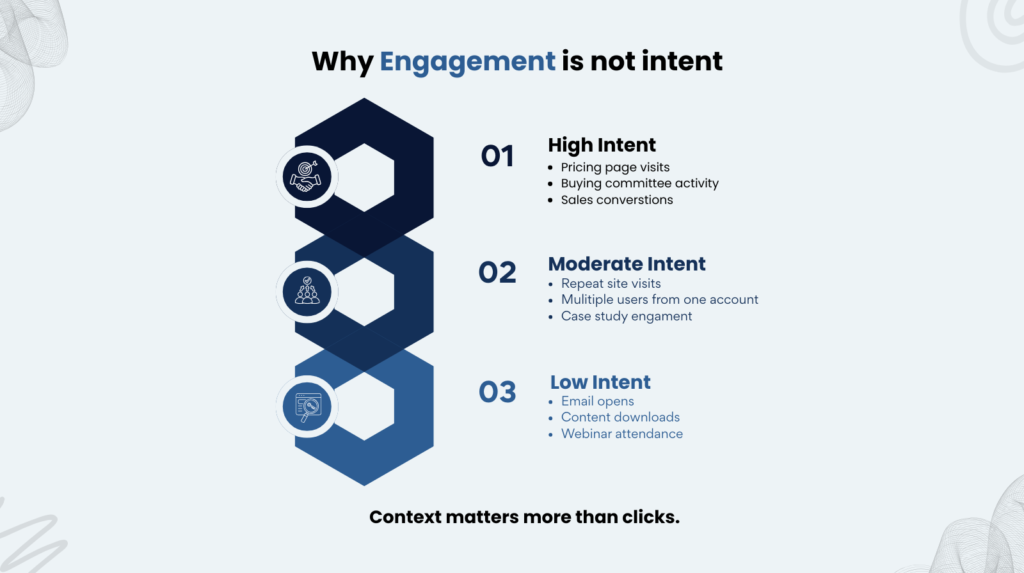
Engagement confusion was, of course, the perception that high engagement equals high intent. A prospect may regularly open emails yet lack purchase authority, while other less visible accounts may conduct their research in secret via various channels. Traditional methodologies commonly misread the behaviors, missing major decision-makers who engage but without touching or talking directly.
According to Sahil Sharma, Founder- Prospectvine, “Conversation-not clicks, is where real engagement begins.”
Signal isolation presents another challenge; evaluating signals independently can be misleading. Just showing up for a webinar, for example, is not enough information on its own. When multiple stakeholders from one account hit your pricing page, case studies, and a webinar, they aren’t just browsing, they’re ready to buy. In complex B2B sales, you need that context to turn raw data into a timely, winning insight.
Turning Insights into Data-Driven Marketing Decisions
The shift from insight to action requires operational rigor with structured frameworks, especially in best-in-class demand gen teams. Establish a signal hierarchy so sales teams know who to call now and who to nurture. A director checking pricing is a high-priority signal; a student downloading a template isn’t.
It is necessary to set up feedback loops to tap into CRM data to determine which marketing signals drive closed deals and examine successful opportunities to determine patterns and sequences of engagement with content that facilitate quick sales cycles.
Teams should develop decision frameworks, not dashboards. Select 5-7 KPIs that anticipate growth in the pipeline and eliminate the ones that you cannot act upon. Focus on creating alerts and workflows tied to these critical signals, rather than producing exhaustive reports that rarely get reviewed.
Prospectvine’s model mirrors this: strategize, execute, and measure against defined objectives and the Ideal Customer Profile, creating a continuous feedback loop of insight and action to drive strategic pivots when needed.
How AI + Human Judgment Outperform Dashboards Alone
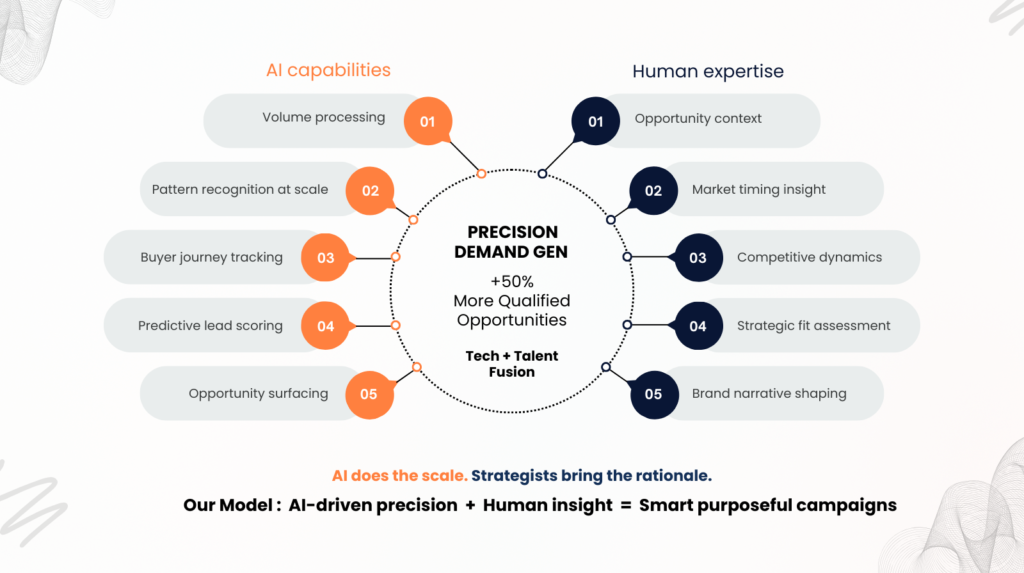
The next frontier in demand generation integrates AI not just with data or dashboards but with human expertise. AI handles the scale, tracing buyer journeys and predicting revenue signals at lightning speed. However, it lacks the intuition to navigate market timing and the complex human dynamics that veterans use to close sales. The solution? Tech-talent fusion: use AI for volume and pattern spotting, while humans interpret context and assess strategic fit.
Prospectvine combines AI precision with human intuition. Humans steer the narrative and read the room, while AI drives the scale. The data backs this up. Research from McKinsey proves this: B2B teams using AI-powered decision-making see a 50% boost in qualified opportunities and significantly higher conversion rates. This proves that the key to future demand-gen strategies lies in combining AI with human expertise.
The Path Forward
The B2B marketing landscape is becoming more intricate: there is more data, bigger buying committees, and longer periods of making a purchase. The source of competitive advantage lies in making fast, informed decisions rather than just having more data. This means that it is necessary to change the focus from data-gathering to the increasing of decision-making speed, to the simplifying of complex dashboards and to the gaining of strategic clarity, and finally to the driving of outcomes rather than just measuring activity.
Companies need decision-making models that will turn their data into insights ready for action, not just numbers, and they also need the discipline to choose the revenue-related indicators over the ones that just look good.
The fundamental question is not whether we have access to the data but rather how we make the decisions. The success of treating pipeline growth numbers depends on the skill of converting information into actions that generate revenue.
Prospectvine wants to help marketing teams use their B2B data effectively, creating demand and supporting a precision demand generation method.