What separates high-performing B2B marketing teams from average ones? It’s not the tools they use. In the race for pipeline, marketing leaders are seduced by a tempting illusion: the next solution will provide a predictable stream of revenue.
Today, average B2B companies use 13 marketing technologies, but 68% of CMOs fail to calculate a clear return on their investment. The toolbox is getting longer. The results are stagnant. High-performing B2B marketing teams know the truth: the performance gap is not measured in software licenses.
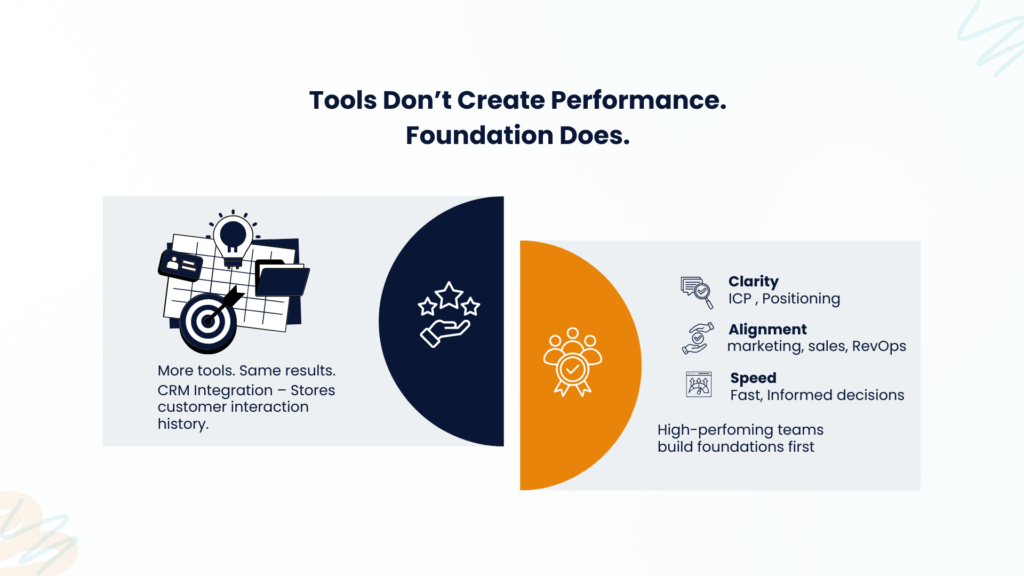
Being better is a result of basic assets that no software or platform will ever install for you: clarity, alignment, and speed. These are the traits that separate high-performing B2B marketing teams from the rest.
Why Tools Don’t Create High-Performing B2B Marketing Teams
A sophisticated martech stack with a weak strategy is like having an F1 engine in a vehicle with no wheels – all power and no traction. They are great for implementing strategies but terrible for developing them.
There exists an “activity trap” that many teams fall under. Results are measured through emails sent or ads displayed. Motion is confused with progress. Campaigns exist in a state that is strategically empty, but technically complete. Nothing resonates with the new B2B buyer.
Think about it, a company invests in an ABM application, loads target accounts, and runs the campaigns. Six months later, the pipeline engagement is low. The application performed perfectly well, like it was expected to. However, without a proper definition of the target customer or alignment on target accounts with the sales team, along with relevant customer-centric content, the application didn’t actually have anything to work with.
ProspectVine illustrates how if marketing views outreach as purely being a numbers game, the result is “low engagement, high costs per lead, and inefficient spend on non-fit accounts.” To solve this problem, marketing must change from reach to relevance.
What High Performers Get Right
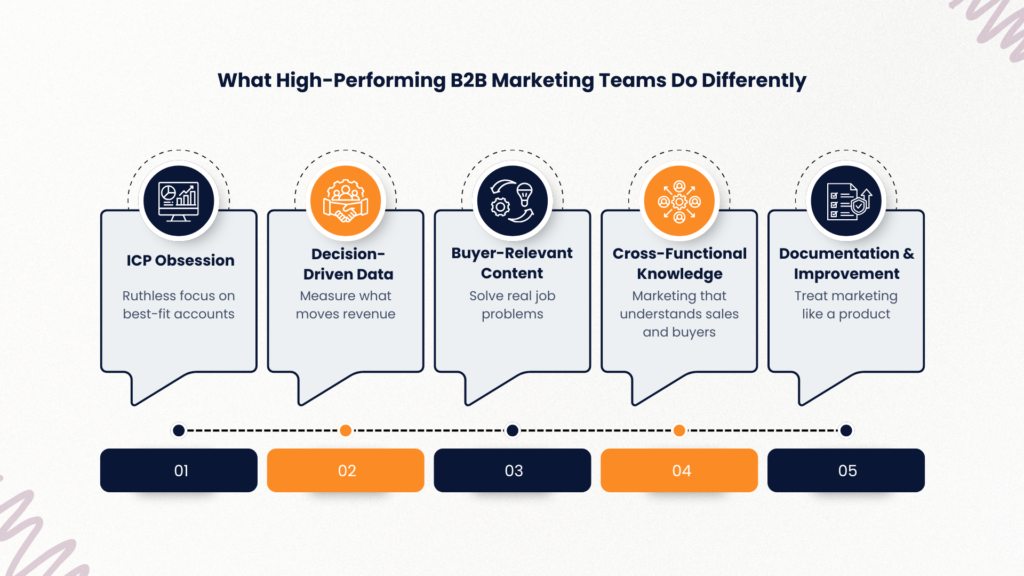
After analyzing hundreds of B2B marketing organizations, clear patterns emerge among the top 20%:
ICP obsession: Elite teams have developed detailed ideal customer profiles based on firmographic data, behavioral signals, and historical conversion patterns. They seem comfortable saying no to opportunities that lie outside their sweet spot. This level of discipline extends all the way through every activity, from content creation to paid media targeting.
Data drives decisions but never paralyzes them. Successful top teams establish leading and lagging indicators that they cross-tie to business outcomes: they track MQLs-to-opportunity conversion rates, deal size by channel, and pipeline velocity; not vanity metrics like email opens. And yet, they don’t wait for perfect data before moving. They run controlled experiments, measure results, and iterate at speed.
Content is relevant to real buyer problems. High performers offer educational content that helps prospects perform their jobs better, whether they eventually become customers. They engage in original research, develop frameworks that make hard decisions easy, and offer authentic findings from actual engagements with customers.
Cross-functional knowledge: The most effective demand gen heads understand sales, basic analysis, the psychology of buyers, and industry dynamics. They speak credibly to sales about pipeline scaling ratios, to the products group about how the firm competes, and so on. This enables them to spot opportunities that might escape the notice of teammates working in the same silo.
Documentation and Improvement: High achievers think of marketing operations like a product and document everything about them. The team sets up service level agreements among the various functions and performs regular retrospectives to identify bottlenecks and improve the process.
Alignment Changes Everything
The single most important differentiator for high-performing B2B marketing teams is alignment. Marketing. Sales. Revenue Ops. This goes beyond attending the same meetings. It requires common definitions. Shared objectives. Unified language.
To fill this sales and marketing misalignment gap, there is a misalignment tax that is very high. Studies show that poor sales and marketing alignment costs a business-to-business company 10% of its business every year. This is seen through unconverted leads, confusing messaging that hinders potential clients, and pointing fingers when the target is missed.
Alignment begins with a common understanding of the customer journey, where the marketing and sales teams need to speak the same language with regards to what constitutes a Marketing-Qualified Lead, transfer criteria, and credit for conversion. Without this, everything the technology and program strategy do, is work against each other.
Successful companies set up regular closed-loop feedback processes. Sales provides input on prospect conversations: the types of objections heard, the presence of competitors in a sale, and questions asked repeatedly of salespeople. Marketing uses this information to improve messaging, develop additional content assets, and modify target criteria. These two departments each improve the other.
Revenue operations has an orchestrating function and is concerned with data hygiene and managing and analyzing the tech stack, giving both sides visibility into what is and isn’t working. With both sides trusting the data, they have time to debate strategy rather than whose numbers are correct.
The embedded demand generation support that ProspectVine has designed to serve the clients leverages this truth. As an extension of the client teams that they represent, ProspectVine actively ensures that alignment is achieved through consistent communication while setting goals for mutual accomplishment.
How High-Performing B2B Teams Choose Speed
Another underleveraged competitive advantage that top performing marketing teams have is the speed of their decisions. In situations where market preferences change fast, companies that adapt quickly to the strategies their competitors use make fast, good decisions that outweigh superior decisions made over longer periods.
Perfection paralysis presents itself through very familiar behaviors: infinitesimal refinement of the message of the campaign, the need for full data sets before initiating a test, several approval cycles for slight tactical modifications. All of which pushes the rewards further and further back.
A team can counter this with strong decision structures. It separates the decisions that are reversible and irreversible. They quickly move ahead with decisions that have little risk but preserve the governance of high-stakes decisions. They believe in “minimum viable campaign,” where they start with 80% solutions and then change course with the data they are getting from the market itself instead of guessing.
This does not necessarily translate to recklessness. Most of the time, the cost of procrastination far surpasses the value of further polish. Launch a campaign next week, which will inform future efforts. This would create more value for a launch that is not “perfect” next quarter.
How High-Performing B2B Marketing Teams Use Agencies
Forward-thinking B2B companies are rethinking their approach to marketing competency structures. Instead of having all these competencies in house, these forward-thinking businesses are using these partners in a force multiplier capacity.
This is where companies like ProspectVine add disproportionate value; not to replace in-house teams, but to stretch capacity and accelerate the execution cycle.
Expertise on demand. The development of expertise with regards to advanced paid media management, complex marketing automation paths, or conversion optimization involves high levels of expenditure. The partnership with an agency enables demand for experts dealing with various clients, as well as exposure to various sectors within the industry that the internal departments cannot monitor.
Objective external perspective. Internal teams develop blind spots and an investment in the status quo. External partners shake up assumptions, spot strategy holes, and offer options based on what they have seen to work in other places. An outside in perspective is essential for preventing groupthink.
Operational Agility and Scale
Execution speed off the headcount charts. In order for the demand generation effort to be launched successfully, some intense work needs to be accomplished up front: campaign creation, asset development, and system configuration. Rather than hiring for peak capacity and then underutilizing, the concept of partnering with execution-driven shops enables scaling the effort up and down to meet business needs.
Knowledge transfer, and capability-building. The best agency partnerships are not dependency-building. They are capability-building. By working alongside and in conjunction with the teams at the agency, ProspectVine enables in-house marketers to up their game through their processes and the reasons behind their decisions. Clients assume more and more in-house work if desired, or increase their projects with ProspectVine for increasingly sophisticated projects.
ProspectVine’s integrated approach to demand generation combines strategic guidance with hands-on execution support. The approach meets a reality where most B2B marketing organizations have a vision regarding what they must do but lack the capacity and expertise to accomplish it at the necessary speed.
The Path Forward
High-performing B2B marketing teams know a simple truth. Success is built on three things. Strategic clarity. Organizational alignment. Disciplined execution. Technology and external partners serve these fundamentals. They don’t replace them.
If your team is drowning in the tools but starving for the results, surely the solution isn’t going to be another platform. Step back to address foundational elements high performers get right: defining your ICP with precision, aligning marketing and sales around shared goals, making decisions quickly based on good-enough information, and extending your team’s capacity through strategic partnerships. These aren’t magical abilities afforded only to companies with unlimited budgets. They’re learnable, implementable practices that any B2B marketing team adopts.
The question is whether you’ll continue investing in tools amplifying your current approach, or whether you’ll do the harder work of building the foundations driving growth.
What’s one area where your team could move from looking for a tool-based solution to a strategic or organizational challenge? Start with that.