Every demand generation leader faces the same problem: spreadsheets packed with thousands of leads, conversion rates near zero. The culprit? A basic misconception that more leads equate to higher revenue. This volume-first strategy exhausts teams and depletes budgets, especially for high-ticket B2B lead generation where deal sizes demand precision.
The story is told through numbers. Only 5-20% of leads generated by businesses are considered high quality, according to research. Businesses that emphasize lead quality in their high-ticket B2B lead generation report 33% lower costs and 50% higher sales.
Why Volume-Based Lead Gen Fails for Complex Sales
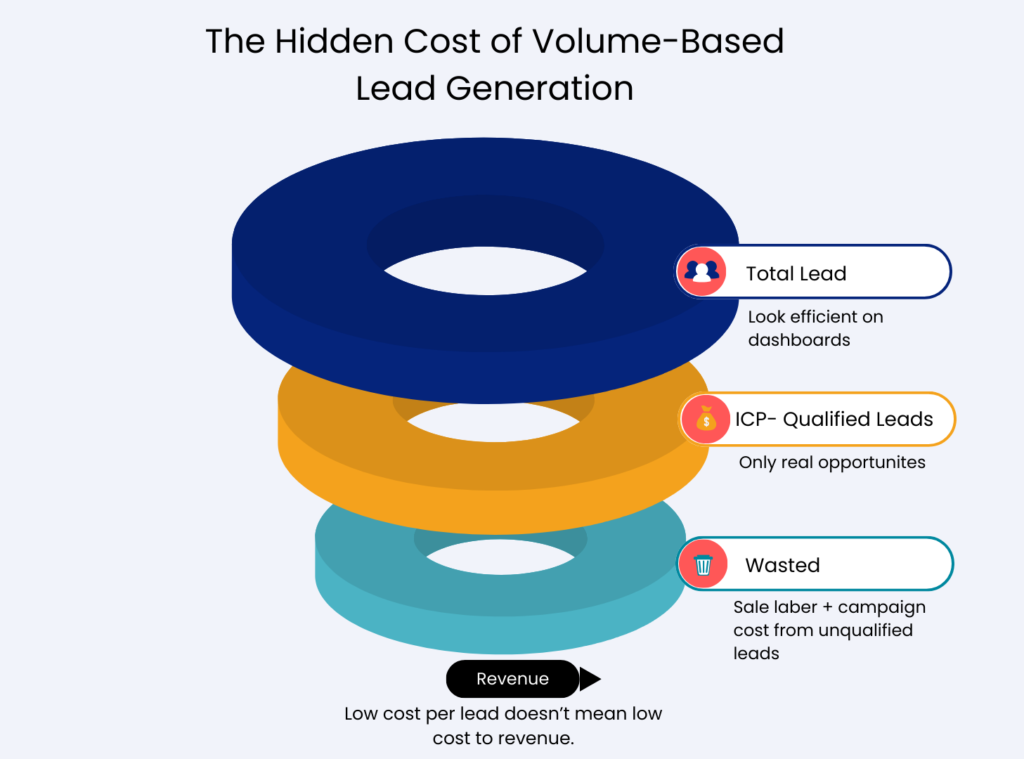
In quarterly reports, high lead counts appear impressive. They produce unstated expenses that add up over time.
While high-value opportunities pass them by, sales teams lose valuable time pursuing unsuitable prospects. Your top representatives did not sign up to sort through useless data. They came together to close important deals. Team morale suffers when SDRs spend days pursuing contacts who don’t have authority or funding. There is a high turnover of performers.
The impact on finances is more severe. With that $10,000 asset producing 2,500 contacts, the cost per lead appears to be $4. Go further. You will have spent $333 per qualified lead if only 30 of those 2,500 fit your ideal customer profile. To qualify each unqualified lead, add 1.5 hours of sales labor at a rate of $58.80 per hour. $228,000 has been squandered on one campaign.
Your brand is harmed by unqualified leads. Long-lasting bad impressions are created when sales teams are compelled to be aggressive with prospects who do not require your solution. Those prospects remember. They inform others.
Precision-targeted outreach consistently outperforms volume-heavy campaigns in high-ticket B2B lead generation, as we have witnessed at Prospectvine. In a spreadsheet, a lead is not a row. Decision-makers face unique obstacles. In addition to destroying opportunities, pushing for volume ignores this human element.
ICP Refinement: The Foundation of High-Ticket Lead Generation
You must pick your target with surgical precision. Most businesses end up at “Mid-market SaaS companies in the US.” That is not an ideal customer profile; rather, it is a starting point.
Your ICP needs to look at:
Technographics: Which tools do they currently employ? Don’t target Azure-heavy stores if you are selling an AWS security layer.
Trigger Events: Has a Series C been raised by the company? A new CMO was hired? These indicate opportunities.
The Anti-ICP: It matters who you don’t want. To save resources later, disqualify early.
The Purchasing Committee: The majority of the 14–23 employees involved in a typical tech purchase are in senior operations or product roles. Determine who makes decisions, who assesses solutions, and who internally supports them.
Don’t trust your instincts. Find your most lucrative, lowest-churn customers by using your CRM data. Reverse-engineer their DNA.
Examine which accounts convert, which roles react to outreach, and which segments engage. Your ICP is constantly changing. The state of the market changes. Your product is changing. Your most valuable clients have also evolved.
When ABM Meets Lead Generation
The future of high-ticket B2B lead generation combines ABM with traditional lead gen strategies.
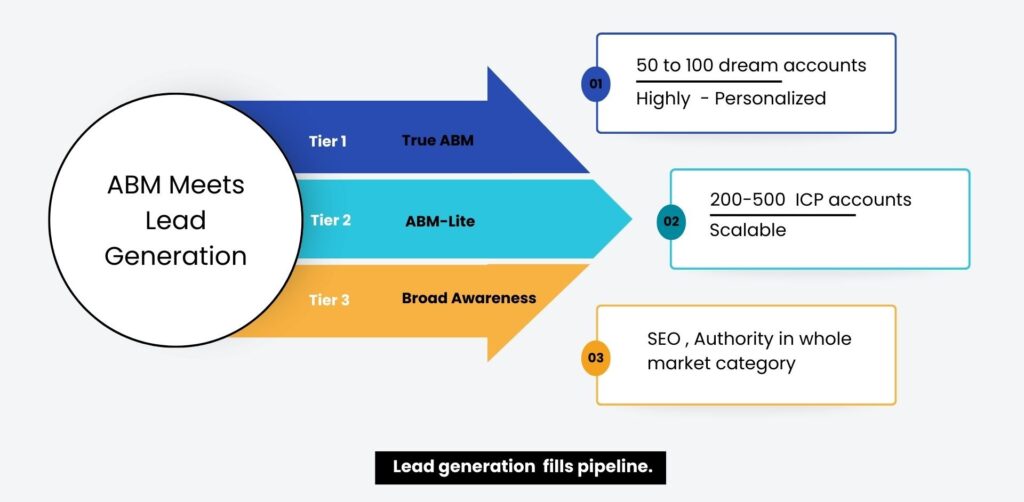
Conventional lead generation is a broad approach for awareness and demand, whereas ABM is a sniper approach, aiming for high-value accounts with personalized campaigns. Combining both methods yields their respective strengths, which could not be accomplished separately.
Manufacture your hybrid engine with these steps:
- Tier 1 (True ABM): A select group of 50 to 100 dream accounts that receive highly personalized touch, content, and selling time.
- Tier 2 (ABM-Lite): A larger group of 200-500 accounts that fit the ICP and receive scalable and segmented communications such as targeted ad campaigns and Webinars.
- Tier 3 (Broad Awareness): Programmatic content or SEO strategies that establish your company as a subject authority in your whole market category.
Use lead generation to keep your pipeline filled. And for your high-value target accounts, execute an ABM strategy. This ensures that you never leave revenue on the table, as you focus on your target markets while treating your high-value prospects right.
Content That Drives High-Ticket B2B Lead Generation
“5 Tips for Improving Productivity” is not what executives are interested in. Executives want content related to ROI, risk management, or competitive advantage. 71% of C-suite executives state that the value of the content is what draws their interest.
Your work should be:
Perspective-Shifting: Challenge the Status Quo. Discuss transforming a business and positioning for competition and market change. You must provide detailed plans for implementation.
Data-Driven: CEOs find research and benchmarks interesting. They seek to understand how they measure up to others. Commission research. Break down market trends. Unpack findings to show expertise.
Human, Brief, and Relevant: Executives are busy. Provide executive summaries. Articulate the “so what” up front. Design for scanability and mobility.
Prospectvine recommends leveraging LinkedIn for social selling. When your leadership team shares insightful, non-promotional content, you build trust. Cold outreach feels like a warm introduction.
Qualification Frameworks That Save Time and Money
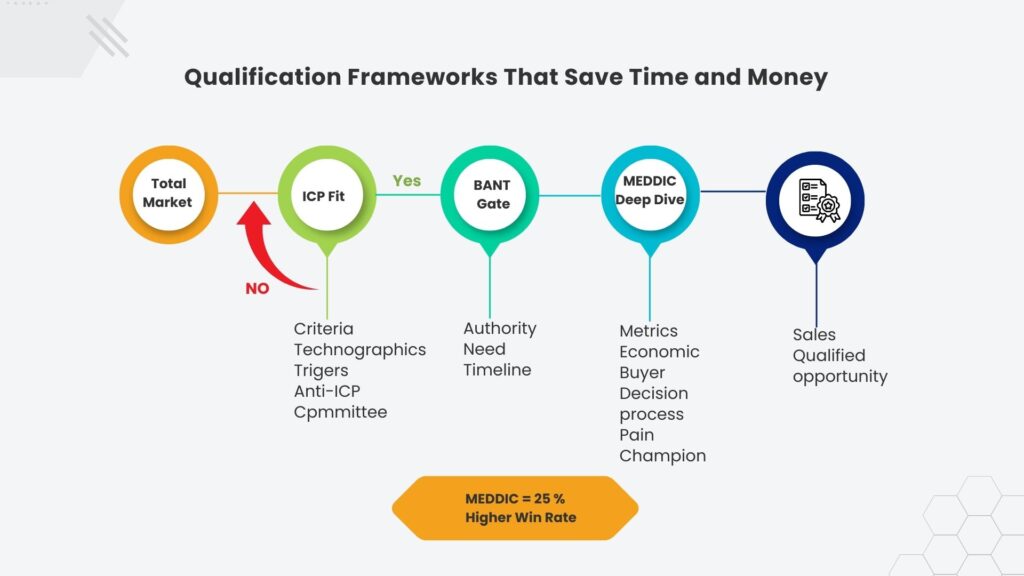
The right framework of qualification distinguishes between teams that succeed and teams that survive. For simple sales, one can use BANT (Budget, Authority, Need, Timeline). For more complex sales, involving more than one party, BANT is too simplistic a framework.
MEDDIC (Metrics, Economic Buyer, Decision Criteria, Decision Process, Identify Pain, and Champion): The MEDDIC model pushes your sales team to find the Champion at the prospective account. They’re going to be the people that will fight for what you’re doing when you’re not there.
Organizations adopting the MEDDIC model claim a 25% increase in win rates based on proper qualification and alignment of sales to the customers’ needs. It is useful in enterprise sales involving complex buying committees and lengthy sales cycles.
Modern buying committees include 6 to 10 decision makers, each bringing independent research. Smart teams now employ a staged approach: use BANT for initial lead qualifications to quickly filter obvious non-fits, then apply MEDDIC for opportunities advancing to discovery and negotiation.
Building Your High-Ticket B2B Lead Generation Engine
The process of implementing a lead generation strategy that emphasizes quality over volume can only be achieved over a certain amount of time. Many businesses that have successfully transitioned to such a strategy often witness increased conversion rates, lower sales cycles, as well as boosted morale of the salesforce
Begin with your ICP. Achieve consensus between marketing and sales about what “qualified” looks like. Build qualification frameworks aligned to your sales complexity.
Employ hybrid ABM lead gen strategies that keep the pipeline full while allocating as much time as possible to highly valued accounts. Keep optimizing your strategy based on conversion data and market feedback.
It is a process, not a program. Organizations that value the quality of their leads, rather than the number, report a 40% close rate on their qualified leads, compared to 11% on unqualified ones. They have shorter sales cycles, lower customer acquisition costs, more precise forecasts, and motivated sales forces.
Conclusion
Your call: a pipeline that looks great in theory but hemorrhages squandered resources, or a lead engine built on quality, alignment, and true buyer fit-theoretically sustainable. For high-ticket B2B sales, ten perfectly qualified leads will always outperform a thousand random contacts.
Your sales team and CFO both, will thank you. Your win rates will prove you called it right.
At Prospectvine, we specialize in this precision-led approach-helping you cut through the noise and connect with the accounts that truly matter.
Stop optimizing for vanity metrics. Start building a lead generation engine that drives revenue.